July 11, 2021
3 mins read

National Security Law Casts Shadow on Future of Hong Kongers

Over 60 per cent of people expressed doubts about their future under the draconian law which was imposed in June last year…reports Asian Lite News

Most Hong Kongers are doubtful about their future under the Chinese imposed national security law which has left a “chilling effect” on people of the territory since its passage in June 2020, according to reports.

Quoting Mainland Affairs Council, Taipei Times reported that over 60 per cent of people expressed doubts about their future under the draconian law which was imposed in June last year.

In a report marking the 24th anniversary of the territory’s handover to China, the council said that the US-based Freedom House in March gave Hong Kong the worst rating in the history of its Freedom in the World report at 52 points, ranking “partly free,” due mainly to the security legislation.

Germany’s Global Public Policy Institute and Reporters Without Borders similarly downgraded the territory in their respective reports on academic and press freedom, it added.

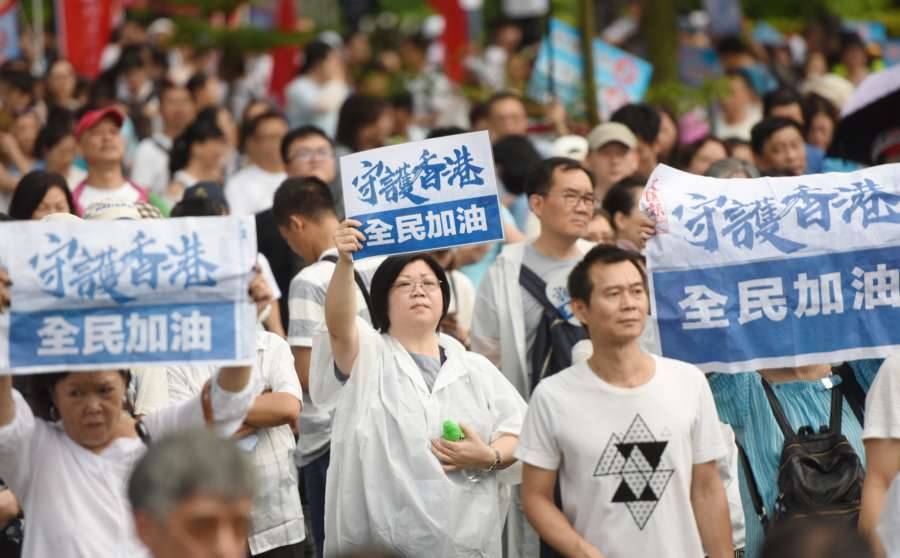
Meanwhile, several people including activists, students, journalists have been arrested in the past few months in Hong Kong under the security legislation. The scope of those prosecuted for speech from prior to the law’s passage — from politicians to academics and journalists — has produced a “chilling effect,” the council’s report said.
HOng KONG

The press especially is facing “unprecedented political violence,” including with the redefinition of “media representative” to only recognize workers of media outlets registered with the government, it said.

Next Digital has emerged as a victim of the security legislation, as police have used it to prosecute owner Jimmy Lai and Apple Daily executives, it said.

ALSO READ: China Fear Revival of Turkistan Islamic Movement

The closure of the Apple Daily on June 25, shortly after the government froze its assets, has “sounded a death knell for press freedom in Hong Kong,” Taipei Times reported.

Many news firms have chosen to stay silent, leading to the closure or removal of content from online publications such as Stand News, Winandmac Media and Post 852, it added.

Meanwhile, increasing numbers of academics critical of Beijing have been dismissed or forced out since last year. Some have even seen their teaching qualifications revoked for disseminating content in support of independence, it added.

Changes to the education curriculum in February also outlawed political activities on campuses and banned teachers from discussing their political views, while mandating education about the security law to more than 8,000 students, it said.

Fear over-reporting by students is likely to deepen self-censorship on campuses, the council said, adding that some academics are also considering cutting back on international exchanges.

Censorship has even extended to the Internet and the arts, drawing an ambiguous red line that would stifle creative freedom, it added.

The Web site HKChronicles, which publishes personal information of police officers and pro-Beijing figures, was reportedly shuttered by Hong Kong security forces with cooperation from Internet service providers, the council said.

Pro-China media have also criticized the Hong Kong Arts Development Council for funding “reactionary” works of art and the M+ museum for exhibiting works by Ai Weiwei, it added.

Changes announced last month to the Film Censorship Ordinance would ban films that “endanger national security,” it said.

Public gatherings have also been halted, including the annual Tiananmen Square Massacre candlelight vigil that had been held every year for three decades, it said.

Even freedom of movement could be affected, as the passage in April of changes to immigration regulations would grant authorities the power to bar individuals from entering or leaving the territory when it goes into effect on August 1, the council added.

The law criminalizes any act of secession (breaking away from China), subversion (undermining the power or authority of the central government), terrorism and collusion with foreign forces, with punishments of up to life in prison. (ANI)
ALSO READ: Cathay Pacific extends Dubai-Hong Kong services

Previous Story

China Fear Revival of Turkistan Islamic Movement

Next Story

Experimental textiles curate ‘fashion beyond’

Previous Story

China Fear Revival of Turkistan Islamic Movement

Next Story

Experimental textiles curate ‘fashion beyond’

Latest from -Top News

Pakistan Risks Overstretching Itself in Yemen War

Pakistan’s expanding military role in Saudi Arabia amid the Yemen conflict could strain its defence resources and fragile finances…reports Asian Lite News Desk Pakistan’s military involvement in the war in Yemen may prove unsustainable because of mounting financial pressures and competing security demands, according to a new report. Islamabad’s growing military presence in Saudi Arabia risks stretching its defence resources while exposing the country to greater strategic and economic challenges. An article by Andrew Wilson in One World Outlook describes Pakistan’s involvement as a case of “fiscal and strategic overreach”, arguing that the country lacks the financial flexibility to sustain an expanded military commitment. Pakistan’s external finances depend heavily on an International Monetary Fund (IMF) programme, financial support from Gulf countries and remittances from Pakistani workers in the region. The report argues that deeper military involvement in the conflict could place additional pressure on these sources of financial stability. It also warns that deploying troops and military equipment abroad could weaken Pakistan’s capacity to address security challenges along its eastern border and deal with two domestic insurgencies. The move could also draw Islamabad into a conflict it has sought to approach cautiously. A Reuters report in May, citing Pakistani security and government sources, said Islamabad had deployed around 8,000 troops, a squadron of approximately 16 aircraft, mostly JF-17 fighter jets, two drone squadrons and a Chinese HQ-9 air-defence battery to Saudi Arabia. According to those sources, Riyadh was financing the deployment, with Pakistani personnel operating the equipment. The sources also said a confidential agreement contemplated the possibility of deploying up to 80,000 troops. Islamabad has not confirmed those figures, although it has acknowledged its military presence in Saudi Arabia, including the deployment of fighter jets at King Abdulaziz Air Base from April. The One World Outlook article argues that Saudi financial support can cover allowances and operating expenses but cannot easily replace military equipment needed elsewhere or resolve the political and strategic challenges of participating in the Yemen conflict. Pakistan’s defence budget is another concern. For the 2026-27 financial year, the federal government allocated PKR 3 trillion, or approximately $10.8 billion, to defence services. The allocation represents an 18 per cent increase from the original PKR 2.55 trillion provision and amounts to around 2.1 per cent of projected gross domestic product (GDP). Defence spending accounts for approximately 16 per cent of the federal government’s PKR 18.8 trillion expenditure. Military pensions are budgeted separately at PKR 822 billion, while debt servicing costs stand at approximately PKR 8 trillion, more than two-and-a-half times the defence allocation. The report argues that these competing financial obligations leave little room for additional military expenditure without placing further pressure on public finances. Pakistan’s reliance on IMF assistance also limits its fiscal flexibility. The country must meet the conditions attached to the programme, including a primary budget surplus target of 2 per cent of GDP and continued restraint on development spending. According to the article, these requirements make it difficult for Islamabad to finance an additional military commitment without compromising other budgetary priorities. Pakistan’s economic indicators offer limited reassurance. Economic growth for the 2025-26 financial year is estimated at between 3.6 and 3.7 per cent, while inflation reached approximately 10.3 per cent in September following an energy price shock. Foreign exchange reserves stood at around $21.5 billion at the end of September. Although this marks an improvement from the low levels recorded in 2023, the report notes that the reserves cover only a few months of imports. Financial assistance from Gulf partners remains central to Pakistan’s external stability. The article says Islamabad holds approximately $8 billion in Saudi deposits at its central bank. In July, the State Bank of Pakistan said Riyadh had extended the maturity of $5 billion in deposits to December 2028, easing the country’s immediate external financing requirements. A further $3 billion deposit was also extended in the spring. However, the article argues that these arrangements provide temporary relief rather than long-term financial independence, particularly as regional conflict threatens the stability of the Gulf economies on which Pakistan relies. The report concludes that Pakistan faces a difficult balance between supporting Saudi Arabia militarily and preserving the financial and military resources needed to address its domestic and regional challenges.

UK and Germany Ratify Kensington Treaty

Britain and Germany ratify the Kensington Treaty, agreeing new cooperation on AI, quantum research, defence and security while targeting investment, jobs and Russian hybrid threats…reports Asian Lite News Desk Britain and Germany

Economic tide is turning in Bangladesh

If there is one thing that can bring some comfort to the struggling Bangladeshi economy, it is good relations with India. Bangladesh should remember that Delhi’s backing, through easy supplies of essentials
Go toTop

Don't Miss

UK welcomes US offer of safe haven to HK residents

Earlier, US President Joe Biden signed a memorandum that provides

Beijing opposes HK resolution by EU parliament

The spokesperson also accused European Parliament of “distorted facts with