The British monopoly on coal mining in Jharia was challenged by Gujarati traders at the turn of the 20th Century and soon other private players followed, making Jharia one of the richest princely estates…reports Praduman Choubey
Bachchan Nonia (45) died by suicide in November last year in Kusunda, Dhanbad. An employee at Godhar Colliery, managed by Bharat Coking Coal Ltd (BCCL), he was duped by a local moneylender, according to his son Vikas Nonia. “Earlier this year, my father had taken a loan of Rs 2 lakh from Mahesh Chauhan, a local moneylender. But Chauhan tricked him into signing a receipt for Rs 10 lakh and was forcing him to repay this amount. Unable to take the pressure, he killed himself.”
“In the post-nationalisation era, the oppression of miners continues as exploiters have now taken on the garb of money lenders in their colonies and trade union leaders at the workplace,” said R.C. Paswan, an employee of Bastacola Colliery.
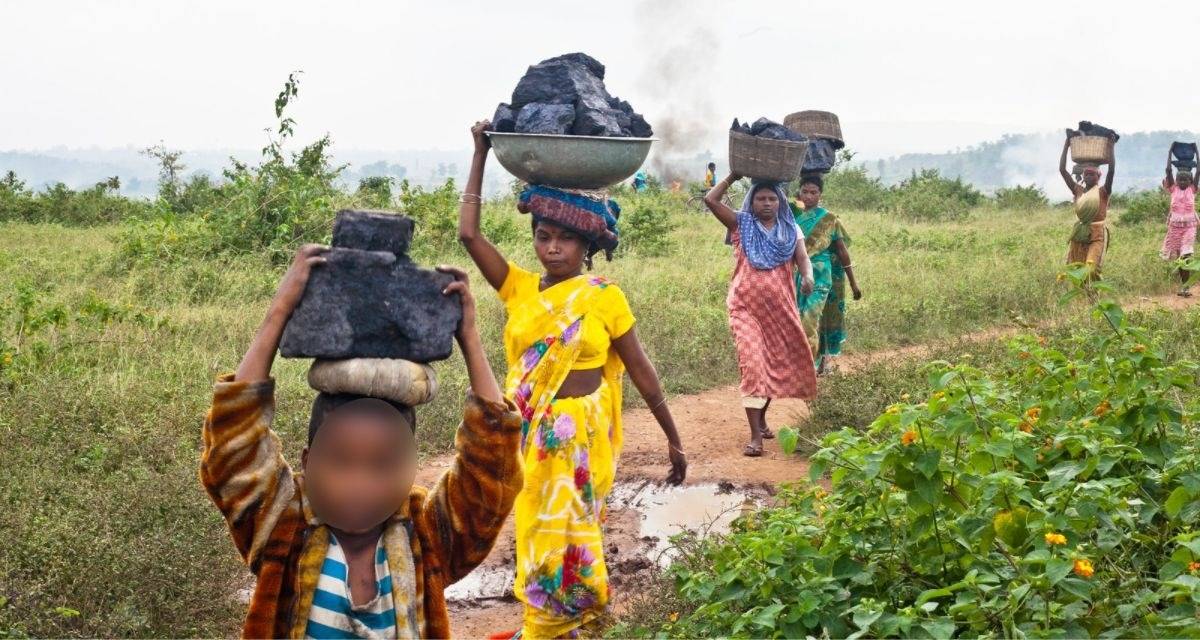
Jharkhand, with more than 200 coal mines, holds 27 per cent of the country’s coking coal reserves estimated at 19.4 billion tonnes and fuels India’s thermal power. However, the families of more than five lakh workers, particularly those in unorganised jobs in the Jharia coalfields region, continue to be victims of exploitation. Government apathy in addition to profiteering private operators with scant regard for worker welfare and safety have forced local coal workers into extreme penury, battling a myriad of health hazards and facing threats of subsidence (sinking of the ground because of underground material movement).
Rinku Rawani (32) lives in Mohribandh locality in Jharia, where an underground coal fire has been raging for decades. One August, four years ago, her neighbour’s home sank into the ground and not even the kitchen utensils were spared. Rawani, a loading worker at Golakdih Colliery, continues to live here with this fear hanging over her even as her family are forced to inhale the poisonous gases coming out of cracks in the ground.
She has nowhere else to go and the promised government rehabilitation hasn’t reached her yet. She can’t help but rue over the lost home from her childhood, once a lush green land, now utterly uninhabitable. “In the past 20 years, because of unscientific and unsystematic mining, especially by private operators, pollution has drastically increased and the threat of subsidence has aggravated.”
Seasons change but exploitation is constant
The British monopoly on coal mining in Jharia was challenged by Gujarati traders at the turn of the 20th Century and soon other private players followed, making Jharia one of the richest princely estates in the Calcutta Presidency thanks to the huge royalties on mining leases.
But local workers got the raw end of the deal, working in harsh conditions for a pittance. The nationalisation of coal mines by Indira Gandhi in the 70s improved working conditions at the PSUs but in the early 2000s, private entities (owned by local business houses, politicians and even local musclemen) once again entered the field as contractors employed for coal extraction, transportation and removal of mines overburden (sand, dust and rock covering the coal). And with that came the return of the unscientific and unethical mining practices pioneered by profit-minded private players.
Consequently, state-owned subsidiaries like BCCL operating in Dhanbad, Central Coalfields Limited (ECL) operating in Bokaro, Ramgarh, Chatra and Ranchi and Eastern Coalfields Limited (ECL) operating in Dhanbad and Godda posted fewer and fewer vacancies, opting to outsource the work to contractual employees until the number of permanent employees are now outnumbered by cheap and disposable contact workers.
A.K. Jha, the national general secretary of Congress-affiliated trade union Indian National Trade Union Congress (INTUC), said, “The employees of these private companies are not provided benefits such as health insurance, gratuity, provident fund and medical reimbursements. Many companies do not provide them with even identity cards and safety gear such as helmets, forcing them to work in unsafe conditions.”
Nasir Iqbal, a Jharia-based general physician said, “Continuous exposure to coal dust in the air causes diseases such as allergic rhinitis, asthma, bronchitis and tuberculosis to people living and working in these mining areas.”
Apart from these contractual workers, musclemen who double as union leaders also engage many labourers from the surrounding areas, mostly women, for Rs 200 per day for loading raw coal and Rs 300 per day for loading prime coal on trucks. Violent clashes between groups engaged by different musclemen over the allotment of work are common at mining sites. Police had to apply brute force to neutralise the situation in Godhar colliery area of BCCL on July 9 this year when two groups started pelting stones at each other. One of these groups was supported by Janta Mazdoor Sangh, a trade union affiliated to the Hind Mazdoor Sabha.
Aasha Devi, who participated in a protest by the residents of Gondudih area of Katras in Dhanbad on December 7 demanding more work allotment, said, “We are allotted work only for 15 to 20 days in a month, that too, for Rs 200 to Rs 300 per day. It is difficult to afford a living with this income and we can’t even shift to agriculture because we don’t own any land.”
A resident of Jharia’s Mohribandh locality and the central secretary of Bihar Colliery Kamgar Union, Rajendra Paswan, said, “The private operators are responsible for the recent shortage in the supply of coal to powerhouses. They collude with PSUs to falsify paperwork on meeting coal extraction targets. Before their entry into this sector, the PSUs were under pressure to meet their coal excavation targets, and hence, such crisis did not occur.”
Paswan said the government should ensure that contractual workers get fair wages, medical facilities, safety gear and uniforms. “We also want the government to force mining companies to increase their allocation of Corporate Social Responsibility (CSR) funds to improve infrastructure in mining areas by constructing roads, opening schools, ensuring drinking water provisions and taking more steps to control pollution,” he said.
“The privatisation in coal mining and amendments in labour laws in favour of private companies by restricting the rights of labourers to protest have aggravated the problems faced by workers,” said the area secretary of Central Industrial Trade Union (CITU).
Another threat around the corner for these workers is the green push to combat climate change. Pramod Pathak, a Dhanbad-based management consultant and former faculty at IIT-Indian School of Mines, Dhanbad said, “The focus on green energy technology in the coming days will lead to job losses as unlike the labour-intensive coal mining operations, green energy is technology-centric.”
ALSO READ-First phase in UP is challenge for BJP, hope for SP