August 18, 2022
4 mins read

Advantage Shah As Gadkari, Yogi & Shivraj Out

Gadkari’s exclusion from the Parliamentary Board is particularly significant as he is a former president of the party, and the other two former presidents —Amit Shah and Rajnath Singh continue to be members. The exclusion of Gadkari follows after another former president, LK Advani was dropped from the Board

In a move that is likely to give Union Home Minister Amit Shah greater role in the BJP and in governance, the party’s president JP Nadda on August 17 effected a major organisational rejig of the Parliamentary Board, the highest decision making authority in the party, and the Central Election Committee (CEC) that goes into candidate selections, a rejig that is significant more for the exclusions than inclusions.

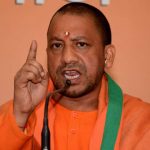
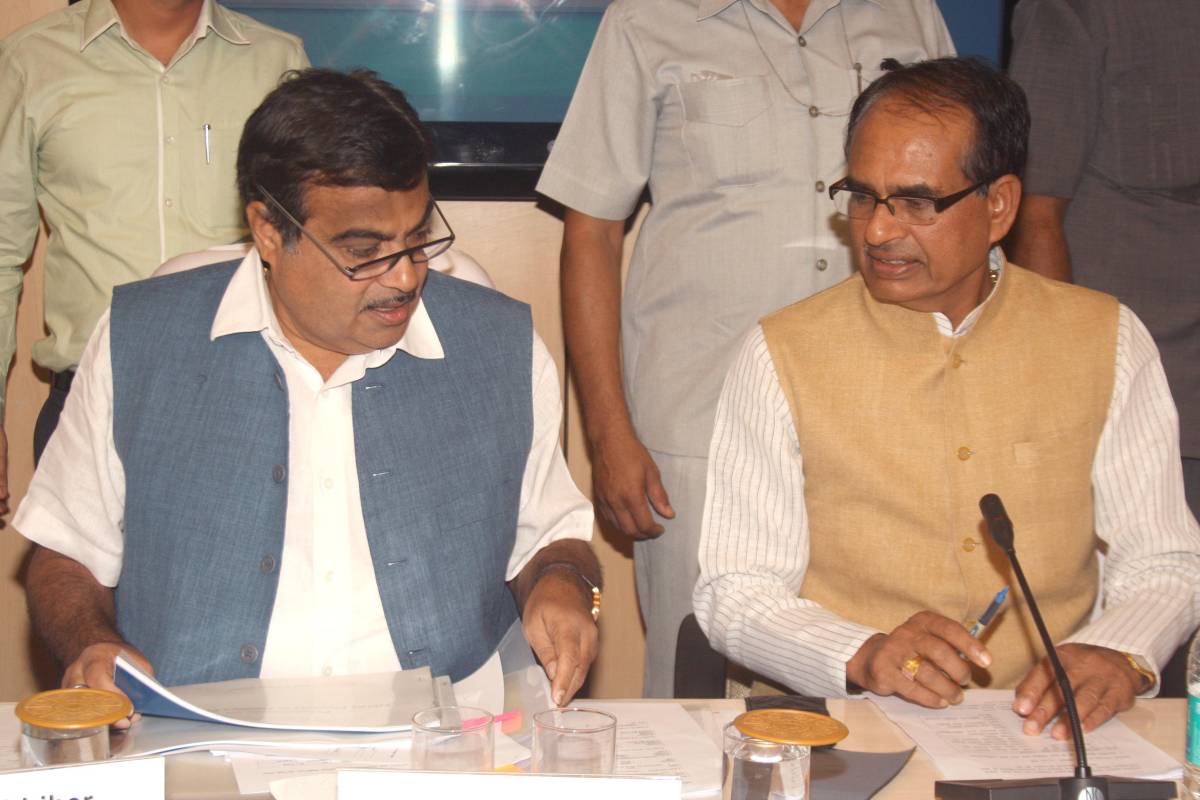
The Parliamentary Board, where Prime Minister Narendra Modi, is also a member, former BJP president and Roads and Highways Minister Nitin Gadkari has been dropped as has Madhya Pradesh Chief Minister Shivraj Singh Chouhan.

Gadkari’s exclusion is particularly significant as he is a former president of the party, and the other two former presidents — Home Minister Amit Shah and Defence Minister Rajnath Singh continue to be members. The exclusion of Gadkari follows after another former president, L.K. Advani was dropped from the Board.

The Board in its previous form had five vacancies due to the passing away of senior leaders Arun Jaitley, Sushma Swaraj, and Ananth Kumar and the election of Venkaiah Naidu as Vice-President of India and Karnataka Governor Thawarchand Gehlot being appointed to that post.

In the 11-member Board, not constituted since 2014, when Home Minister Amit Shah was party president, Nadda, Prime Minister Modi, Shah, Rajnath Singh and general seceretary (organisation) B.L. Santhosh continue as before.

In the vacancies thus filled, interestingly, the inclusions are former Chief Minister of Karnataka B.S. Yediyurappa, whose inclusion acknowledges the fact that he is unlikely to fade into the political sunset anytime soon and is still a force to reckon with in State politics. Mr. Yeddyurappa has also been made member of the CEC.

Former Assam Chief Minister Sarbananda Sonowal has also been appointed to the Parliamentary Board, party sources saying in a bid to diversify the membership, as he belongs to a tribal community from Assam. The chief of the party’s OBC Morcha and Rajya Sabha MP K. Laxman who belongs to Telangana is another significant inclusion.

For the first ever in the party’s recent history, a Sikh member, Iqbal Singh Lalpura has been appointed to the Board, a nod to the protest movement against the farm laws (which the Union Government repealed) and the political exigencies in Punjab. Other inclusions are former MP from Mahendragarh in Haryana, Sudha Yadav. Her husband, Deputy Commandant Sukhbir Singh Yadav, of the Border Security Force (BSF), had died fighting Pakistani intruders during the Kargil war. Satynarayana Jatiya, former MP and former Union Minister in the Vajpayee Government.

In the 15 member CEC, the surprise inclusion has been that of Maharashtra Deputy Chief Minister Devendra Fadanvis, an acknowledgement that he needed validation at the national level, in order to offset the disappointment felt by some quarters in Maharashtra BJP over him being overlooked as Chief Minister. BJP’s mahila morcha president, Tamil Nadu MLA Vanathi Srinivasan has also been made a member of the CEC. Union Minister Bhupendra Yadav and senior party leader Om Mathur are the other two members. Former Union Ministers Jual Oram and Shahnawaz Hussain have been dropped.

Rejig emphasises diversity, says BJP

“The new reconstituted Parliamentary Board shows how the party rewards old workers and values their experience. People like B.S. Yediyurappa, Satyanarayan Jatia, K. Laxman have given their lives to the party, building it brick by brick from the start. Their coming to the highest decision-making body shows how the party values its esteemed Karyakartas (workers),” BJP sources said.

Pointing towards the diversity of the newly constituted Parliamentary Board, BJP sources said: “There is an emphasis on diversity. Sarbananda Sonowal is from the Northeast, L. Laxman and B.S. Yeddyurappa hail from South. In Iqbal Singh Lalpura there is a Sikh.”

“Sudha Yadav is a self-made political leader whose husband was martyred in Kargil. Her inclusion shows utmost respect to women and families of armed forces personnel. Representation from the South and Northeast is at an all-time high in the Parliamentary Board,” sources added.
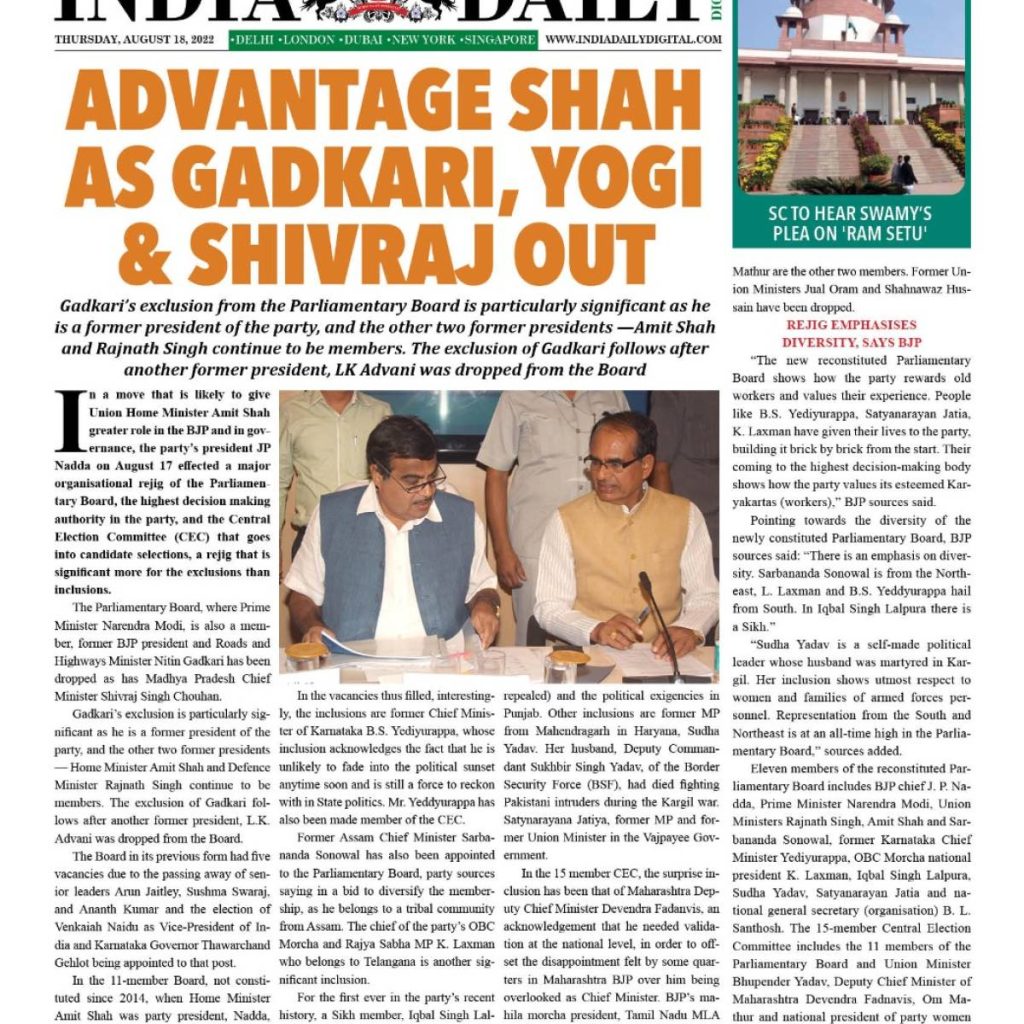
Eleven members of the reconstituted Parliamentary Board includes BJP chief J. P. Nadda, Prime Minister Narendra Modi, Union Ministers Rajnath Singh, Amit Shah and Sarbananda Sonowal, former Karnataka Chief Minister Yediyurappa, OBC Morcha national president K. Laxman, Iqbal Singh Lalpura, Sudha Yadav, Satyanarayan Jatia and national general secretary (organisation) B. L. Santhosh.

The 15-member Central Election Committee includes the 11 members of the Parliamentary Board and Union Minister Bhupender Yadav, Deputy Chief Minister of Maharashtra Devendra Fadnavis, Om Mathur and national president of party women wing Vanathi Srinivasan. Senior leaders Shahnawaz Hussain and Jual Oram were dropped from the CEC.

ALSO READ-Amit Shah announces e-Census by 2024
Previous Story

UAE private sector workers jump 9% to 5.3 mn

Next Story

Israel, Turkey to restore full diplomatic ties

Previous Story

UAE private sector workers jump 9% to 5.3 mn

Next Story

Israel, Turkey to restore full diplomatic ties

Latest from -Top News

Pakistan Risks Overstretching Itself in Yemen War

Pakistan’s expanding military role in Saudi Arabia amid the Yemen conflict could strain its defence resources and fragile finances…reports Asian Lite News Desk Pakistan’s military involvement in the war in Yemen may prove unsustainable because of mounting financial pressures and competing security demands, according to a new report. Islamabad’s growing military presence in Saudi Arabia risks stretching its defence resources while exposing the country to greater strategic and economic challenges. An article by Andrew Wilson in One World Outlook describes Pakistan’s involvement as a case of “fiscal and strategic overreach”, arguing that the country lacks the financial flexibility to sustain an expanded military commitment. Pakistan’s external finances depend heavily on an International Monetary Fund (IMF) programme, financial support from Gulf countries and remittances from Pakistani workers in the region. The report argues that deeper military involvement in the conflict could place additional pressure on these sources of financial stability. It also warns that deploying troops and military equipment abroad could weaken Pakistan’s capacity to address security challenges along its eastern border and deal with two domestic insurgencies. The move could also draw Islamabad into a conflict it has sought to approach cautiously. A Reuters report in May, citing Pakistani security and government sources, said Islamabad had deployed around 8,000 troops, a squadron of approximately 16 aircraft, mostly JF-17 fighter jets, two drone squadrons and a Chinese HQ-9 air-defence battery to Saudi Arabia. According to those sources, Riyadh was financing the deployment, with Pakistani personnel operating the equipment. The sources also said a confidential agreement contemplated the possibility of deploying up to 80,000 troops. Islamabad has not confirmed those figures, although it has acknowledged its military presence in Saudi Arabia, including the deployment of fighter jets at King Abdulaziz Air Base from April. The One World Outlook article argues that Saudi financial support can cover allowances and operating expenses but cannot easily replace military equipment needed elsewhere or resolve the political and strategic challenges of participating in the Yemen conflict. Pakistan’s defence budget is another concern. For the 2026-27 financial year, the federal government allocated PKR 3 trillion, or approximately $10.8 billion, to defence services. The allocation represents an 18 per cent increase from the original PKR 2.55 trillion provision and amounts to around 2.1 per cent of projected gross domestic product (GDP). Defence spending accounts for approximately 16 per cent of the federal government’s PKR 18.8 trillion expenditure. Military pensions are budgeted separately at PKR 822 billion, while debt servicing costs stand at approximately PKR 8 trillion, more than two-and-a-half times the defence allocation. The report argues that these competing financial obligations leave little room for additional military expenditure without placing further pressure on public finances. Pakistan’s reliance on IMF assistance also limits its fiscal flexibility. The country must meet the conditions attached to the programme, including a primary budget surplus target of 2 per cent of GDP and continued restraint on development spending. According to the article, these requirements make it difficult for Islamabad to finance an additional military commitment without compromising other budgetary priorities. Pakistan’s economic indicators offer limited reassurance. Economic growth for the 2025-26 financial year is estimated at between 3.6 and 3.7 per cent, while inflation reached approximately 10.3 per cent in September following an energy price shock. Foreign exchange reserves stood at around $21.5 billion at the end of September. Although this marks an improvement from the low levels recorded in 2023, the report notes that the reserves cover only a few months of imports. Financial assistance from Gulf partners remains central to Pakistan’s external stability. The article says Islamabad holds approximately $8 billion in Saudi deposits at its central bank. In July, the State Bank of Pakistan said Riyadh had extended the maturity of $5 billion in deposits to December 2028, easing the country’s immediate external financing requirements. A further $3 billion deposit was also extended in the spring. However, the article argues that these arrangements provide temporary relief rather than long-term financial independence, particularly as regional conflict threatens the stability of the Gulf economies on which Pakistan relies. The report concludes that Pakistan faces a difficult balance between supporting Saudi Arabia militarily and preserving the financial and military resources needed to address its domestic and regional challenges.

UK and Germany Ratify Kensington Treaty

Britain and Germany ratify the Kensington Treaty, agreeing new cooperation on AI, quantum research, defence and security while targeting investment, jobs and Russian hybrid threats…reports Asian Lite News Desk Britain and Germany
Go toTop

Don't Miss

All eyes on UP as BJP sets the ball rolling for 2022 polls

The party has made it clear that it will bank

Yogi adds 7 new ministers including Jitin Prasada ahead of polls

Among those who were sworn in are one cabinet minister