July 25, 2022
7 mins read

Taiwan is to East Asia what Israel is to West Asia

Takeover of Taiwan by the PRC would upend the security of the Indo-Pacific, writes Prof. Madhav Nalapat

It remains to be seen whether Speaker of the US House of Representatives, Nancy Pelosi, will continue in that office once the two-year term of the present batch of legislators ends. The decision may not necessarily be hers to take, in that she would have to make way for a new Speaker of the House, were the Republican party to wrest the majority from the Democrats.

The inflationary and recessionary trends caused by the Biden-Johnson sanctions on Russia as a consequence of its war on Ukraine have made the current US President unpopular. Instead of rewarding lower income voters, who backed him in large numbers during the Presidential poll, Biden is showering money on Ukraine. In the process, he is delighting weapons manufacturers not just in the United States but worldwide.

Not to mention the oil industry, which is reaping the benefit of a huge spurt in oil and gas prices as a consequence of US-led sanctions on Russia that have been added on to those imposed on major oil producers such as Venezuela and Iran. Thanks to such policies by the US and some of its allies, the cost of oil is far above what it needs to be to ensure global economic health. Countries in Asia are starting to be worried about the quality of leadership exhibited within NATO.

Such worthies are coming up with Alice in Wonderland plans such as enforcing a price cap on Russian, but not on US or UK, oil. The manner in which the Atlantic Alliance has reacted to the war in Ukraine appears to have dealt a death blow to any hopes of recovering its primacy within the international system. At the same time, NATO has proved unable to prevent the dismemberment and destruction of Ukraine. In the fantasy world that the present occupants of the White House and Number 10 Downing Street live in, their performance during the Ukraine war is taken as a deterrent to China’s attempting a takeover by force of Taiwan.

Given the economic pain to NATO member states that its own sanctions on Russia are causing, the thinking within the Central Military Commission (CMC) in Beijing is veering around to the view that (after being mauled by their own sanctions on Russia) there is likely to be zero appetite within NATO to impose similar sanctions on China. After all, the other superpower is a country that is many times more closely linked in commerce with the Atlantic Alliance than Russia. In Ukraine, there has since 2014 been an indoctrination designed to create Russophobic mindsets in those elements of the public that do not speak Russian as the mother tongue.

Military vehicles of the Chinese People’s Liberation Army arrive in Moscow, Russia, Aug. 14, 2021. (Photo by Yu Xiaoping_Xinhua)

Yet even within convinced Russophobes, hopes for the entry on Ukraine’s side of NATO during the war with Russia have faded. Instead, fatigue has set in as a consequence of the damage that the country has suffered by continuing its senseless war rather than working out a peace settlement with Moscow.

Neither President Biden nor Boris Johnson appears to be concerned about the fact that the longer the war continues, the harsher will be the peace terms insisted on by President Putin as a condition to stop the fighting. Should Liz Truss be the next PM, the Cowboys and Injuns approach of Boris Johnson to the Ukraine conflict is likely to continue, to the detriment of the UK. Public opinion within NATO is not what it was during the intoxicating days in the initial weeks of the conflict, when it was accepted wisdom that (a) Russia would soon be forced to withdraw, and (b) Putin would be ousted from the Kremlin.

Instead, the Russian leader is moving towards fulfillment of his stated aim of ensuring that Ukraine never again becomes a threat to Russia, something that even the embedded media in NATO countries is no longer able to cover up. Given the rapid decline within the broader public within NATO of the earlier appetite for continuing the war with Russia over Ukraine, the Central Military Commission (CMC) in Beijing is developing the conviction that citizens in Taiwan would not follow the Ukrainian example and themselves take up arms to throw out invaders from the PRC.

As for intervention by the US, according to President Biden, his generals in Washington are terrified even by the prospect of Speaker Pelosi visiting Taiwan. Given the rising unpopularity of Xi as a consequence of the mismanagement of the economy, diplomacy and handling the pandemic, pressure on him to follow the example of Putin and attack Taiwan is mounting. Of course, the Russia-obsessed fantasists in the White House believe the contrary is true, just as they believed that Russia would be easy prey for a Ukraine boosted by NATO firepower. A Commander-in-Chief, who walked away even from confronting a ragtag force such as the Taliban, does not inspire confidence as an ally.

It is in the context of declining confidence in the value of a security partnership with the US led by Joe Biden that a probable visit to Taiwan by House Speaker Nancy Pelosi ought to be seen. Mike Pompeo showed the courage to brave the wrath of not just the CCP leadership but the well-resourced PRC lobby in the US to visit Taiwan. Former Defense Secretary Mark Esper is following in his wake, as will perhaps Mike Pence later. Pompeo met with that country’s leaders as a former Secretary of State. There is a world of difference between Speaker Pelosi going to Taiwan as distinct from a later visit by ex-Speaker Pelosi.
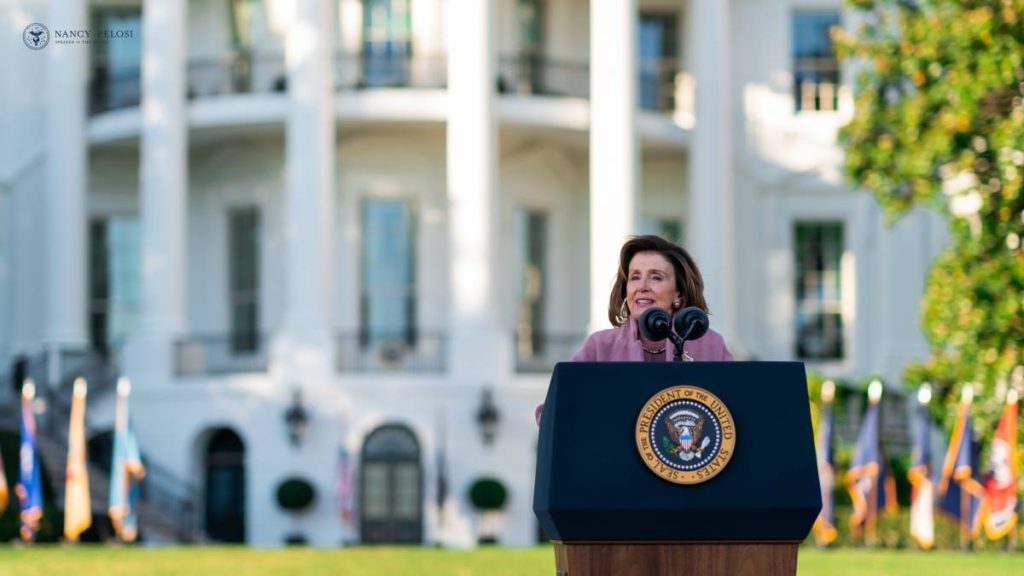
Speaker Pelosi

The US Speaker is showing spine, which is more than can be said for the leader of her party and the nation, President Biden. Neither he nor the current Japanese Prime Minister Fumio Kishida are known for the firmness on matters relating to China of Shinzo Abe. The death of the latter has removed from the highest councils of Japan a voice that would have been steadfast in calling for steps to repel any military invasion by China across the Taiwan Straits. The reason being given by the assassin seems to be a cover story, given that there are dozens of politicians in Japan who are far closer than Abe ever was to the religious group identified by the killer as being the trigger for his act.

Abe’s killer is a traitor to Japan and not just a murderer, and a comprehensive investigation into the ecosystem he drew sustenance and inspiration from is essential rather than a cover-up of the truth as took place in the “enquiry” by President Biden’s commission to investigate the origins of Covid-19.

Takeover of Taiwan by the PRC would upend the security of the Indo-Pacific, and severely compromise that of not just Japan and South Korea but of all democracies in the Indo-Pacific immediately. The world would move closer to a situation where the PRC is dominant. Should General Secretary Xi believe that the consequences for his country would be temporary and bearable, he would be inclined to allow the PLA to fulfill its longstanding goal of attempting a takeover by force of a tech superpower.

Taiwan is to East Asia what Israel is to West Asia. By braving the ire of the White House (and, if Biden is to be believed, the Pentagon) and going ahead with her visit to Taiwan, Speaker Pelosi would show the world that she understands the importance of the country at the centre-point of the global tech industry with a resoluteness yet to be demonstrated by President Joe Biden.


ALSO READ: Understanding China’s intent on Taiwan

Previous Story

Bolsonaro officially launches re-election campaign

Next Story

Go First may go public

Previous Story

Bolsonaro officially launches re-election campaign

Next Story

Go First may go public

Latest from -Top News

Houthis Claim Missile Strike on Riyadh Airport

Yemen’s Houthi group claims a ballistic missile struck Riyadh’s King Khalid International Airport, with Saudi authorities yet to confirm the latest attack…reports Asian Lite News Desk Yemen’s Houthi group has claimed responsibility

US Green Card Freeze Hits Indian IT Giants

The Trump administration has suspended employment-based green card processing for eight major technology companies, including Infosys, TCS, Wipro and HCL, citing ongoing investigations…reports Asian Lite News Desk The Trump administration has suspended a key employment-based green card process for eight major technology and outsourcing companies, including Indian IT giants Infosys, Tata Consultancy Services, Wipro and HCL, as Vice President JD Vance announced a crackdown on alleged visa fraud. The suspension, announced on Thursday by US Labour Secretary Keith Sonderling at a press conference led by Vance, also covers Cognizant, Capgemini, Microsoft and Adobe. It bars the companies from filing new permanent labour certification applications and halts the processing of pending applications under the programme. Sonderling said the decision followed ongoing criminal and federal investigations into the companies. “Due to ongoing criminal investigations led by the Department of Labour’s Inspector General Anthony DiEsposito, who will get into this shortly, I am hereby suspending from the Permanent Labour Certification Program some of the largest IT outsourcing firms in the world, Cognizant, Infosys, Tata, Wipro, HCL, and Capgemini,” Sonderling said. He added that Microsoft and Adobe were also being suspended because of multiple active federal investigations. “We will not accept or process any pending permanent labour certification applications involving these companies,” he said. The Permanent Labour Certification programme, commonly known as PERM, is a key step in the process through which employers sponsor foreign workers for employment-based permanent residence in the United States. According to figures presented by Sonderling, the eight companies had collectively requested nearly three million foreign workers since 2009. They had received more than 230,000 H-1B visa approvals and over 100,000 permanent labour certifications. The administration did not disclose company-specific findings or provide details of the alleged violations during the press conference. Vance accused employers of using the H-1B visa programme to replace American workers with lower-paid foreign employees. He said the programme was intended to help companies recruit highly skilled workers for positions that could not be filled by American employees. “The H-1B visa program is meant to allow companies to bring in really the best of the best from outside the United States of America for positions that are completely impossible to fill with American workers,” he said. Vance singled out Microsoft, alleging that the company had laid off 6,000 American workers while benefiting from 6,300 H-1B visas and nearly 3,000 green cards. He said the administration wanted companies to change their hiring practices rather than withdraw from the American market. Asked whether the suspension would be temporary or permanent, Vance said, “The suspension of PERM is gonna last as long as it needs to.” He added that the administration had the tools to continue the suspension indefinitely but wanted the companies to improve their conduct. The US Justice Department also announced that it was actively investigating companies suspected of favouring foreign workers over American employees. Attorney General Todd Blanche said the authorities could pursue criminal prosecutions and civil lawsuits as part of the enforcement measures. The decision could have significant implications for Indian technology professionals and outsourcing companies operating in the United States, where Indian firms have long relied on employment-based immigration programmes to deploy skilled workers to American clients. The H-1B visa programme allows US employers to hire foreign workers in qualifying specialised occupations on a temporary basis. PERM, meanwhile, is part of a separate process through which employers seek to sponsor eligible foreign workers for permanent residence. The suspension announced on Thursday specifically concerns permanent labour certification applications involving the eight named companies. It does not, by itself, establish the cancellation of existing H-1B visas or green cards. The impact on individual employees will depend on their immigration status and the stage of their applications. The administration did not provide a detailed timeline for the suspension or specify when processing might resume.

Nepal Floods Cause $1.66 Billion In Damage, Says World Bank

Nepal’s August 2026 floods caused an estimated US$1.66 billion in direct physical damage, with infrastructure accounting for 83 per cent of the total…reports Asian Lite News Desk Nepal’s devastating floods in August 2026 caused an estimated US$1.66 billion in direct physical damage, with infrastructure accounting for 83 per cent of the total, according to a World Bank report. The estimate, included in the World Bank’s Nepal Development Update unveiled this week, is close to the Nepal government’s preliminary Rapid Damage and Needs Assessment (RDNA), which put physical damage at US$1.81 billion. The government’s assessment also estimated losses beyond physical assets at US$883.32 million, taking the total economic effects of the disaster to approximately US$2.7 billion. The World Bank’s Global Rapid Post-Disaster Damage Estimation (GRADE) found that infrastructure suffered the greatest damage, estimated at US$1.38 billion, or 83 per cent of the total. Residential buildings accounted for US$185 million, or 11 per cent, while non-residential buildings sustained damage worth US$101 million, or 6 per cent. The floods along the Bhotekoshi and Trishuli rivers caused extensive damage to hydropower projects, solar energy facilities, electricity transmission infrastructure and transport networks. The energy sector, particularly hydropower, was among the worst affected. The August 2026 floods affected 12 hydropower projects and one solar project, involving 281.1 MW of operational capacity and 395.02 MW of capacity under construction. Damage to transmission lines and substations also disrupted the transmission of 149.6 MW of electricity to the national grid. The total affected capacity reached approximately 430.7 MW, equivalent to 10.6 per cent of Nepal’s installed hydropower and solar capacity at the end of fiscal year 2025-26, which concluded in mid-July. The disaster also severely damaged transport infrastructure along the 82-km Rasuwa trade corridor, which connects Kathmandu with the Rasuwagadhi border point with China. More than 55 km of the corridor was damaged, including 40 km that was completely destroyed. The floods also damaged 37 motorable bridges and 68 suspension bridges. The disaster resulted in significant human losses along the affected corridor and beyond. According to Nepal’s National Disaster Risk Reduction and Management Authority, 1,455 people had been confirmed dead, while 5,285 remained missing following the disaster. The World Bank report found that the physical damage was concentrated in three districts in central Nepal: Rasuwa, Nuwakot and Dhading. Rasuwa was the worst-affected district, accounting for US$1.07 billion, or 64 per cent, of the total direct damage. Nuwakot recorded an estimated US$551 million in damage, while Dhading suffered approximately US$39 million. “The findings highlight the concentration of physical damage in a small number of districts and the disproportionate impact on infrastructure, underscoring the scale of the reconstruction challenge facing the affected areas,” the World Bank said. The global development financier said the floods had demonstrated the scale and complexity of disaster risks in Nepal’s Himalayan environment. The event also showed how a single extreme weather event could trigger cascading impacts across sectors and geographical areas. The report said recovery efforts should extend beyond restoring infrastructure to its pre-disaster condition. While the principle of “Build Back Better” remained relevant, the World Bank stressed that rebuilding infrastructure to higher engineering standards in the same locations might not always be sufficient. “In some cases, simply rebuilding the same infrastructure in the same location to a higher engineering standard may not be sufficient. Nepal may need to build differently — based on a better understanding of risk, more careful decisions about location and design, greater redundancy in critical networks, stronger monitoring and early warning, and a more integrated approach to infrastructure development in the Himalayas,” the report said. The World Bank said Nepal’s recovery strategy should incorporate improved risk assessment, more informed infrastructure planning, stronger monitoring systems and better early warning mechanisms. The report emphasised that reconstruction should not only restore damaged assets but also reduce the impact of future disasters, particularly in the country’s vulnerable Himalayan regions.

Vaccine Delays Fuel Bangladesh Measles Outbreak

More than 32,000 suspected cases and over 250 deaths have been reported since mid-March, with children making up most of the fatalities….reports Asian Lite News Desk Bangladesh’s measles outbreak has intensified, with
Go toTop

Don't Miss

Egypt to Intensify Aid Delivery Efforts to Gaza

Egypt is ready to exert any effort to achieve calm

Israel’s unilateral actions undermine chances for peace, two-state solution

A senior Palestine official has said that the unilateral Israeli