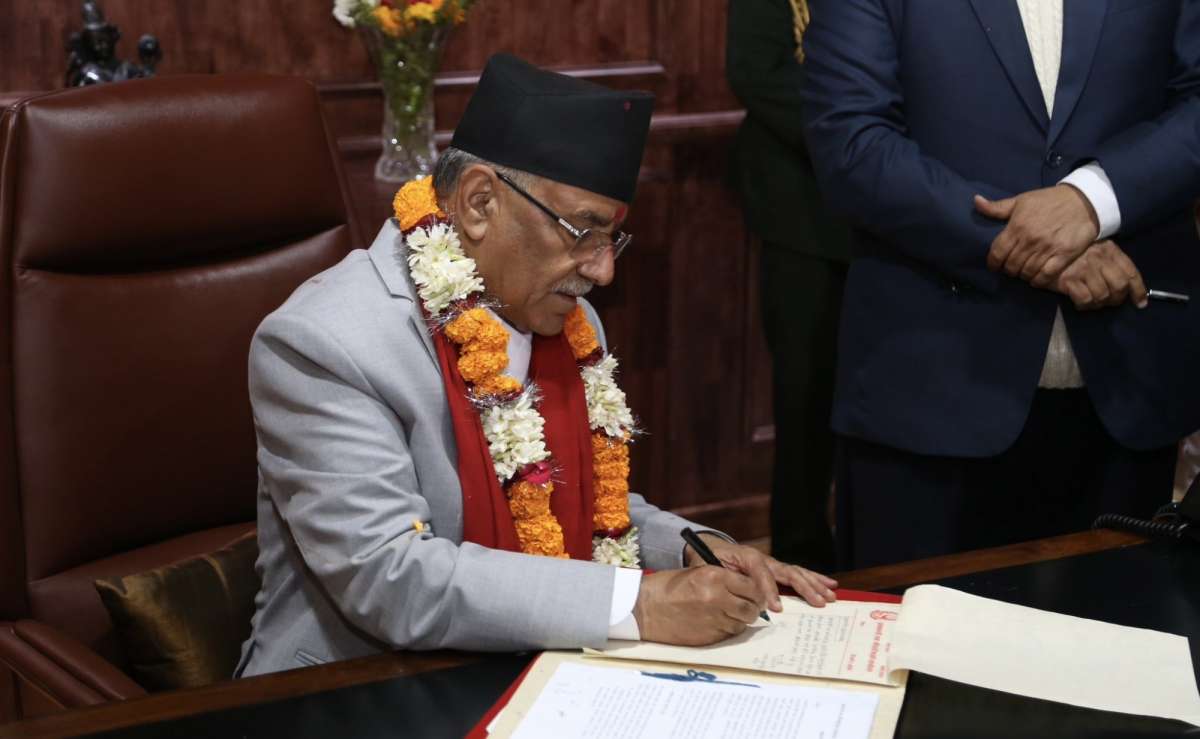
Dahal may have mellowed with time, and become wiser after tasting power, but it is still difficult to believe that he would agree to Nepal becoming a kingdom again and a Hindu Rashtra to boot….reports Asian Lite News
China may be blowing the diplomatic trumpet over the developments in Nepal but the U-turn taken by Nepali Maoist supremo, Pushpa Kamal Dahal ‘Prachanda’ to propel himself into the Prime Ministers chair with the KP Sharma Oli crutches heralds a period of political instability the Himalayan nation can ill-afford.
Dahal and Oli are friends-turned-enemies who have decided now to bury the hatchet in order to share the spoils of office. This is in sync with the pre-poll phenomenon of giving a go-by to ideology that has resulted in the electorate voting a hung Parliament.
And there is nothing fishy about it, more so since the Nepal Communists have become a political amoeba even under the Dragon’s close watch owing to their penchant for power politics.
More than the new found Dahal-Oli bonhomie, which is understandable, really intriguing is their readiness to co-opt the Rastriya Prajatantra Party (RPP), which stands for Hindu nation and constitutional monarchy.
RPP chief Kamal Thapa has saved himself from some embarrassment by deciding to not to join the coalition government. All eyes will be on Prachanda, however, since all his life he has been opposed to the monarchy.
Politics of unpredictability has become the norm in Nepal. It is this unpredictability factor that made Prachanda to break off ties with the five-party alliance that had sought mandate in the November polls under the leadership of Sher Bahadur Deuba of Nepali Congress.
The ostensible ground for his volte face was that Deuba was not willing to let him lead the government for the first half of the five-year term of the new Parliament. That sounds specious.
Since Deuba and Dahal had gone together before the electorate, it is rather unlikely that they had not worked out in advance the manner in which to divide the Prime Minister’s term in case they won the polls for the lower house of Parliament.
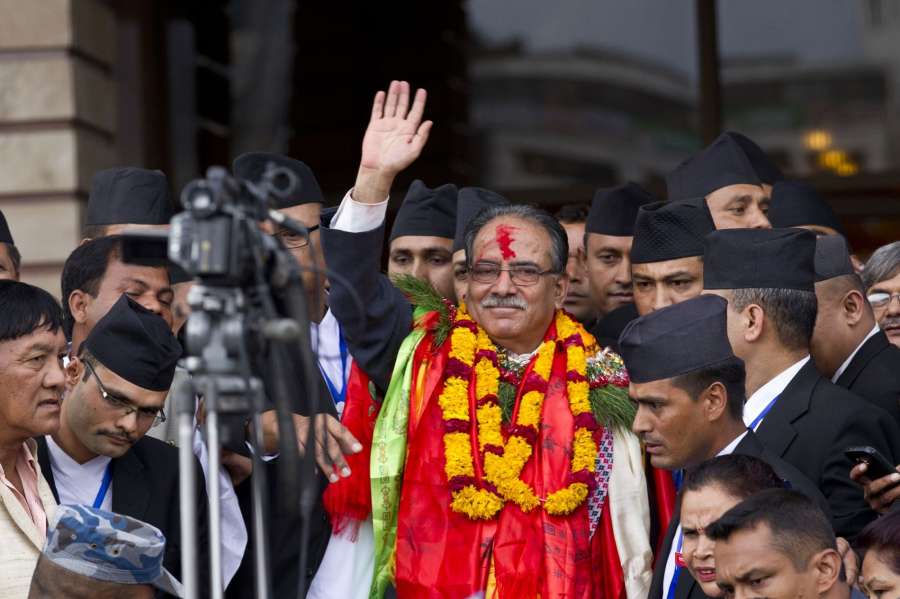
If Dahal was so keen to become the Prime Minister in the first half of the tenure, he would have conveyed it loud and clear to Deuba and the coalition partners. Deuba obviously received no such hint. If he was hiding his wish for averting trouble before the polls, he was being unfair.
From what the Kathmandu Post reported, his desire for the first shot at the Prime Minister post is clearly an outcome of crafty reading of the results that placed the Nepali Congress as the single largest party (89 seats) but well short of the half way mark in the 278-member house.
Dahal’s Communist Party of Nepal (Maoist Centre) was a distant third with 32 seats, while Oli’s Communist Party grabbed the second slot with 78 seats.
Deuba is a veteran at maneuvering hung Parliaments to his advantage. He appears to have not anticipated that Dahal would opt out of his coalition, least of all because the Maoist leader had brought down the Oli government last year for the same reason for which Dahal parted ways with Deuba now, the question of the order of rotation of the office of the Prime Minister.
Cut to the RPP’s Hindu card and monarchy fixation. It is difficult to believe that Dahal is in agreement with that kind of demand though anything is possible in Nepal’s power centric politics.
He had waged a bloody war against the state, demanding abrogation of the monarchy. The armed insurgency lasted a decade and took a heavy toll of civilian lives.
Dahal may have mellowed with time, and become wiser after tasting power, but it is still difficult to believe that he would agree to Nepal becoming a kingdom again and a Hindu Rashtra to boot.
The only area where Dahal did appear to have made a compromise was his inveterate pursuit of anti-India policies and embracing China tightly. The real politic forced him to climb down from his position as a strong anti-India leader. The age-old people-to-people ties with India do not leave much room for a long-lasting, strong anti-India politics in Nepal.
There are undeniably Nepalese who do not like India but a lot of feelings against India spring from cultivating Chinese manipulation of Nepal politics. An impression has gone around that Nepal can profit much more from closeness to cash-rich and militarily powerful China than India.
Oli tried to inject much venom in the Indo-Nepal ties while following a strong pro-China policy. But by the time Dahal ousted him, Oli had tried to soften his stand on India, though purely for political expediency.
In a previous tenure as Prime Minister, Dahal after a while had distanced himself from anti-India stance only to discover that it had upset the Chinese who accused him of following a policy of ‘appeasement’ towards India.
But the Chinese were also worried over the differences among the Communist leaders in Nepal. Also over their penchant to float new Communist party variants as it could weaken the burgeoning China-Nepal ties.
The then Chinese ambassador Hou Yanqi had brazenly worked openly for preventing fragmentation of the Nepalese Communists.
Her shuttle diplomacy in Kathmandu embarrassed Beijing in so small measure but it had no effect on the Nepali comrades nursing their own factions.
This does not mean that the Chinese have given up their open interference in the domestic affairs of Nepal, which, in effect, is a campaign to form a solid pro-China, anti-India group.
The joining of hands by Dahal and Oli may be part of those efforts.
How Dahal steers his India policy will have to be watched. He is unlikely to adopt a rabid anti-India policy.
But with �hawkish’ Oli behind him, he may have to move closer to China than his immediate predecessor Deuba.
It will be interesting to watch how Dahal negotiates with India on contentious issues like border demarcation, which came up front under Oli’s Prime Ministership.