April 5, 2023
2 mins read

Invites issued for King Charles’ coronation on May 6

The shape of the Green Man, crowned in natural foliage, is formed of leaves of oak, ivy and hawthorn, and the emblematic flowers of the UK…reports Asian Lite News

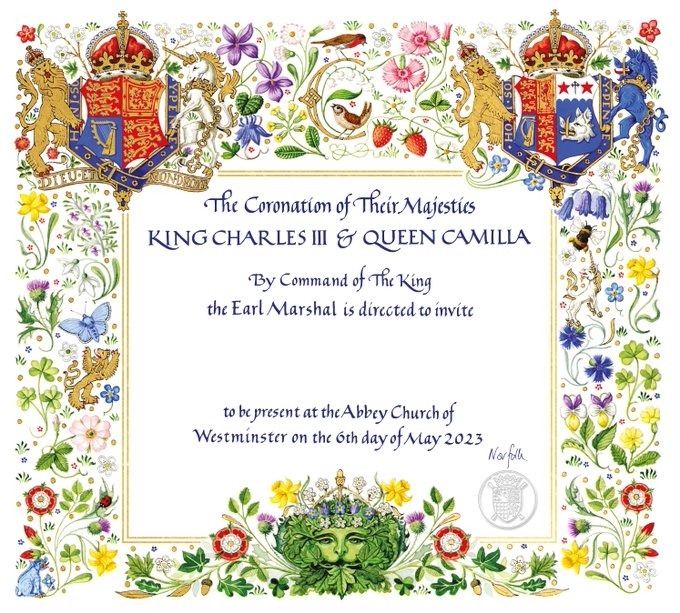
Invites for the May 6 coronation of the UK’s King Charles III have been issued by the Buckingham Palace.

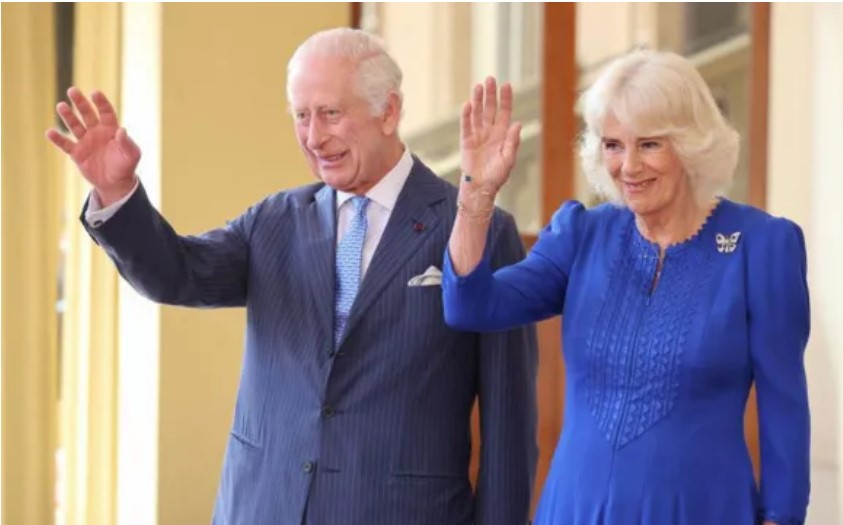
Along with the ornately illustrated invitation from “King Charles III and Queen Camilla”, a new photograph of the royals which was taken last month in the Blue Drawing Room at the Buckingham Palace was also released on Tuesday.

The invite, printed on recycled paper, shows the coronation will mark a change in how Camilla is titled — from Queen Consort to Queen.

In a statement, the Palace said the invitation will be issued in due course to over 2,000 guests who will form the congregation in Westminster Abbey.

At the coronation service, Camilla will be crowned alongside the King, 18 years after the couple married. The invitation has been designed by Andrew Jamieson, a heraldic artist and manuscript illuminator whose work is inspired by the chivalric themes of Arthurian legend.

The original artwork for the invitation was hand-painted in watercolour and gouache, and the design will be reproduced and printed on recycled card, with gold foil detailing.

Central to the design is the motif of the Green Man, an ancient figure from British folklore, symbolic of spring and rebirth, to celebrate the new reign.

The shape of the Green Man, crowned in natural foliage, is formed of leaves of oak, ivy and hawthorn, and the emblematic flowers of the UK.

The British wildflower meadow bordering the invitation features lily of the valley, cornflowers, wild strawberries, dog roses, bluebells, and a sprig of rosemary for remembrance, together with wildlife including a bee, a butterfly, a ladybird, a wren and a robin.

Flowers appear in groupings of three, signifying The King becoming the third monarch of his name, said the statement.

A lion, unicorn and a boar — taken from the coats of arms of the Monarch — can be seen amongst the flowers.

ALSO READ-Camilla’s title to be changed after King Charles’ coronation
Previous Story

TikTok fined $16 mn in UK for misusing kids’ data

Next Story

BoE approves UBS’s Credit Suisse takeover

Previous Story

TikTok fined $16 mn in UK for misusing kids’ data

Next Story

BoE approves UBS’s Credit Suisse takeover

Latest from -Top News

Pakistan Risks Overstretching Itself in Yemen War

Pakistan’s expanding military role in Saudi Arabia amid the Yemen conflict could strain its defence resources and fragile finances…reports Asian Lite News Desk Pakistan’s military involvement in the war in Yemen may prove unsustainable because of mounting financial pressures and competing security demands, according to a new report. Islamabad’s growing military presence in Saudi Arabia risks stretching its defence resources while exposing the country to greater strategic and economic challenges. An article by Andrew Wilson in One World Outlook describes Pakistan’s involvement as a case of “fiscal and strategic overreach”, arguing that the country lacks the financial flexibility to sustain an expanded military commitment. Pakistan’s external finances depend heavily on an International Monetary Fund (IMF) programme, financial support from Gulf countries and remittances from Pakistani workers in the region. The report argues that deeper military involvement in the conflict could place additional pressure on these sources of financial stability. It also warns that deploying troops and military equipment abroad could weaken Pakistan’s capacity to address security challenges along its eastern border and deal with two domestic insurgencies. The move could also draw Islamabad into a conflict it has sought to approach cautiously. A Reuters report in May, citing Pakistani security and government sources, said Islamabad had deployed around 8,000 troops, a squadron of approximately 16 aircraft, mostly JF-17 fighter jets, two drone squadrons and a Chinese HQ-9 air-defence battery to Saudi Arabia. According to those sources, Riyadh was financing the deployment, with Pakistani personnel operating the equipment. The sources also said a confidential agreement contemplated the possibility of deploying up to 80,000 troops. Islamabad has not confirmed those figures, although it has acknowledged its military presence in Saudi Arabia, including the deployment of fighter jets at King Abdulaziz Air Base from April. The One World Outlook article argues that Saudi financial support can cover allowances and operating expenses but cannot easily replace military equipment needed elsewhere or resolve the political and strategic challenges of participating in the Yemen conflict. Pakistan’s defence budget is another concern. For the 2026-27 financial year, the federal government allocated PKR 3 trillion, or approximately $10.8 billion, to defence services. The allocation represents an 18 per cent increase from the original PKR 2.55 trillion provision and amounts to around 2.1 per cent of projected gross domestic product (GDP). Defence spending accounts for approximately 16 per cent of the federal government’s PKR 18.8 trillion expenditure. Military pensions are budgeted separately at PKR 822 billion, while debt servicing costs stand at approximately PKR 8 trillion, more than two-and-a-half times the defence allocation. The report argues that these competing financial obligations leave little room for additional military expenditure without placing further pressure on public finances. Pakistan’s reliance on IMF assistance also limits its fiscal flexibility. The country must meet the conditions attached to the programme, including a primary budget surplus target of 2 per cent of GDP and continued restraint on development spending. According to the article, these requirements make it difficult for Islamabad to finance an additional military commitment without compromising other budgetary priorities. Pakistan’s economic indicators offer limited reassurance. Economic growth for the 2025-26 financial year is estimated at between 3.6 and 3.7 per cent, while inflation reached approximately 10.3 per cent in September following an energy price shock. Foreign exchange reserves stood at around $21.5 billion at the end of September. Although this marks an improvement from the low levels recorded in 2023, the report notes that the reserves cover only a few months of imports. Financial assistance from Gulf partners remains central to Pakistan’s external stability. The article says Islamabad holds approximately $8 billion in Saudi deposits at its central bank. In July, the State Bank of Pakistan said Riyadh had extended the maturity of $5 billion in deposits to December 2028, easing the country’s immediate external financing requirements. A further $3 billion deposit was also extended in the spring. However, the article argues that these arrangements provide temporary relief rather than long-term financial independence, particularly as regional conflict threatens the stability of the Gulf economies on which Pakistan relies. The report concludes that Pakistan faces a difficult balance between supporting Saudi Arabia militarily and preserving the financial and military resources needed to address its domestic and regional challenges.

UK and Germany Ratify Kensington Treaty

Britain and Germany ratify the Kensington Treaty, agreeing new cooperation on AI, quantum research, defence and security while targeting investment, jobs and Russian hybrid threats…reports Asian Lite News Desk Britain and Germany

Economic tide is turning in Bangladesh

If there is one thing that can bring some comfort to the struggling Bangladeshi economy, it is good relations with India. Bangladesh should remember that Delhi’s backing, through easy supplies of essentials
Go toTop

Don't Miss

Coronation was just amazing to see, says Jill Biden

An American president has never attended a British coronation and

Harry to attend King Charles’ coronation without Markle

Harry and Meghan, who is biracial, have alleged she faced