Seven-judge Constitution Bench overruled the 1998 PV Narasimha Rao judgment case, which granted immunity to MPs and MLAs from prosecution for taking bribes for voting in Parliament or assemblies…reports Asian Lite News
The Supreme Court on Monday held that “corruption and bribery by members of the legislatures erode probity in public life” while overturning a previous ruling that offered immunity to lawmakers from charges of accepting bribes for casting votes or making speeches in Parliament or state legislatures.
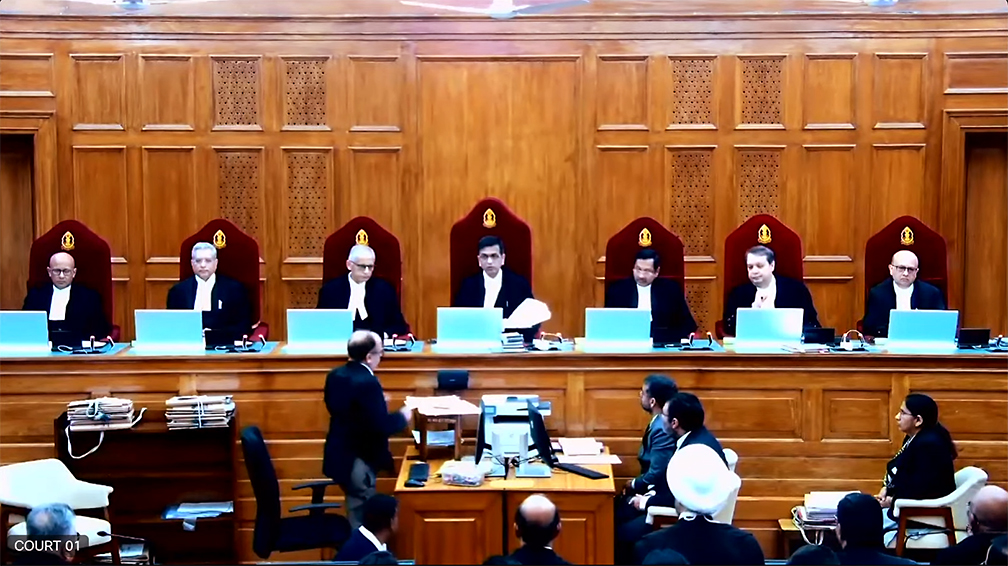
The Supreme Court’s seven-judge Constitution Bench overruled the 1998 PV Narasimha Rao judgment case, which granted immunity to members of Parliament and members of the legislative assembly from prosecution for taking bribes for voting in Parliament or state assemblies.
“Corruption and bribery by members of the legislatures erode probity in public life,” the bench led by Chief Justice DY Chandrachud said. The other judges on the bench included Justices AS Bopanna, MM Sundresh, PS Narasimha, JB Pardiwala, Sanjay Kumar, and Manoj Misra.
The bench strongly opined that “the offence of bribery is agnostic to the performance of the agreed action and crystallises on the exchange of illegal gratification.”
“It does not matter whether the vote is cast in the agreed direction or if the vote is cast at all. The offence of bribery is complete at the point in time when the legislator accepts the bribe,” the court viewed.
Overruling the judgement given in the PV Narasimha Rao case, the court said that the interpretation given in that judgement is contrary to the text and purpose of Articles 105 and 194.
The interpretation placed in the judgment of the majority in the PV Narasimha Rao case (supra) results in a paradoxical outcome where a legislator is conferred with immunity when they accept a bribe and follow through by voting in the agreed direction, the court said, adding further that on the other hand, a legislator who agrees to accept a bribe, but eventually decides to vote independently will be prosecuted. “Such an interpretation is contrary to the text and purpose of Articles 105 and 194,” the court ruled.
“In the course of this judgment, while analysing the reasoning of the majority and minority in PV Narasimha Rao (supra) we have independently adjudicated on all the aspects of the controversy, namely, whether, by virtue of Articles 105 and 194 of the Constitution, a Member of Parliament or the Legislative Assembly, as the case may be, can claim immunity from prosecution on a charge of bribery in a criminal court. We disagree with and overrule the judgment of the majority on this aspect,” the top court ordered.
“The judgment of the majority in PV Narasimha Rao (supra), which grants immunity from prosecution to a member of the legislature who has allegedly engaged in bribery for casting a vote or speaking has wide ramifications on public interest, probity in public life and parliamentary democracy. There is a grave danger of this Court allowing an error to be perpetuated if the decision is not reconsidered,” the court observed.
“Unlike the House of Commons in the UK, India does not have ‘ancient and undoubted’ privileges which were vested after a struggle between Parliament and the King. Privileges in pre-independence India were governed by statute in the face of a reluctant colonial government. The statutory privilege transitioned to a constitutional privilege after the commencement of the Constitution,” the court said.
“An individual member of the legislature cannot assert a claim of privilege to seek immunity under Articles 105 and 194 from prosecution on a charge of bribery in connection with a vote or speech in the legislature. Such a claim to immunity fails to fulfil the two-fold test that the claim is tethered to the collective functioning of the House and that it is necessary to the discharge of the essential duties of a legislator,” it added.
Articles 105 and 194 of the Constitution seek to sustain an environment in which debate and deliberation can take place within the legislature. This purpose is destroyed when a member is induced to vote or speak in a certain manner because of an act of bribery, the top court said.
The jurisdiction which is exercised by a competent court to prosecute a criminal offence and the authority of the House to take action for a breach of discipline in relation to the acceptance of a bribe by a member of the legislature exist in distinct spheres. The scope, purpose and consequences of the court exercising jurisdiction in relation to a criminal offence and the authority of the House to discipline its members are different, the top court said
“The potential of misuse against individual members of the legislature is neither enhanced nor diminished by recognizing the jurisdiction of the court to prosecute a member of the legislature who is alleged to have indulged in an act of bribery,” the court said. (ANI)
ALSO READ-‘Embryos Are babies’: Haley Sides With Alabama Court Ruling