April 27, 2025
4 mins read

Bangladesh plans to send troops to serve in Qatari forces 

Yunus discussed the deployment of Bangladeshi troops with Sheikh Saoud bin Abdulrahman Al-Thani, Qatar’s deputy prime minister and minister of state for defense affairs 

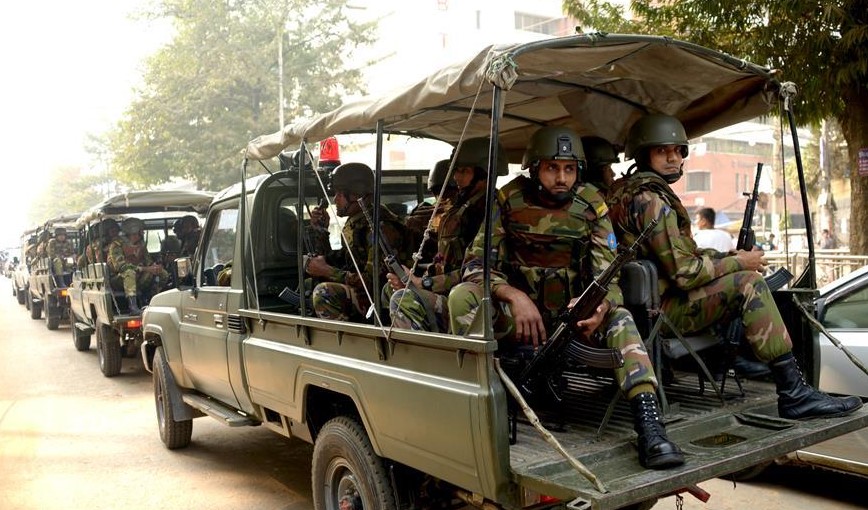
Bangladesh is planning to send hundreds of soldiers to work for the Qatar Armed Forces, a government spokesperson said, following this week’s talks between the Qatari leadership and the head of the Bangladeshi interim government. 

Bangladesh’s chief adviser, Prof. Mohammed Yunus, was in Doha from Monday to Friday to attend the Earthna Summit organized by the Qatar Foundation. On the sidelines of the summit, the Nobel-winning economist also held meetings with top Qatari officials. 

Yunus discussed the deployment of Bangladeshi troops with Sheikh Saoud bin Abdulrahman Al-Thani, Qatar’s deputy prime minister and minister of state for defense affairs. 

“An agreement was reached to send 725 members of the Bangladesh Armed Forces on deputation to work with the Qatar Armed Forces,” Azad Majumder, deputy press secretary to the chief adviser, told Arab News on Friday. 

“During the discussion, our National Security Adviser Dr. Khalilur Rahman was also present. So, all our topmost responsible authorities held this discussion with Qatari authorities.” 

As the head of Bangladesh’s interim government, Yunus also oversees its defense portfolio. His caretaker administration assumed office in August last year, when former prime minister Sheikh Hasina quit and fled the country amid violent protests. 

Talks between the Bangladeshi and Qatari armed forces will determine the structure of the team that will be dispatched from Bangladesh and identify areas where Qatar requires its expertise. 

“It could be in sectors such as medical, infantry, engineering, etc. The details are still being worked out,” Majumder said. 

“This is not a tough job for us, as Bangladesh already has this experience. For many years, Bangladesh has been sending soldiers to different UN missions. Bangladeshi armed forces members have also been serving in Kuwait for many years.” 

Bangladeshi soldiers are known for contributing to UN peacekeeping missions, with more than 6,300 personnel currently deployed to 10 such operations worldwide. 

Beyond these commitments, Bangladesh also engages non-UN international deployments, with its most prominent military presence being in Kuwait. 

About 6,000 members of the Bangladesh Military Contingent are currently enlisted with the Kuwait Armed Forces, according to data from the Bangladeshi embassy in the Gulf state. 

Kuwait has been recruiting soldiers from Bangladesh under a bilateral agreement with the Bangladeshi government since the end of the 1991 Gulf War. 

Initially, they were deployed to conduct extensive land mine clearance operations, but their responsibilities have expanded over the years to include engineering, construction, medical support and logistical assistance. 

Meanwhile,  the Bangladesh Hindu Buddhist Christian Unity Council, the largest minority group in the country, on Sunday issued a statement strongly condemning recent incidents of communal violence across the country. 

These include the murder of Bhavesh Chandra Roy in Biral, Dinajpur; the forced resignation of school headmaster Kantilal Acharya in Sitakunda, Chattogram; and the rape of a Marma girl in Kaukhali, Rangamati, the statement said. 

The statement also mentioned that in March, around fifty violent incidents took place across the country. 

“These include murder, rape, attacks on temples, arrests on charges of religious defamation, attacks on indigenous people, and looting of homes and businesses”, the statement said. 

The council leaders, Ushatan Talukder, Nim Chandra Bhowmik, Nirmal Rozario, and Acting General Secretary Monindra Kumar Nath, said these events are increasing fear and worry among minority communities during this period of unrest and communal tension. 

They demanded the immediate arrest of the criminals and strict punishment under the law. 

According to the reports, the postmortem of Hindu community leader Bhavesh Chandra Roy, who was allegedly abducted from his home and beaten to death earlier this week in Dinajpur district’s Biral upazila, has been completed, police confirmed on Saturday. 

According to earlier reports, Bhavesh had received a phone call around 4:30 pm on Wednesday. His wife, Shantana Roy, told the local media outlet The Daily Star that the call was allegedly made by the perpetrators to confirm his presence at home. About 30 minutes later, four men arrived on two motorcycles and forcibly took him from the premises. 

Eyewitnesses said Bhavesh was taken to Narabari village, where he was brutally assaulted. Later that evening, the attackers reportedly returned his unconscious body to the family in a van. 

Notably, the situation for minorities and Hindus in Bangladesh continues to deteriorate, after Bangladesh’s dramatic leadership change last August, when mass protests led by a wide-ranging coalition of student groups, civil society activists, and radical Islamists forced Prime Minister Sheikh Hasina to resign. 
Previous Story

Nepal marks 10-year anniversary of earthquake 

Next Story

Jackson Saves the Day for Chelsea 

Previous Story

Nepal marks 10-year anniversary of earthquake 

Next Story

Jackson Saves the Day for Chelsea 

Latest from -Top News

Pakistan Risks Overstretching Itself in Yemen War

Pakistan’s expanding military role in Saudi Arabia amid the Yemen conflict could strain its defence resources and fragile finances…reports Asian Lite News Desk Pakistan’s military involvement in the war in Yemen may prove unsustainable because of mounting financial pressures and competing security demands, according to a new report. Islamabad’s growing military presence in Saudi Arabia risks stretching its defence resources while exposing the country to greater strategic and economic challenges. An article by Andrew Wilson in One World Outlook describes Pakistan’s involvement as a case of “fiscal and strategic overreach”, arguing that the country lacks the financial flexibility to sustain an expanded military commitment. Pakistan’s external finances depend heavily on an International Monetary Fund (IMF) programme, financial support from Gulf countries and remittances from Pakistani workers in the region. The report argues that deeper military involvement in the conflict could place additional pressure on these sources of financial stability. It also warns that deploying troops and military equipment abroad could weaken Pakistan’s capacity to address security challenges along its eastern border and deal with two domestic insurgencies. The move could also draw Islamabad into a conflict it has sought to approach cautiously. A Reuters report in May, citing Pakistani security and government sources, said Islamabad had deployed around 8,000 troops, a squadron of approximately 16 aircraft, mostly JF-17 fighter jets, two drone squadrons and a Chinese HQ-9 air-defence battery to Saudi Arabia. According to those sources, Riyadh was financing the deployment, with Pakistani personnel operating the equipment. The sources also said a confidential agreement contemplated the possibility of deploying up to 80,000 troops. Islamabad has not confirmed those figures, although it has acknowledged its military presence in Saudi Arabia, including the deployment of fighter jets at King Abdulaziz Air Base from April. The One World Outlook article argues that Saudi financial support can cover allowances and operating expenses but cannot easily replace military equipment needed elsewhere or resolve the political and strategic challenges of participating in the Yemen conflict. Pakistan’s defence budget is another concern. For the 2026-27 financial year, the federal government allocated PKR 3 trillion, or approximately $10.8 billion, to defence services. The allocation represents an 18 per cent increase from the original PKR 2.55 trillion provision and amounts to around 2.1 per cent of projected gross domestic product (GDP). Defence spending accounts for approximately 16 per cent of the federal government’s PKR 18.8 trillion expenditure. Military pensions are budgeted separately at PKR 822 billion, while debt servicing costs stand at approximately PKR 8 trillion, more than two-and-a-half times the defence allocation. The report argues that these competing financial obligations leave little room for additional military expenditure without placing further pressure on public finances. Pakistan’s reliance on IMF assistance also limits its fiscal flexibility. The country must meet the conditions attached to the programme, including a primary budget surplus target of 2 per cent of GDP and continued restraint on development spending. According to the article, these requirements make it difficult for Islamabad to finance an additional military commitment without compromising other budgetary priorities. Pakistan’s economic indicators offer limited reassurance. Economic growth for the 2025-26 financial year is estimated at between 3.6 and 3.7 per cent, while inflation reached approximately 10.3 per cent in September following an energy price shock. Foreign exchange reserves stood at around $21.5 billion at the end of September. Although this marks an improvement from the low levels recorded in 2023, the report notes that the reserves cover only a few months of imports. Financial assistance from Gulf partners remains central to Pakistan’s external stability. The article says Islamabad holds approximately $8 billion in Saudi deposits at its central bank. In July, the State Bank of Pakistan said Riyadh had extended the maturity of $5 billion in deposits to December 2028, easing the country’s immediate external financing requirements. A further $3 billion deposit was also extended in the spring. However, the article argues that these arrangements provide temporary relief rather than long-term financial independence, particularly as regional conflict threatens the stability of the Gulf economies on which Pakistan relies. The report concludes that Pakistan faces a difficult balance between supporting Saudi Arabia militarily and preserving the financial and military resources needed to address its domestic and regional challenges.

UK and Germany Ratify Kensington Treaty

Britain and Germany ratify the Kensington Treaty, agreeing new cooperation on AI, quantum research, defence and security while targeting investment, jobs and Russian hybrid threats…reports Asian Lite News Desk Britain and Germany

Economic tide is turning in Bangladesh

If there is one thing that can bring some comfort to the struggling Bangladeshi economy, it is good relations with India. Bangladesh should remember that Delhi’s backing, through easy supplies of essentials
Go toTop

Don't Miss

Mizo group seek shelter homes for refugees from Bangladesh, Myanmar

A senior YMA leader said that during the organisation’s conference

Qatar commits $10 bn investment in India 

Alongside economic collaboration, the two nations have agreed to expand