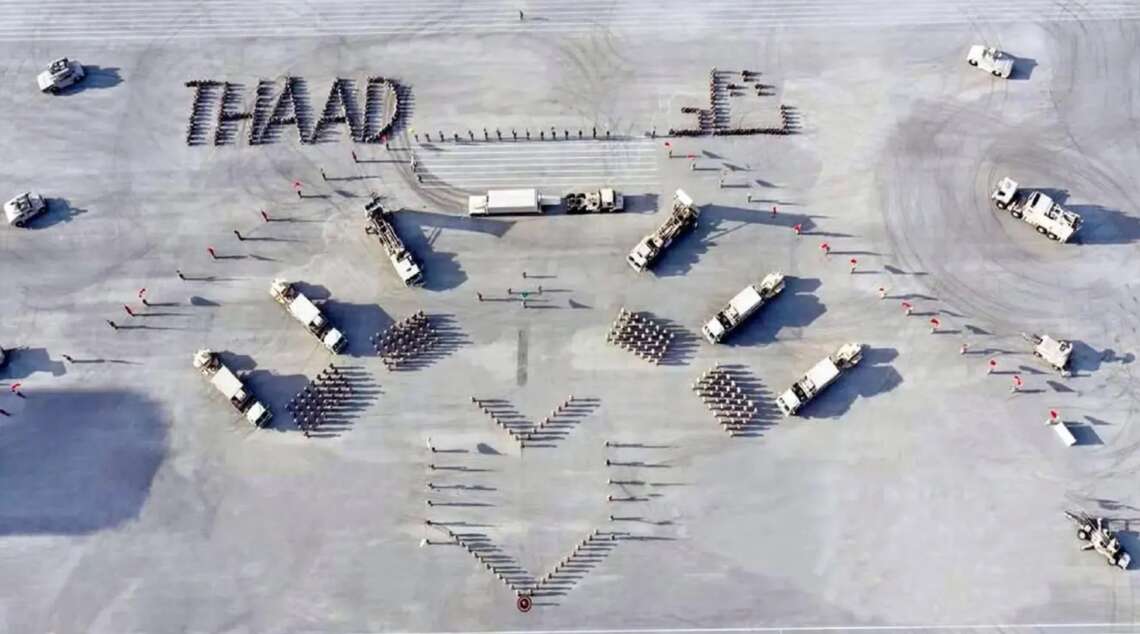
Riyadh boosts its long-range missile defence with U.S.-made THAAD system, amid growing regional missile threats.
Saudi Arabia has officially activated its first Terminal High Altitude Area Defence (THAAD) missile unit, marking a critical milestone in the Kingdom’s efforts to strengthen its multi-layered defence network amid growing regional missile threats. The unit was inaugurated during a ceremony at the Air Defence Forces Institute in Jeddah, the Ministry of Defence announced this week.
Lieutenant General Mazyad Al-Amro, Commander of the Royal Saudi Air Defence Forces, presided over the ceremony, formally handing over the unit’s flag to the commander of the 1st Air Defence Group. The move signals the THAAD battery’s full operational readiness following months of testing, evaluation, and personnel training both in Saudi Arabia and abroad.
The commissioning of the first THAAD battery is part of a $15 billion deal with the United States, signed in 2017 under a Foreign Military Sales programme. The agreement includes the delivery of seven fire units, 44 launchers, 360 interceptors, 16 fire control and communication units, and seven AN/TPY-2 radars. The deployment adds a new layer of long-range defence to Saudi Arabia’s existing Patriot missile systems, enhancing its ability to intercept ballistic threats outside the atmosphere.
The Ministry said the THAAD system underwent extensive operational training, with Saudi personnel completing specialised courses at Fort Bliss in Texas, the United States Army’s primary base for air defence training.
“This system offers a significant upgrade in capability, allowing Saudi Arabia to intercept medium- and long-range ballistic missiles before they descend into the atmosphere,” a senior defence official said. “It represents a major deterrent and enhances protection of our critical infrastructure, airspace, and national interests.”
THAAD, developed by Lockheed Martin, is capable of intercepting ballistic missiles at altitudes of up to 150 kilometres with a range of approximately 200 kilometres. The system uses hit-to-kill technology, which destroys incoming threats by direct impact rather than detonation, reducing collateral damage on the ground.
The move comes amid heightened tensions in the region, particularly with Iran and Iranian-backed Houthi groups in Yemen, who have repeatedly launched missiles and drones into Saudi territory. The advanced interception capability of THAAD is expected to significantly bolster Saudi Arabia’s response capacity against such threats.
Saudi Arabia is now the second country in the Gulf to field THAAD after the United Arab Emirates. Qatar is also expected to introduce the system in the coming years under a wider $42 billion defence agreement with the United States, which includes air defence platforms, drones, and fighter jets.
The Kingdom is also working to localise parts of the THAAD system’s production. In May 2025, Lockheed Martin announced a cooperation agreement with Saudi defence firms to manufacture critical components like missile transport pallets within the Kingdom. This initiative is part of Saudi Arabia’s Vision 2030 plan to diversify its economy and build a domestic defence industry capable of high-tech manufacturing and export.
“This commissioning is not just a defence milestone,” said a security analyst at the Gulf Research Centre. “It’s a diplomatic and industrial signal that Saudi Arabia is taking control of its future in terms of both national security and technological development.”
The deployment of the first battery is expected to be followed by six more over the next three years, with full system integration into Saudi Arabia’s existing missile defence architecture. Analysts believe the move is part of a broader regional strategy that aims to link Gulf states’ air defence capabilities into a cooperative shield, especially amid uncertainty over U.S. military commitments in the region.