Secret Stories: Roslin has no interest in keeping up with the competition, and that is precisely what makes it worth watching..writes Ashok Parameswar
Among the recent wave of Malayalam web series on JioHotstar, many of them leaning toward romantic comedy or fast-paced procedural drama, Secret Stories: Roslin arrives as something of a deliberate outlier. Directed by Sumesh Nandakumar and presented under the creative stewardship of Jeethu Joseph, the six-part series stakes its identity on mood, restraint, and a climactic revelation that retrospectively reconfigures almost everything the viewer has watched. Whether that trade-off feels worthwhile will largely depend on one’s appetite for slow-burn storytelling.
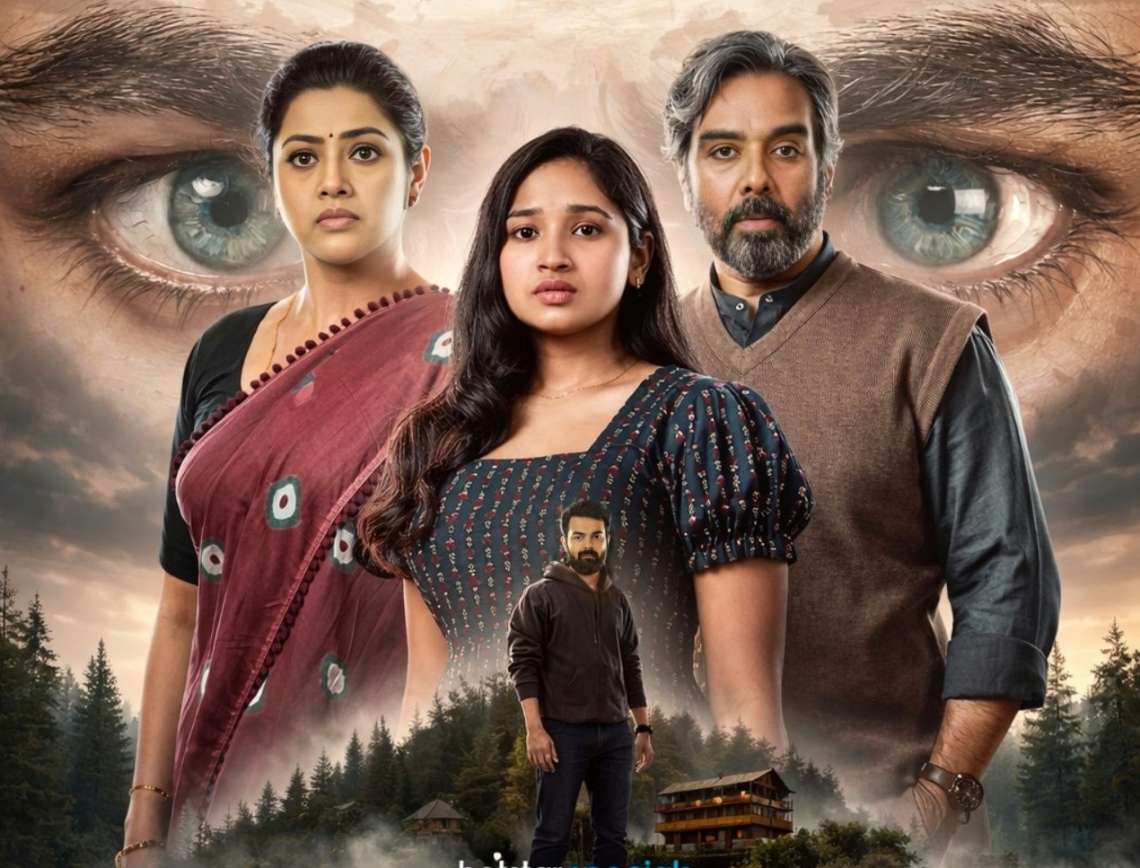
The narrative centres on Roslin, a seventeen-year-old girl spending her summer on an isolated family farm, a setting that signals psychological unease before a single scene of genuine menace has occurred. The rural domestic space, ostensibly peaceful, quietly accumulates a sense of dread. Beneath the surface of ordinary family routine, the story negotiates grief, unresolved trauma, and a subtle reconfiguration of emotional allegiances triggered by a newborn’s arrival in the household. Roslin’s behaviour is shaped, at least in part, by the death of her elder brother, a loss whose shadow falls across the series without ever being melodramatically foregrounded.

What distinguishes the series aesthetically is its commitment to interiority over event. Rather than engineering narrative momentum through plot mechanics, Nandakumar sustains tension through atmosphere: long, unhurried takes, careful sound design, and recurring dream sequences in which a green-eyed figure haunts Roslin’s sleeping and waking hours alike. These visions, unsettling precisely because their ontological status remains ambiguous, are among the most effective passages in the series. The blurring of nightmare and reality functions not merely as a stylistic flourish but as a structural device, holding open the interpretive uncertainty that the twist will eventually resolve.
This is, in many respects, the Jeethu Joseph mode of storytelling: the elaborate construction of a narrative whose full meaning is withheld until its final moments. The climactic reveal is genuinely bold, recontextualising earlier scenes with the kind of retroactive precision that rewards attentive viewing. Several seemingly incidental details, an exchanged glance, a withheld reaction, a moment of stillness that initially reads as unremarkable, acquire new weight once the conclusion is in place.

The performances carry considerable responsibility given how much of the series operates at an emotional rather than a plot-driven frequency. Meena brings a quiet authority to the mother’s role, grounding the family dynamics in something credibly felt rather than merely performed. Vineeth’s contribution is perhaps more understated still. A great deal of the series’ mood is communicated through the register of his presence, his eye contact, the way stillness functions as its own form of expression. Sanjana Dipu, carrying the series as Roslin, manages the difficult task of portraying vulnerability and confusion without tipping into affectation. Her performance holds the viewer’s investment during stretches where the narrative itself offers little forward momentum.
That said, the pacing will test certain viewers. The series is explicitly not designed for audiences who expect revelations at regular intervals or movement as a constant condition of engagement. Some stretches feel prolonged in ways that serve atmosphere more than story, and there are moments where the slow accumulation of dread begins to feel like deferral rather than construction. The series trusts its conclusion perhaps too heavily, leaning on the promise of the twist to justify stretches that might otherwise feel indulgent.

Compared with other recent JioHotstar originals such as Kerala Crime Files or 1000 Babies, Roslin occupies a notably different register, less rooted in realism, more interested in the interior architecture of fear and guilt. It belongs, broadly, to a tradition of literary psychological thriller that favours implication over exposition and invites the viewer to sit with discomfort rather than resolve it quickly. That is, in the current landscape of Malayalam streaming content, a genuinely uncommon ambition.
The series is directed by Sumesh Nandakumar. It also marks the screenwriting debut of popular Malayalam lyricist Vinayak Sasikumar. Music composed by Vishnu Shyam, Cinematography handled by PM Unnikrishnan, Editing by Riyas K Badhar and Sound Design by Fazal A Backer.
For the patient viewer, Secret Stories: Roslin offers a carefully engineered mystery whose pleasures are cumulative and whose payoff is real. It is not a thriller for every taste, but for those willing to meet it on its own terms, it represents one of the more considered and atmospherically sustained entries in recent Malayalam web fiction.