The European Union and India have agreed to deepen cooperation on trade, technology and strategic supply chains, signalling Brussels’ growing interest in India as a key economic partner. The move places India among a select group of countries with which the EU has established a formal Trade and Technology Council framework…reports Asian Lite News Desk
The European Union and India have agreed to significantly expand their partnership on trade, technology and strategic industries, underlining Brussels’ efforts to strengthen economic ties with New Delhi as it diversifies global supply chains and reduces strategic dependencies.
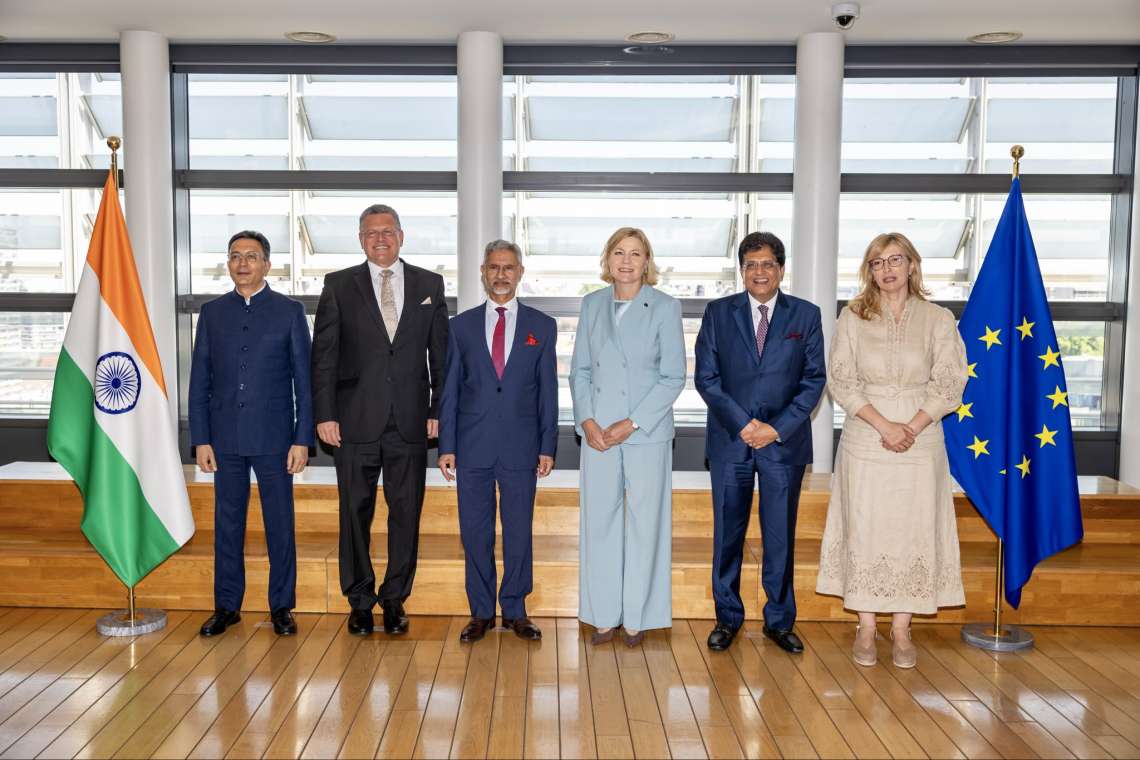
The decision was announced following the third meeting of the EU-India Trade and Technology Council (TTC) held in Brussels on 15 July, where both sides committed to enhancing cooperation across critical technologies, innovation and resilient supply chains.
The EU-India TTC, launched in 2022 by European Commission President Ursula von der Leyen and Prime Minister Narendra Modi, has become one of the European Union’s most important strategic partnerships outside the United States. India remains only the second country to establish such a framework with the EU.
The meeting brought together External Affairs Minister S. Jaishankar, Commerce and Industry Minister Piyush Goyal and Minister of State for Electronics and Information Technology Jitin Prasada, alongside European Commission Executive Vice-President Henna Virkkunen, Trade Commissioner Maros Sefcovic and Commissioner for Start-ups, Research and Innovation Ekaterina Zaharieva.
Both sides agreed to begin formal negotiations on India’s association with Horizon Europe, the EU’s flagship research and innovation programme, with discussions expected to conclude before the end of 2026. The partnership will also establish the first EU-India Innovation Hub focused on electric vehicle charging technologies and testing.
Other initiatives include launching an EU-India start-up partnership focused on deep technology and clean technologies, while expanding cooperation in semiconductors, artificial intelligence, high-performance computing, quantum technologies and sixth-generation telecommunications networks.
The two sides also pledged to strengthen strategic value chains in pharmaceuticals, agri-food products and clean energy technologies as part of broader efforts to build more resilient supply networks.
According to an analysis published by The European Conservative, the developments reflect Brussels’ growing recognition of India’s economic and geopolitical importance as the global economy evolves beyond traditional transatlantic partnerships and strategic dependence on China.
The report noted that India’s expanding industrial capabilities, large consumer market and independent foreign policy make it an increasingly attractive partner for the European Union’s long-term economic strategy.
The EU’s engagement with India comes at a time when Brussels is actively pursuing closer economic partnerships across Asia and seeking to diversify supply chains in critical sectors such as technology, energy and manufacturing.
The strengthening relationship also builds on wider progress in EU-India economic ties. Earlier this year, both sides concluded negotiations on a landmark Free Trade Agreement and are continuing discussions on investment protection arrangements expected to be finalised before the end of 2026.
Officials from both sides have indicated that the Trade and Technology Council will be further upgraded by the end of the year as part of the Joint EU-India Comprehensive Strategic Agenda adopted during the 16th India-EU Summit in January.
The latest agreements highlight India’s growing role in global technology and supply chain partnerships and reinforce the European Union’s strategic efforts to build stronger economic and technological links with one of the world’s fastest-growing major economies.