November 22, 2021
3 mins read

UAE commits to lead disruptive growth of key industrial sectors

The event will also run a six-day manufacturing and advanced technology exhibition to showcase some of the UAE’s most innovative capabilities…reports Asian Lite News

A high-level delegation of ministers and industry leaders from the United Arab Emirates are confirmed to participate at the fourth edition of the Global Manufacturing and Industrialisation Summit (#GMIS2021), which will be held from November 22-27 at the Dubai Exhibition Centre at EXPO 2020.

UAE commits to lead disruptive growth of key industrial sectors

This aims to reflect country’s commitment of building an advanced manufacturing sector underpinned by advanced technologies and Fourth Industrial Revolution solutions.

Co-chaired by the UAE Ministry of Industry Advanced Technology and the United Nations Industrial Development Organisation, #GMIS2021 will convene over 45 UAE policymakers and industry leaders, alongside over 250 international speakers, to engage in 70 sessions.

Under the theme, ‘Rewiring Societies: Repurposing Digitalisation for Prosperity’, discussions at the Summit will explore how data and connectivity are becoming the leading factors shaping the future of supply chains, green manufacturing, sustainable energy, climate action, policymaking, and resilient global economies.
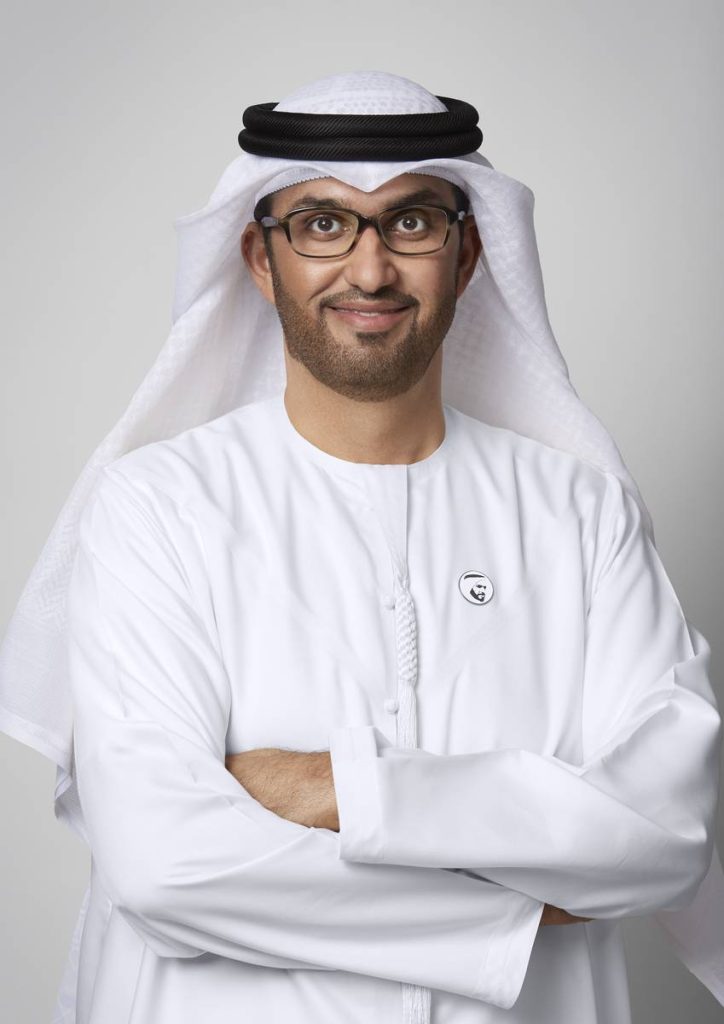
Dr. Sultan bin Ahmed Al Jaber

Dr. Sultan bin Ahmed Al Jaber, UAE Minister of Industry and Advanced Technology, and LI Yong, Director General of the United Nations Industrial Development Organization (UNIDO), in their capacity as co-chairs of the Global Manufacturing and Industrialisation Summit, will give keynote addresses at the opening ceremony on the first day of the Summit.

Khaldoon Al Mubarak, Managing Director and Group CEO of Mubadala, will conduct a one-on-one fireside chat titled ‘Investing in the leading edge of innovation’ moderated by John Defterios, former CNN anchor.

Shamma bint Suhail Faris Al Mazrui, UAE Minister of State for Youth will introduce and open the Global Prosperity Conference, while Zaki Anwar Nusseibeh, Cultural Advisor to the President of the UAE and Chancellor of the United Arab Emirates University (UAEU), will deliver a keynote titled ‘Springboard to Prosperity’, and Sarah bint Yousef Al Amiri, Minister of State for Advanced Technology and Chairwoman of the UAE Space Agency will offer insights on a panel related to Society 5.0.

On November 24, Sharif Al Olama, Undersecretary, Ministry of Energy and Infrastructure, will conduct a fireside chat at the Green Chain conference.

The UAE policymakers will be joined by leading industry leaders and experts who will share their insights and engage in keynote addresses and panel discussions during the Summit, including Mattar Mohammed Al Tayer, Director General and Chairman of the Board of Executive Directors of the UAE’s Roads and Transport Authority, and Eng. Awaidha Murshed Al Marar, Chairman of Abu Dhabi Department of Energy.

With special emphasis on the Summit’s host country, a dedicated session will explore how the UAE’s National Strategy for Industry and Advanced Technology, ‘Operation 300bn’, aims to transform the nation into a diversified, industrial economy over the next 30 years. The National Strategy stems from an integrated vision of the Ministry of Industry and Advanced Technology to develop the UAE industrial sector and establish the UAE as a global hub for future industries. Eng. Saeed Ghumran Al Remeithi, CEO of Emirates Steel; Abdaullah Al Shamsi, Assistant Undersecretary for Industry Growth Sector at the Ministry of Industry and Advanced Technology; Abdulnasser bin Kalban, CEO of Emirates Global Aluminium; Khaleefa Yousef Al Mheiri, Acting CEO of TA’ZIZ; Ahmed Mohamed Al Naqbi, CEO of Emirates Development Bank; and Saud Abu Al-Shawareb, Managing Director of Dubai Industrial City; will join the discussion on ways to safeguard public health, advance sustainable economic growth, deploy clean energy solutions, drive industrial innovation, and promote responsible consumption and production.

#GMIS2021 is being held during the six-day GMIS Week which will take place from November 22-27 at EXPO’s Dubai Exhibition Centre, featuring over 250 global speakers.

ALSO READ: UAE submits three proposals backing IMO’s strategic reforms

The GMIS Week will include a Global Prosperity Conference and the Green Chain Conference – an Alternative & Renewable Energy Conference – on November 24 and country-focused conferences in partnership with the United Kingdom, Australia, and Italy on November 24 & 25

 The event will also run a six-day manufacturing and advanced technology exhibition to showcase some of the UAE’s most innovative capabilities.

Previous Story

Taliban ban Afghan women anchors

Next Story

India Invites World to Join Its Energy Transition Journey

Previous Story

Taliban ban Afghan women anchors

Next Story

India Invites World to Join Its Energy Transition Journey

Latest from -Top News

Pakistan Risks Overstretching Itself in Yemen War

Pakistan’s expanding military role in Saudi Arabia amid the Yemen conflict could strain its defence resources and fragile finances…reports Asian Lite News Desk Pakistan’s military involvement in the war in Yemen may prove unsustainable because of mounting financial pressures and competing security demands, according to a new report. Islamabad’s growing military presence in Saudi Arabia risks stretching its defence resources while exposing the country to greater strategic and economic challenges. An article by Andrew Wilson in One World Outlook describes Pakistan’s involvement as a case of “fiscal and strategic overreach”, arguing that the country lacks the financial flexibility to sustain an expanded military commitment. Pakistan’s external finances depend heavily on an International Monetary Fund (IMF) programme, financial support from Gulf countries and remittances from Pakistani workers in the region. The report argues that deeper military involvement in the conflict could place additional pressure on these sources of financial stability. It also warns that deploying troops and military equipment abroad could weaken Pakistan’s capacity to address security challenges along its eastern border and deal with two domestic insurgencies. The move could also draw Islamabad into a conflict it has sought to approach cautiously. A Reuters report in May, citing Pakistani security and government sources, said Islamabad had deployed around 8,000 troops, a squadron of approximately 16 aircraft, mostly JF-17 fighter jets, two drone squadrons and a Chinese HQ-9 air-defence battery to Saudi Arabia. According to those sources, Riyadh was financing the deployment, with Pakistani personnel operating the equipment. The sources also said a confidential agreement contemplated the possibility of deploying up to 80,000 troops. Islamabad has not confirmed those figures, although it has acknowledged its military presence in Saudi Arabia, including the deployment of fighter jets at King Abdulaziz Air Base from April. The One World Outlook article argues that Saudi financial support can cover allowances and operating expenses but cannot easily replace military equipment needed elsewhere or resolve the political and strategic challenges of participating in the Yemen conflict. Pakistan’s defence budget is another concern. For the 2026-27 financial year, the federal government allocated PKR 3 trillion, or approximately $10.8 billion, to defence services. The allocation represents an 18 per cent increase from the original PKR 2.55 trillion provision and amounts to around 2.1 per cent of projected gross domestic product (GDP). Defence spending accounts for approximately 16 per cent of the federal government’s PKR 18.8 trillion expenditure. Military pensions are budgeted separately at PKR 822 billion, while debt servicing costs stand at approximately PKR 8 trillion, more than two-and-a-half times the defence allocation. The report argues that these competing financial obligations leave little room for additional military expenditure without placing further pressure on public finances. Pakistan’s reliance on IMF assistance also limits its fiscal flexibility. The country must meet the conditions attached to the programme, including a primary budget surplus target of 2 per cent of GDP and continued restraint on development spending. According to the article, these requirements make it difficult for Islamabad to finance an additional military commitment without compromising other budgetary priorities. Pakistan’s economic indicators offer limited reassurance. Economic growth for the 2025-26 financial year is estimated at between 3.6 and 3.7 per cent, while inflation reached approximately 10.3 per cent in September following an energy price shock. Foreign exchange reserves stood at around $21.5 billion at the end of September. Although this marks an improvement from the low levels recorded in 2023, the report notes that the reserves cover only a few months of imports. Financial assistance from Gulf partners remains central to Pakistan’s external stability. The article says Islamabad holds approximately $8 billion in Saudi deposits at its central bank. In July, the State Bank of Pakistan said Riyadh had extended the maturity of $5 billion in deposits to December 2028, easing the country’s immediate external financing requirements. A further $3 billion deposit was also extended in the spring. However, the article argues that these arrangements provide temporary relief rather than long-term financial independence, particularly as regional conflict threatens the stability of the Gulf economies on which Pakistan relies. The report concludes that Pakistan faces a difficult balance between supporting Saudi Arabia militarily and preserving the financial and military resources needed to address its domestic and regional challenges.
Go toTop

Don't Miss

India keen to boost space ties with UAE

The indigenously developed space sector of India and the fast-growing

UAE, Oman ink deal on environmental preservation

The meeting culminated in the signing of an MoU aimed