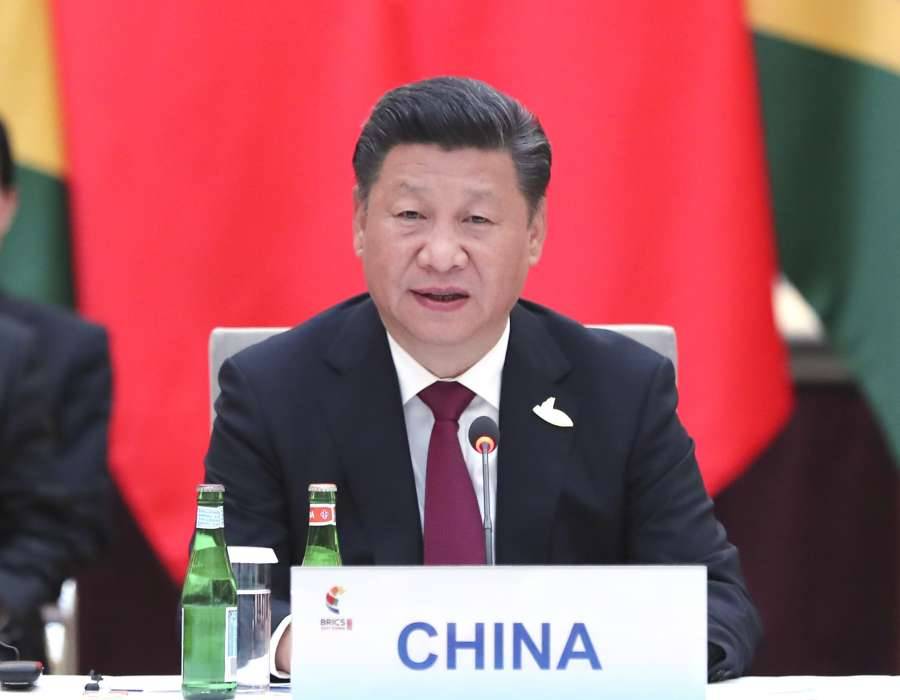
The South China Sea has also attracted strategic interest from the US amid Chinese assertiveness in the region….reports Asian Lite News
Chinese President Xi Jinping assured leaders of the 10-country Association of Southeast Asian Nations (ASEAN) of mutual co-operation on the sidelines of the China-ASEAN Summit held virtually.
The assurance comes as a part of the rising tension over the South China Sea where there is competition between Beijing and other countries of the Association of South-East Asian Nations.
The South China Sea has also attracted strategic interest from the US amid Chinese assertiveness in the region.
According to CNN, China’s assertion of sovereignty over the South China Sea has set it against ASEAN member nations such as Vietnam and the Philippines, while Brunei, Taiwan, and Malaysia also lay claim to parts of the South China Sea.
China-Philippines have heightened tension over China’s Spratly Islands in the South China Sea.
On the other hand, Beijing’s gesture comes at a time when several of the South East Asian countries have started to gravitate towards Washington and Tokyo for security co-operation.
In an effort to balance its relations in South East Asia, Chinese President Xi Jinping emphasized China’s commitment to the development of the ASEAN nations.
“China would never seek hegemony nor take advantage of its size to coerce smaller countries, and would work with ASEAN to eliminate interference,” he said.
“China was, is, and will always be a good neighbor, good friend, and good partner of ASEAN,” he added.
According to the CNN, Chinese President’s assurance comes at a backdrop when the Philippines have expressed concerns over the actions of three Chinese coast guard vessels that it said blocked and used water cannon on resupply boats headed towards a Philippine-occupied atoll in the sea.
Earlier, during the Summit Chinese President has set aside the claims that China wishes to extend its Sphere of Influence in the South East Asian countries as a part of the new Cold War with the United States.
“China and ASEAN had cast off the gloom of the Cold War — when the region was wracked by superpower competition and conflicts such as the Vietnam War — and had jointly maintained regional stability,” the Chinese President said.
It’s noted that China was firmly against the US position during the early stage of the Vietnam War until 1969 when it started to support Washington’s interest as a part of the US-Beijing relations from the late 1960s through to the end of the Cold War.
On the other hand, the China-ASEAN summit was held without a representative from Myanmar and some of the member states weren’t comfortable with Beijing’s request to include Myanmar’s top general Min Aung Hlain.
China frequently criticizes the United States for “Cold War thinking” when Washington engages its regional allies to push back against Beijing’s growing military and economic influence.
Earlier, US President Joe Biden joined ASEAN leaders for a virtual summit in October and pledged greater engagement with the region, and as a part of its commitment, the US pledged $40 million economic package. (ANI)