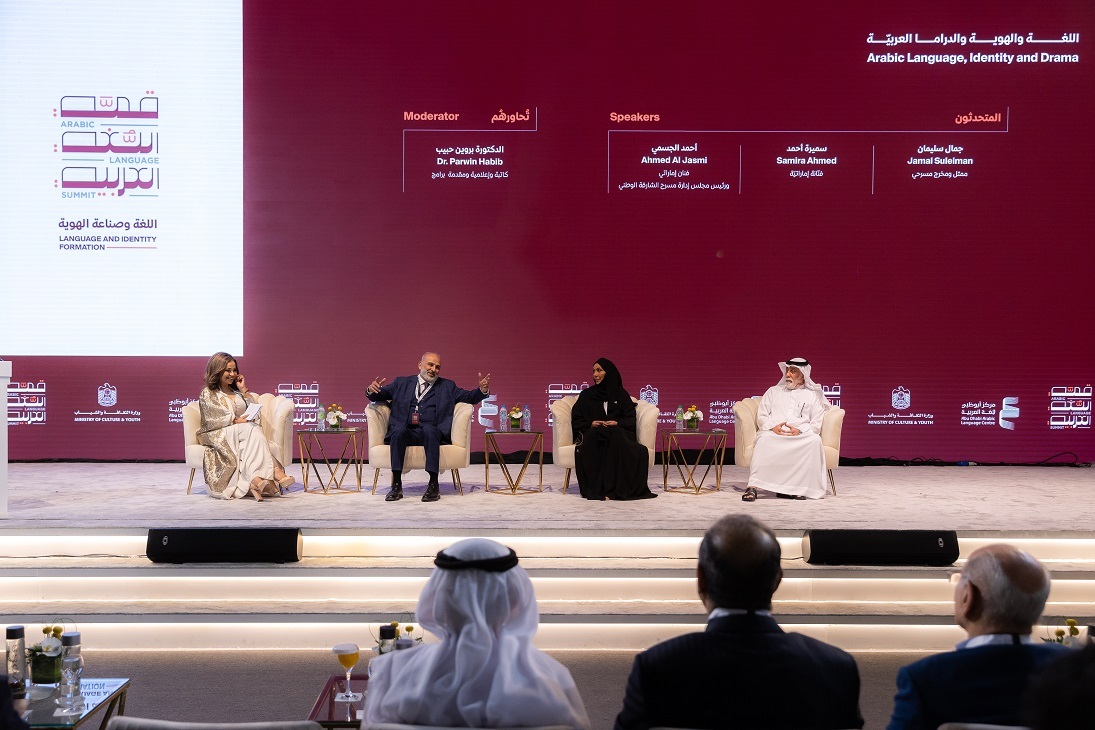
This came during a panel discussion titled “Arab Language, Identity and Drama” held as part of the first day of the Arabic Language Summit ….reports Asian Lite News
A group of top Arab actors stressed the importance of drama in bringing the Arabic language closer to new generations, pointing out the importance of concerted efforts of all institutions to develop a joint plan to produce major dramas in classical Arabic and sharing responsibility for promoting the language.
This came during a panel discussion titled “Arab Language, Identity and Drama” held as part of the first day of the Arabic Language Summit organised by the Ministry of Culture and Youth in cooperation with the Abu Dhabi Arabic Language Centre. The panel hosted Syrian actor Jamal Suleiman, Emiratis Samira Ahmed and Ahmed Al Jassmi, Chairman of the Board of Directors of the Sharjah National Theatre.
During his speech at the session, which was moderated by Bahraini journalist Dr. Parween Habib, Jamal Suleiman touched upon the need to abandon the old traditional methods of teaching the Arabic language. He called for adopting the latest methods that bring younger generations closer to their language and producing dramas that introduce them to their history and poets, referring to the musical play that narrated the history of Al-Mutanabbi in the Lebanese capital, Beirut. The play attracted a high turnout of school students.
On the contribution of different dialects for consolidating identity, such the classic Arabic, Suleiman said: “It is absurd to put the colloquial language and local dialects in the face of hostility and existential conflict with the classical Arabic language, because language and art must have a dialectical relationship and an interdependence between form and content. The expression of the subject must be in the appropriate linguistic form.”
Suleiman pointed out that colloquial dialects have a tremendous poetic and expressive power, such as those presented in Salah Jahin’s poems, which were written colloquially. He explained that the idea is to enjoy the language in its context and the extent of its impact. Suleiman called on the concerned institutions to make drama a mandatory subject within the school curricula for its educational impact, and its role in enhancing the self-confidence of new generations, and inculcating a spirit of teamwork within them.
For her part, Emirati artist Samira Ahmed spoke about her experience in working in classical Arabic. She stressed the importance of instilling the Arabic language in the hearts of new generations from a young age. She objected that many families in Arab societies today seek to teach their children foreign languages and do not emphasise on Arabic as much.
With regards to the production of a film or series in simple language that helps in bringing the Arabic language closer to children, she said, “There are producers who do not accept the existence of these works, which is a challenge to overcome.”
Artist Samira Ahmed called for paying more attention to school theatre and presenting works in classical Arabic and not judging the generation for not liking the Arabic language, she said: “There are those who love the language and seek to learn it and appreciate its aesthetics. They should have the means to do so,” noting that it is the child’s right to know their identity, and it is necessary to be clear in our work because the responsibility does not fall only on the shoulders of media institutions.”
For his part, Chairman of the Board of Directors of the Sharjah National Theatre, Emirati artist Ahmed Al Jassmi, called for collaborative drama projects that address the Arab world and its problems. He stressed that it was important to select the details accurately and contribute to its promotion.
Al Jassmi said, “There are many who say that the audience needs comedy and entertainment, and we do not deny the importance of this type of art. Having said that it is not true that classic Arabic is difficult, as it is a means to present important works across broader horizons.”
Al Jassmi pointed out that digital platforms have a great impact on new generations, so institutions, individuals and families must take measures that enhance the link between new generations in their mother tongue. He called for a plan for drama production, even if it is one production every year without the pressure of commercialising the production, but rather seeking to raise more contemporary social issues. He recommended the establishment of specialised committees from the Ministry of Culture and Ministry of Education to ensure proper implementation.