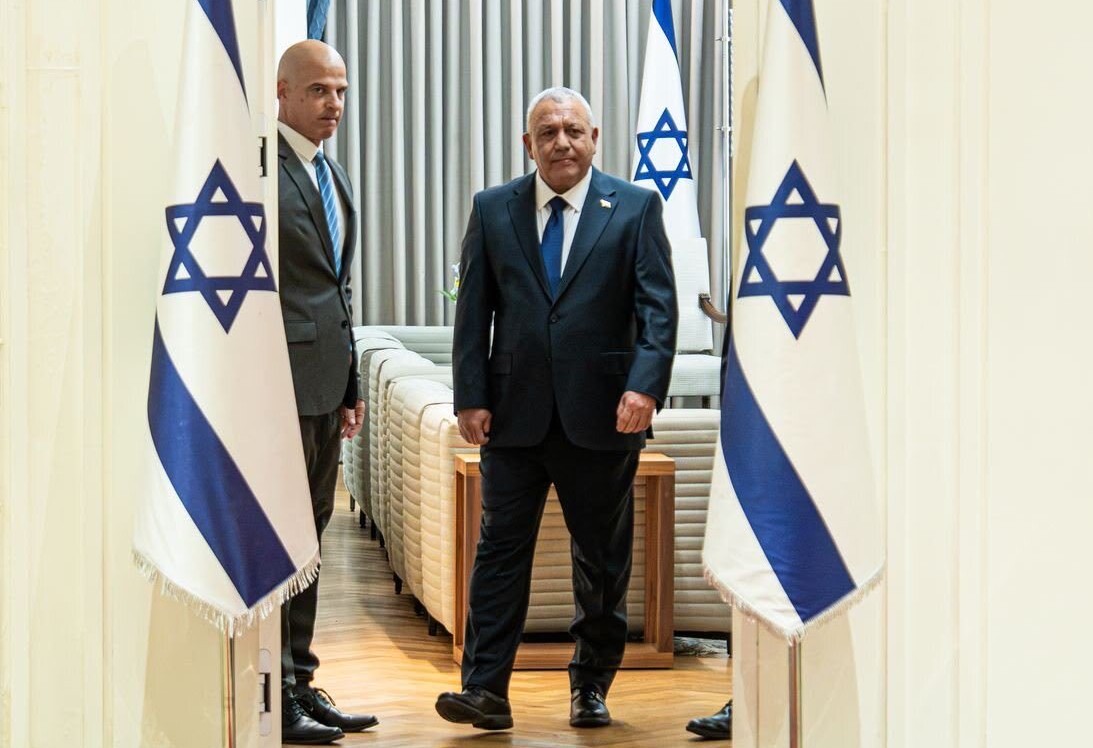
Israeli prime ministerial hopeful Gadi Eisenkot has defended the country’s Arab minority against what he described as attempts to collectively vilify its political representatives, as their growing parliamentary influence becomes central to negotiations over the formation of a new government.
Eisenkot’s intervention follows a series of attacks by caretaker Prime Minister Benjamin Netanyahu and other right-wing politicians against Arab-majority parties, whose combined 19 seats in the 120-member Knesset could prove decisive in determining the country’s next government.
Writing on X, Eisenkot said Arab citizens were an integral part of Israel and warned that attempts to marginalise their representatives undermined the country’s founding principles.
“Arab citizens of Israel are an integral part of the Israeli story,” he said.
“The attempt to marginalise them and vilify them collectively is a profound violation of the principles of civic responsibility. It dishonours Israel’s Declaration of Independence and the values we take pride in as a Jewish and democratic state.”
He acknowledged that political disagreements with Arab party representatives were legitimate but drew a distinction between criticising their positions and attacking an entire community.
“It is entirely legitimate to disagree with representatives of the Arab parties, even to strongly disapprove of some of them. But it is neither legitimate nor acceptable to malign an entire community, and I will not allow it,” he said.
The remarks come at a critical stage in government formation, with the two Arab-majority political groupings, Raam and the Joint List, holding nearly one-sixth of the seats in parliament after last month’s election.
Both groups recommended Eisenkot for the premiership during consultations with President Isaac Herzog, who tasked him with forming a government on Sunday.
Arab lawmakers face fresh attacks
The dispute has intensified following repeated criticism from Netanyahu and his allies over the Arab parties’ position on Hamas.
The right-wing politicians have accused Arab party leaders of refusing to describe Hamas as a terrorist organisation following its October 7, 2023 attack on Israel.
However, leaders of the Arab parties have condemned the attack, in which Arab citizens of Israel were also among those killed.
Arab citizens, many of whom are descendants of Palestinians who remained within Israel after its establishment in 1948, account for more than 20 per cent of the country’s population.
Netanyahu has also repeatedly alleged electoral irregularities involving Arab-majority parties, claims that have been rejected by electoral authorities.
Addressing the inauguration of the new Knesset this week, Netanyahu accused the two Arab political groupings of refusing to recognise Israel as a Jewish state. He also claimed they sought to establish either an Islamic state or a Palestinian nationalist state.
His remarks drew further controversy during the parliamentary ceremony when National Security Minister Itamar Ben Gvir heckled Joint List leader Youssef Jabareen during his oath of allegiance, accusing him of having pledged allegiance to Hamas.
Coalition arithmetic complicates government formation
The political confrontation comes as Eisenkot attempts to assemble a governing coalition following Herzog’s decision to give him the mandate to form a government.
The combined 19 seats held by Raam and the Joint List give the Arab political groupings considerable leverage in the negotiations, potentially making their support essential to securing a parliamentary majority.
However, their possible involvement has exposed divisions among Eisenkot’s prospective allies.
Avigdor Liberman, one of the right-wing politicians aligned with the coalition effort, has warned that he would withdraw his support if Arab parties were included in the government.
The position presents Eisenkot with a difficult political calculation: securing sufficient parliamentary backing while keeping potential coalition partners on board.
Under the government formation process, Eisenkot has 28 days to assemble a coalition. He can request a further 14 days if he needs additional time.
If he fails to secure a government within the permitted period, the mandate can be transferred to another lawmaker, with Netanyahu among the likely candidates.
The outcome will determine not only who leads Israel’s next government but also whether Arab political representatives can translate their electoral strength into a meaningful role in national decision-making.