Dr. Al Jaber called on developed nations to live up to their historic responsibilities and come through with the $100 billion dollars in climate finance they pledged over a decade ago…reports Asian Lite News
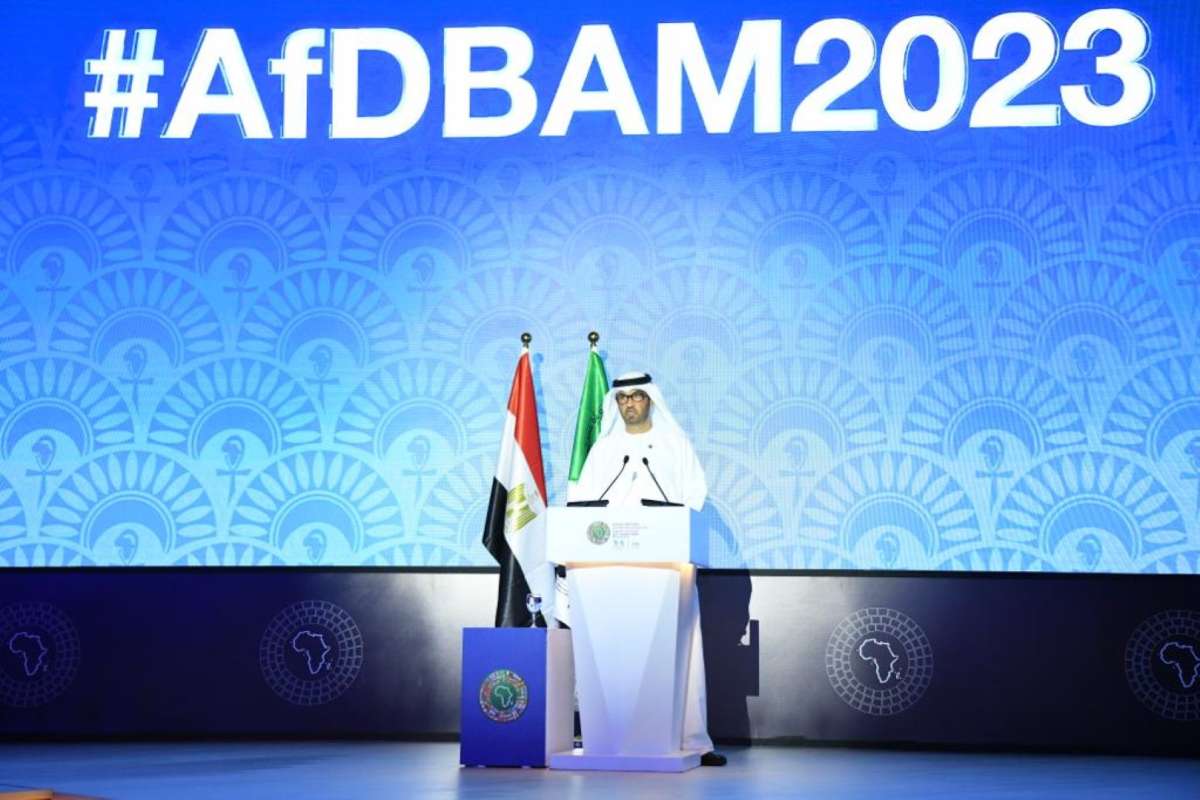
Dr. Sultan bin Ahmed Al Jaber, Minister of Industry and Advanced Technology and the COP28 President-Designate, called for a major boost to public and private finance to allow the African continent to battle climate change.
In an address today to the African Development Bank Annual Meeting, he said, “Africa has huge potential for low-carbon growth and sustainable development. But one critical challenge stands in its way – and that is the lack of available, accessible, affordable finance. And this lack of finance is putting the world’s climate goals and Africa’s sustainable development at risk.”
Dr. Al Jaber pointed out that “When it comes to renewable energy, only two per cent of the three trillion dollars invested worldwide over the last twenty years have made their way to Africa. If we can shift the balance on climate finance to Africa, I believe this continent can become a defining force in low carbon sustainable growth.”
As a first step in closing this finance gap, Dr. Al Jaber called on developed nations to live up to their historic responsibilities and come through with the $100 billion dollars in climate finance they pledged over a decade ago.
“Failure to do so has undermined trust in the multilateral process, which must be restored,” Dr. Al Jaber said. “There are encouraging signals coming from donor countries on this front, which I hope will soon be followed by concrete action.”
Africa’s 54 countries have done the least to cause climate change, Dr. Al Jaber noted, contributing less than four per cent of global emissions. Yet they are suffering some of the worst consequences: Over 700 million hectares of agricultural land across this continent are currently degraded – an area twice the size of India. And Africa is losing four million more every year. At the same time, droughts and famine are impacting lives and livelihoods, forcing migration and undermining the biodiversity that African people depend on for their livelihood. At the same time, over 600 million people lack access to electricity and almost one billion lack access to clean cooking fuel.
But to make the transformational progress that is required, Dr. Al Jaber added that the flow of private capital needs to be mobilised. To accomplish this, fundamental reform of IFIs and MDBs are required to unlock much more concessional finance, lowering risk, and attracting private capital.
“COP28 is exploring additional mechanisms to supercharge the flow of private finance to Africa,” he said. “And, by adopting policies and regulations that create a favorable investment climate for the private sector, African governments can build a robust pipeline of sustainable investment.
“If we fail to deliver effective climate finance for Africa,” he warned, “many countries will have no choice but to follow a high carbon development pathway. And that is in no one’s interest.”
While mitigating climate change is important, Dr. Al Jaber noted, the gap in adaptation funding is also large. “Donor countries need to double their commitment to adaptation finance by 2025,” he said.
Dr. Al Jaber concluded by saying “There is great potential for Africa to set an example for low-carbon, high-growth sustainable development. Instead of becoming a dumping ground for old technologies, Africa can emerge as a hub for renewable energies, and a driver for clean growth for the world. Finance is the key to turn good intentions into real results.
“We need every country and every stakeholder united in solidarity on this issue, alongside every other pillar of the climate agenda. Addressing climate change is more than a set of numbers. It is more than meeting goals. It’s about people, who deserve a better future for their families.
“Delivering effective climate finance to Africa will help Africa to develop. It will help put the world back on track to achieve the goals of the Paris Agreement. And it will enable an energy transition that leaves no-one behind.”