February 20, 2023
3 mins read

Can Nikki Haley be the Kamala Harris of Republican Party?

On paper, Nikki is a formidable candidate to contend with, given her experience and campaigner for an anti-abortion conservative woman of colour. ..Writes TN ASHOK

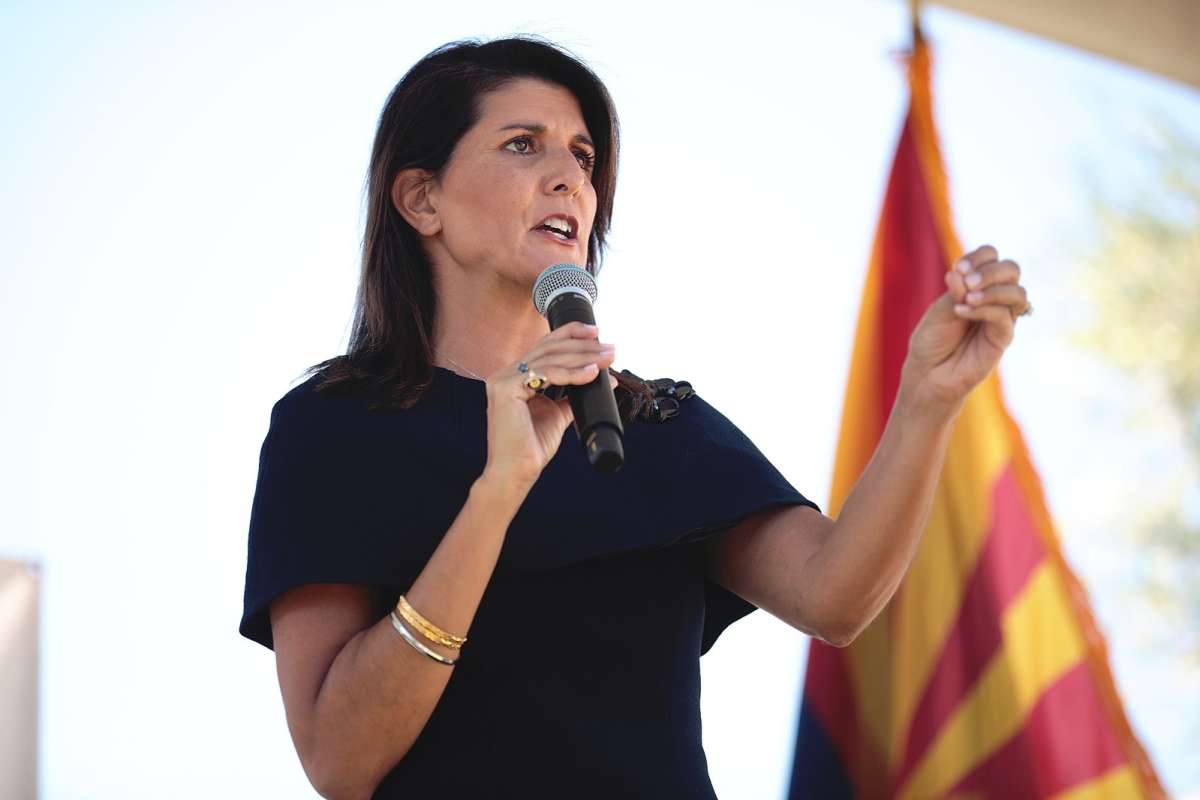
Republican Nikki Haley, a former ambassador of the US government to the UN, is trying to create history once again to become another Ms Kamala Harris – that is what she is to the democratic party Nikki wants to be for the GOP.

Despite a rabid call by a ultra right wing republican asking her to go back home to India, Nikki Haley has thrown the gauntlet for the republican nomination, like Kamala Harris, for the top post, in the 2024 presidential run to the White House, media reports say.

Media has taken the news in different perspectives. One is absolutely skeptical. She has no chance, whatever, so what is she really running for? Vice president? Yet another different take is however hopeful of her chances — Don’t write off Nikki Haley just yet.

On paper, Nikki is a formidable candidate to contend with, given her experience and campaigner for an anti-abortion conservative woman of colour. She brings with her executive experience as the two-term governor of an early primary state, who held a Cabinet-level foreign policy position in the last republican administration.

Though she is relatively young, she is seasoned enough to be plausible, telegenic and eloquent without the rough edges that doomed many a GOP candidate in the November midterm elections, says the Washington Examiner in a special dispatch analysing Haley’s chances at the hustings.

Nikki Haley obviously lacks a clear path to the nomination as the race appears likely to unfold with strong arm candidates such as Florida Hero Governor Ron De Santis waiting in the shadows, though his popularity is shrinking within the GOP, Trump making a strong comeback bid with a huge personal campaign corpus at his disposal and former VP Mike Pence also likely to prove a spoilsport for all. A Quinnipiac poll found that she was the third choice of Republicans nationally – but at 5 per cent, with former President Donald Trump taking 42 per cent and Gov. Ron De Santis (R-FL) receiving 36 per cent, the examiner said.
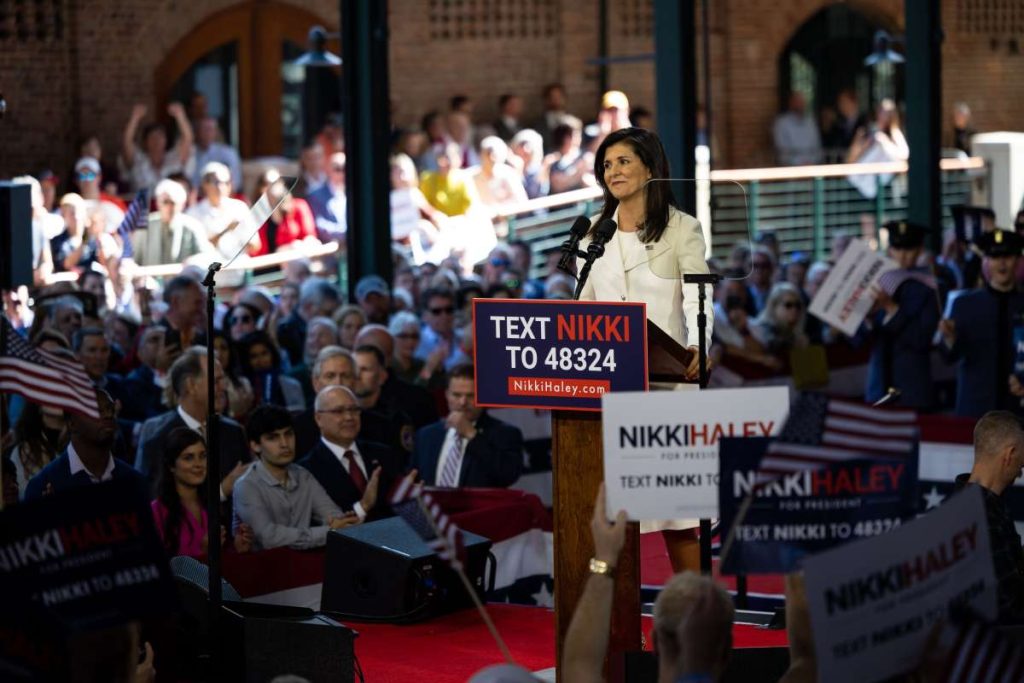
One thing is clear whether Trump triumphs over Santis or loses, it’s quite likely either of them could choose Nikki Haley as the running mate, because she is of colour, of Indian origin, and very experienced executive fit enough to be the Vice President like Kamala Harris and could deliver the ethnic votes from blacks to Latinos in GOP’s favour, analysts feel.

Haley is currently running 31 points behind the second-placed candidate, whose level of support is almost equal to the number of points she lags behind the front-runner.

Quinnipiac poll shows Haley leads former Vice President Mike Pence. She trails them in a number of others. The RealClearPolitics polling average has Trump at 46 per cent, DeSantis at 31.2 per cent, Pence at 6.4 per cent, and then Haley at 4 per cent.

Iowa could be the pointer for Haley even though this 42-point deficit is surmountable with a strong performance. A January Trafalgar poll showed Haley had a lot of ground to make up in her home state of South Carolina. She was in fourth place with 12 per cent of the vote, behind Trump at 43 per cent, DeSantis at 28 per cent, and fellow native son Sen. Tim Scott (R-SC) at 14 per cent.

Pollsters predict that having a second South Carolinian in the race could be an obstacle in itself. As former Gov. Jeb Bush (R-FL) and Sen. Marco Rubio (R-FL) can tell from their 2016 experiences, sharing donors and consultants, as Haley and Scott would, can be a challenging proposition. Divided attention is what you get with voters.

While it’s too soon to assess Haley’s chances, there is also not a sure shot indication of the outcome, as they were 10 years ago. But Haley’s basic problem is she has to overtake two formidable candidates ahead of her with a wide margin, not an easy task. And she has to contend with early reports that say it’s a two-Florida-man race even before the second of them has said he is running, the Examiner said.

ALSO READ: Nikki Haley is a formidable challenger to Democrats

Previous Story

Mitchell visits Turkey-Syria earthquake response

Next Story

Kevin McCarthy expresses commitment to deepen India-US ties

Previous Story

Mitchell visits Turkey-Syria earthquake response

Next Story

Kevin McCarthy expresses commitment to deepen India-US ties

Latest from -Top News

Pakistan Risks Overstretching Itself in Yemen War

Pakistan’s expanding military role in Saudi Arabia amid the Yemen conflict could strain its defence resources and fragile finances…reports Asian Lite News Desk Pakistan’s military involvement in the war in Yemen may prove unsustainable because of mounting financial pressures and competing security demands, according to a new report. Islamabad’s growing military presence in Saudi Arabia risks stretching its defence resources while exposing the country to greater strategic and economic challenges. An article by Andrew Wilson in One World Outlook describes Pakistan’s involvement as a case of “fiscal and strategic overreach”, arguing that the country lacks the financial flexibility to sustain an expanded military commitment. Pakistan’s external finances depend heavily on an International Monetary Fund (IMF) programme, financial support from Gulf countries and remittances from Pakistani workers in the region. The report argues that deeper military involvement in the conflict could place additional pressure on these sources of financial stability. It also warns that deploying troops and military equipment abroad could weaken Pakistan’s capacity to address security challenges along its eastern border and deal with two domestic insurgencies. The move could also draw Islamabad into a conflict it has sought to approach cautiously. A Reuters report in May, citing Pakistani security and government sources, said Islamabad had deployed around 8,000 troops, a squadron of approximately 16 aircraft, mostly JF-17 fighter jets, two drone squadrons and a Chinese HQ-9 air-defence battery to Saudi Arabia. According to those sources, Riyadh was financing the deployment, with Pakistani personnel operating the equipment. The sources also said a confidential agreement contemplated the possibility of deploying up to 80,000 troops. Islamabad has not confirmed those figures, although it has acknowledged its military presence in Saudi Arabia, including the deployment of fighter jets at King Abdulaziz Air Base from April. The One World Outlook article argues that Saudi financial support can cover allowances and operating expenses but cannot easily replace military equipment needed elsewhere or resolve the political and strategic challenges of participating in the Yemen conflict. Pakistan’s defence budget is another concern. For the 2026-27 financial year, the federal government allocated PKR 3 trillion, or approximately $10.8 billion, to defence services. The allocation represents an 18 per cent increase from the original PKR 2.55 trillion provision and amounts to around 2.1 per cent of projected gross domestic product (GDP). Defence spending accounts for approximately 16 per cent of the federal government’s PKR 18.8 trillion expenditure. Military pensions are budgeted separately at PKR 822 billion, while debt servicing costs stand at approximately PKR 8 trillion, more than two-and-a-half times the defence allocation. The report argues that these competing financial obligations leave little room for additional military expenditure without placing further pressure on public finances. Pakistan’s reliance on IMF assistance also limits its fiscal flexibility. The country must meet the conditions attached to the programme, including a primary budget surplus target of 2 per cent of GDP and continued restraint on development spending. According to the article, these requirements make it difficult for Islamabad to finance an additional military commitment without compromising other budgetary priorities. Pakistan’s economic indicators offer limited reassurance. Economic growth for the 2025-26 financial year is estimated at between 3.6 and 3.7 per cent, while inflation reached approximately 10.3 per cent in September following an energy price shock. Foreign exchange reserves stood at around $21.5 billion at the end of September. Although this marks an improvement from the low levels recorded in 2023, the report notes that the reserves cover only a few months of imports. Financial assistance from Gulf partners remains central to Pakistan’s external stability. The article says Islamabad holds approximately $8 billion in Saudi deposits at its central bank. In July, the State Bank of Pakistan said Riyadh had extended the maturity of $5 billion in deposits to December 2028, easing the country’s immediate external financing requirements. A further $3 billion deposit was also extended in the spring. However, the article argues that these arrangements provide temporary relief rather than long-term financial independence, particularly as regional conflict threatens the stability of the Gulf economies on which Pakistan relies. The report concludes that Pakistan faces a difficult balance between supporting Saudi Arabia militarily and preserving the financial and military resources needed to address its domestic and regional challenges.

UK and Germany Ratify Kensington Treaty

Britain and Germany ratify the Kensington Treaty, agreeing new cooperation on AI, quantum research, defence and security while targeting investment, jobs and Russian hybrid threats…reports Asian Lite News Desk Britain and Germany

Economic tide is turning in Bangladesh

If there is one thing that can bring some comfort to the struggling Bangladeshi economy, it is good relations with India. Bangladesh should remember that Delhi’s backing, through easy supplies of essentials
Go toTop

Don't Miss

US capital lifts Indoor mask mandate

Citizens can now decide for their own whether to wear

Apple to Pay $25 Million in Settlement with US DOJ

This is the largest award recovered under the anti-discrimination provision