February 16, 2023
4 mins read

Deals worth Rs 80,000 cr signed at Aero India

As many as 266 partnerships, 201 MoUs, 53 major announcements and nine product launches were firmed up at Aero India…reports Asian Lite News

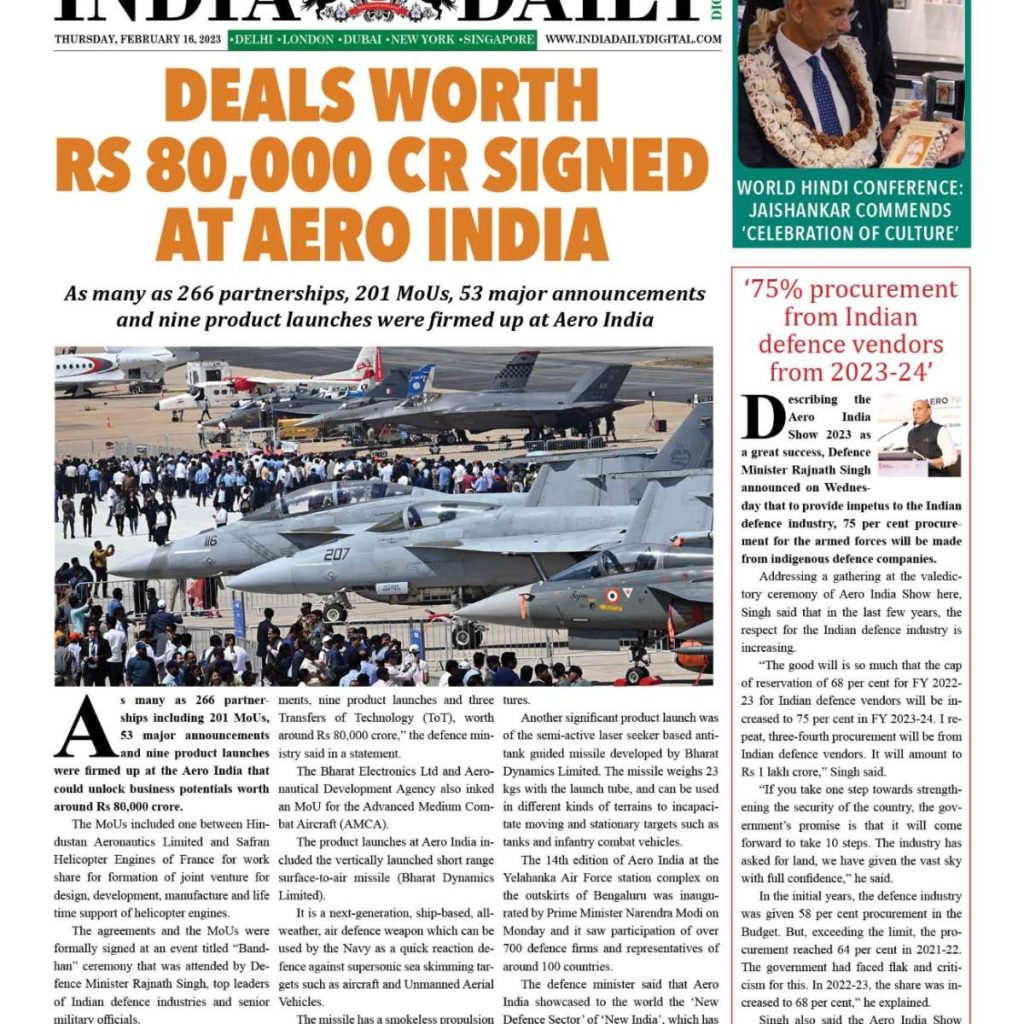
As many as 266 partnerships including 201 MoUs, 53 major announcements and nine product launches were firmed up at the Aero India that could unlock business potentials worth around Rs 80,000 crore.

The MoUs included one between Hindustan Aeronautics Limited and Safran Helicopter Engines of France for work share for formation of joint venture for design, development, manufacture and life time support of helicopter engines.

The agreements and the MoUs were formally signed at an event titled “Bandhan” ceremony that was attended by Defence Minister Rajnath Singh, top leaders of Indian defence industries and senior military officials.

“The Bandhan ceremony also witnessed the forging of 266 partnerships including 201 MoUs, 53 major announcements, nine product launches and three Transfers of Technology (ToT), worth around Rs 80,000 crore,” the defence ministry said in a statement.

The Bharat Electronics Ltd and Aeronautical Development Agency also inked an MoU for the Advanced Medium Combat Aircraft (AMCA).

The product launches at Aero India included the vertically launched short range surface-to-air missile (Bharat Dynamics Limited).

It is a next-generation, ship-based, all-weather, air defence weapon which can be used by the Navy as a quick reaction defence against supersonic sea skimming targets such as aircraft and Unmanned Aerial Vehicles.

The missile has a smokeless propulsion system with all-weather capability. It has a highly agile configuration with state-of-the-art electronic counter-measures features.
Another significant product launch was of the semi-active laser seeker based anti-tank guided missile developed by Bharat Dynamics Limited. The missile weighs 23 kgs with the launch tube, and can be used in different kinds of terrains to incapacitate moving and stationary targets such as tanks and infantry combat vehicles.

The 14th edition of Aero India at the Yelahanka Air Force station complex on the outskirts of Bengaluru was inaugurated by Prime Minister Narendra Modi on Monday and it saw participation of over 700 defence firms and representatives of around 100 countries.

The defence minister said that Aero India showcased to the world the ‘New Defence Sector’ of ‘New India’, which has not only grown in the last few years, but is now fully ready to walk alongside the defence sectors of leading countries.

He expressed satisfaction that the event paved the way to strengthen the Indian defence industry, terming it as the beginning of a new era of ‘aatmanirbharta’.

The minister exuded confidence that the sector will move forward strongly on the path of progress with new energy and determination.

The MoUs and technology transfer agreements signed during Aero India will facilitate a new beginning for defence manufacturing in India, Singh said.

‘75% procurement from Indian defence vendors from 2023-24’

Describing the Aero India Show 2023 as a great success, Defence Minister Rajnath Singh announced on Wednesday that to provide impetus to the Indian defence industry, 75 per cent procurement for the armed forces will be made from indigenous defence companies.

Addressing a gathering at the valedictory ceremony of Aero India Show here, Singh said that in the last few years, the respect for the Indian defence industry is increasing.

“The good will is so much that the cap of reservation of 68 per cent for FY 2022-23 for Indian defence vendors will be increased to 75 per cent in FY 2023-24. I repeat, three-fourth procurement will be from Indian defence vendors. It will amount to Rs 1 lakh crore,” Singh said.

“If you take one step towards strengthening the security of the country, the government’s promise is that it will come forward to take 10 steps. The industry has asked for land, we have given the vast sky with full confidence,” he said.

In the initial years, the defence industry was given 58 per cent procurement in the Budget. But, exceeding the limit, the procurement reached 64 per cent in 2021-22. The government had faced flak and criticism for this. In 2022-23, the share was increased to 68 per cent,” he explained.
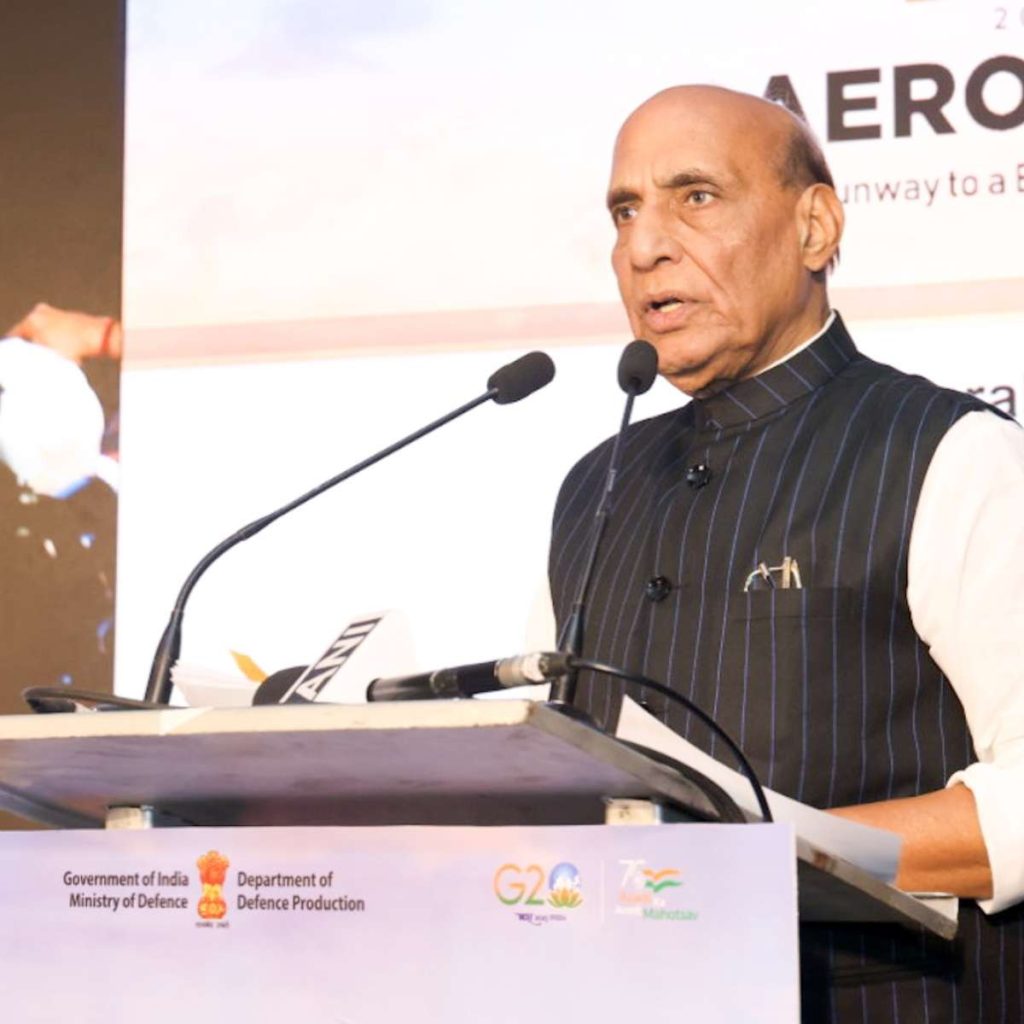
Singh also said the Aero India Show will go a long way in strengthening the Indian defence industry.

“This is a new beginning. It has showcased that the Indian defence industry is ready to collaborate with other countries of the world. As many as 1,500 MoUs have been signed in the show, DRDO technology transfer agreements have been made, important decisions have been taken regarding manufacturing in private and public sector industries. The show has given a push to the defence industry at the global level,” the minister said.

ALSO READ-US heavy bombers at Aero India mark strategic ties with India

Previous Story

US eases rules to help aged-out Indian children

Next Story

World Hindi Conference: Jaishankar commends ‘celebration of culture’

Previous Story

US eases rules to help aged-out Indian children

Next Story

World Hindi Conference: Jaishankar commends ‘celebration of culture’

Latest from -Top News

Pakistan Risks Overstretching Itself in Yemen War

Pakistan’s expanding military role in Saudi Arabia amid the Yemen conflict could strain its defence resources and fragile finances…reports Asian Lite News Desk Pakistan’s military involvement in the war in Yemen may prove unsustainable because of mounting financial pressures and competing security demands, according to a new report. Islamabad’s growing military presence in Saudi Arabia risks stretching its defence resources while exposing the country to greater strategic and economic challenges. An article by Andrew Wilson in One World Outlook describes Pakistan’s involvement as a case of “fiscal and strategic overreach”, arguing that the country lacks the financial flexibility to sustain an expanded military commitment. Pakistan’s external finances depend heavily on an International Monetary Fund (IMF) programme, financial support from Gulf countries and remittances from Pakistani workers in the region. The report argues that deeper military involvement in the conflict could place additional pressure on these sources of financial stability. It also warns that deploying troops and military equipment abroad could weaken Pakistan’s capacity to address security challenges along its eastern border and deal with two domestic insurgencies. The move could also draw Islamabad into a conflict it has sought to approach cautiously. A Reuters report in May, citing Pakistani security and government sources, said Islamabad had deployed around 8,000 troops, a squadron of approximately 16 aircraft, mostly JF-17 fighter jets, two drone squadrons and a Chinese HQ-9 air-defence battery to Saudi Arabia. According to those sources, Riyadh was financing the deployment, with Pakistani personnel operating the equipment. The sources also said a confidential agreement contemplated the possibility of deploying up to 80,000 troops. Islamabad has not confirmed those figures, although it has acknowledged its military presence in Saudi Arabia, including the deployment of fighter jets at King Abdulaziz Air Base from April. The One World Outlook article argues that Saudi financial support can cover allowances and operating expenses but cannot easily replace military equipment needed elsewhere or resolve the political and strategic challenges of participating in the Yemen conflict. Pakistan’s defence budget is another concern. For the 2026-27 financial year, the federal government allocated PKR 3 trillion, or approximately $10.8 billion, to defence services. The allocation represents an 18 per cent increase from the original PKR 2.55 trillion provision and amounts to around 2.1 per cent of projected gross domestic product (GDP). Defence spending accounts for approximately 16 per cent of the federal government’s PKR 18.8 trillion expenditure. Military pensions are budgeted separately at PKR 822 billion, while debt servicing costs stand at approximately PKR 8 trillion, more than two-and-a-half times the defence allocation. The report argues that these competing financial obligations leave little room for additional military expenditure without placing further pressure on public finances. Pakistan’s reliance on IMF assistance also limits its fiscal flexibility. The country must meet the conditions attached to the programme, including a primary budget surplus target of 2 per cent of GDP and continued restraint on development spending. According to the article, these requirements make it difficult for Islamabad to finance an additional military commitment without compromising other budgetary priorities. Pakistan’s economic indicators offer limited reassurance. Economic growth for the 2025-26 financial year is estimated at between 3.6 and 3.7 per cent, while inflation reached approximately 10.3 per cent in September following an energy price shock. Foreign exchange reserves stood at around $21.5 billion at the end of September. Although this marks an improvement from the low levels recorded in 2023, the report notes that the reserves cover only a few months of imports. Financial assistance from Gulf partners remains central to Pakistan’s external stability. The article says Islamabad holds approximately $8 billion in Saudi deposits at its central bank. In July, the State Bank of Pakistan said Riyadh had extended the maturity of $5 billion in deposits to December 2028, easing the country’s immediate external financing requirements. A further $3 billion deposit was also extended in the spring. However, the article argues that these arrangements provide temporary relief rather than long-term financial independence, particularly as regional conflict threatens the stability of the Gulf economies on which Pakistan relies. The report concludes that Pakistan faces a difficult balance between supporting Saudi Arabia militarily and preserving the financial and military resources needed to address its domestic and regional challenges.

UK and Germany Ratify Kensington Treaty

Britain and Germany ratify the Kensington Treaty, agreeing new cooperation on AI, quantum research, defence and security while targeting investment, jobs and Russian hybrid threats…reports Asian Lite News Desk Britain and Germany

Economic tide is turning in Bangladesh

If there is one thing that can bring some comfort to the struggling Bangladeshi economy, it is good relations with India. Bangladesh should remember that Delhi’s backing, through easy supplies of essentials
Go toTop

Don't Miss

US heavy bombers at Aero India mark strategic ties with India
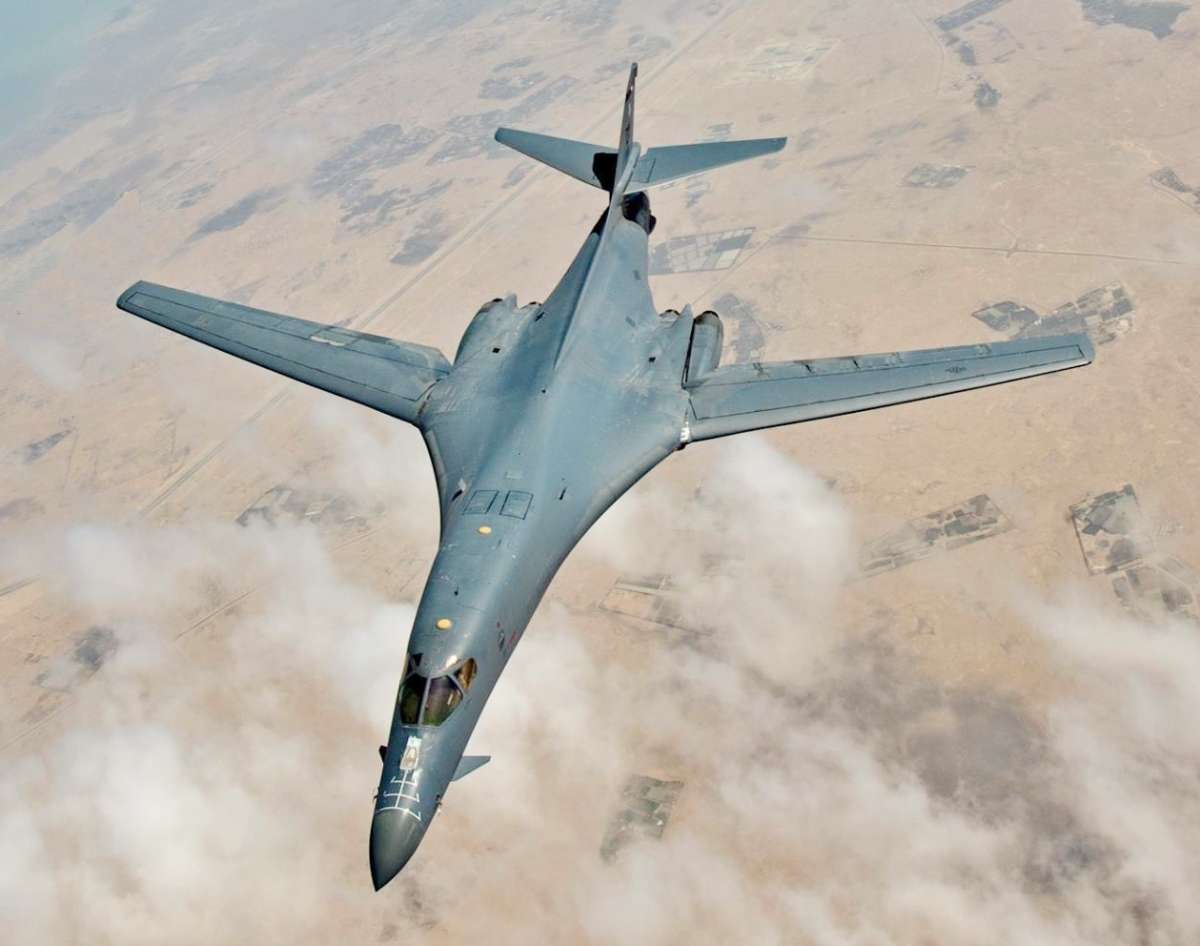
The  bomber’s return to India for Aero India 2023 underscores the

India-Russia defence partnership touches new heights at Aero India  

Russian unmanned aerial vehicles, including reconnaissance and strike Orion-E, reconnaissance