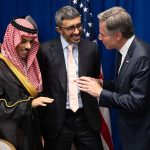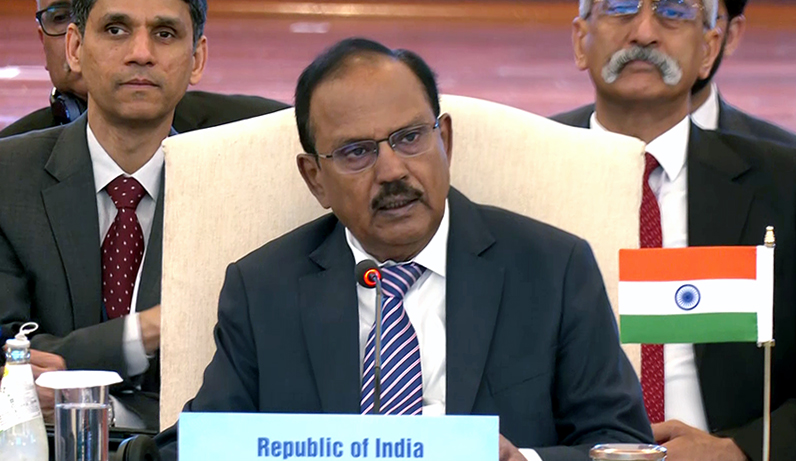
National Security Advisor met his counterparts from the US, Saudi Arabia and the United Arab Emirates…reports Asian Lite News
National Security Advisor Ajit Doval Sunday met his counterparts from the US, Saudi Arabia and the United Arab Emirates to discuss an ambitious proposal being pushed by the White House to link West Asian countries through rail — using Indian expertise — and connect the region to South Asia via sea lanes.
Sources in New Delhi said Doval has travelled to Saudi Arabia for Sunday’s meeting. The participants are expected to discuss the broad contours of the massive joint project to build railway, maritime and road connectivity in the larger region, linking the Indian subcontinent in South Asia with West Asia — which the US calls the Middle East.
The development was first reported by US news website Axios. It said this is among the key initiatives the White House wants to push in the Middle East as China’s influence in the region grows. The Middle East is a key part of China’s Belt and Road vision.
Axios reported: “The US, Saudi, Emirati and Indian national security advisers are expected on Sunday to discuss a possible major joint infrastructure project to connect Gulf and Arab countries via a network of railways that would also be connected to India via shipping lanes from ports in the region.”
Sources in Delhi explained that the Indian side is keen to participate in the project as it fulfils three strategic objectives.
First, Beijing has expanded its sphere of political influence in the West Asian region through what Delhi views as “mission creep” — the breakthrough in ties between Saudi Arabia and Iran had caught India unawares. This has potential implications for India’s interests in West Asia, which provides energy security. Such connectivity will allow for faster movement of the crude and minimise India’s costs in the long term. The connectivity boost will also help India’s eight million citizens who live and work in the Gulf region.
Second, the project will help India build a brand as an infrastructure builder in the railways sector. Boasting a strong rail network at home and buoyed by the success of creating such infrastructure in Sri Lanka, India has the confidence to do it overseas. It wants private companies as well as public sector enterprises to explore the potential economic and infrastructure opportunities in the region. This will also have the effect of countering the Chinese Belt and Road project, which has burdened many countries in the region with infrastructure that has limited utility. The US, which had proposed the Blue Dot network, is one of the elements in the creation of the connectivity project that will be financially sustainable and viable.
Third, the government feels that India’s connectivity to its western neighbours has been limited for long by Pakistan’s blocking of overland transit routes. So, Delhi wants to use shipping routes to reach West Asian ports. These include Chabahar and Bandar-e-Abbas (Iran), Duqm (Oman), Dubai (UAE), Jeddah (Saudi Arabia) and Kuwait City. Connectivity projects crisscrossing the Gulf and Arab countries, with Indian stakes, open up trading opportunities.
According to the Axios report, the idea for the new initiative came up during talks held over the last 18 months in a forum called I2U2, which includes the US, Israel, the UAE and India. The forum was established in late 2021 to discuss strategic infrastructure projects in West Asia.
With China in mind, Israel raised the idea of connecting the region through railways during the I2U2 meetings over the last year. Part of the idea was to use India’s expertise on such big infrastructure projects, a former Israeli official was quoted as saying by Axios.
The Biden administration in recent months expanded on the idea to include Saudi Arabia’s participation. The initiative would include connecting Arab countries in the Levant and the Gulf via a network of railways that will also connect to India through seaports in the Gulf, sources told the US news outlet.
S NSA Jake Sullivan hinted at this initiative during his speech Thursday at the Washington Institute for Near East Policy. “If you remember nothing else from my speech, remember I2U2, because you will be hearing more about it as we go forward,” he said.
Sullivan said the basic plan is to connect South Asia, the Middle East and the US “in ways that advance our economic technology and diplomacy”.
He said a number of projects are already underway, along with “some new exciting steps that we are looking forward to undertaking in the months ahead”.
The US NSA said in his speech that one of the pillars of the Biden administration’s strategy in the Middle East is regional integration.
“A more integrated, interconnected Middle East empowers our allies and partners, advances regional peace and prosperity, and reduces the resource demands on the US in this region over the long term without sacrificing our fundamental interests or our involvement in the region,” he said.
According to the Axios report, Israel is not part of this initiative at the moment, but could be added to it in the future if efforts to normalise relations in the region make progress.