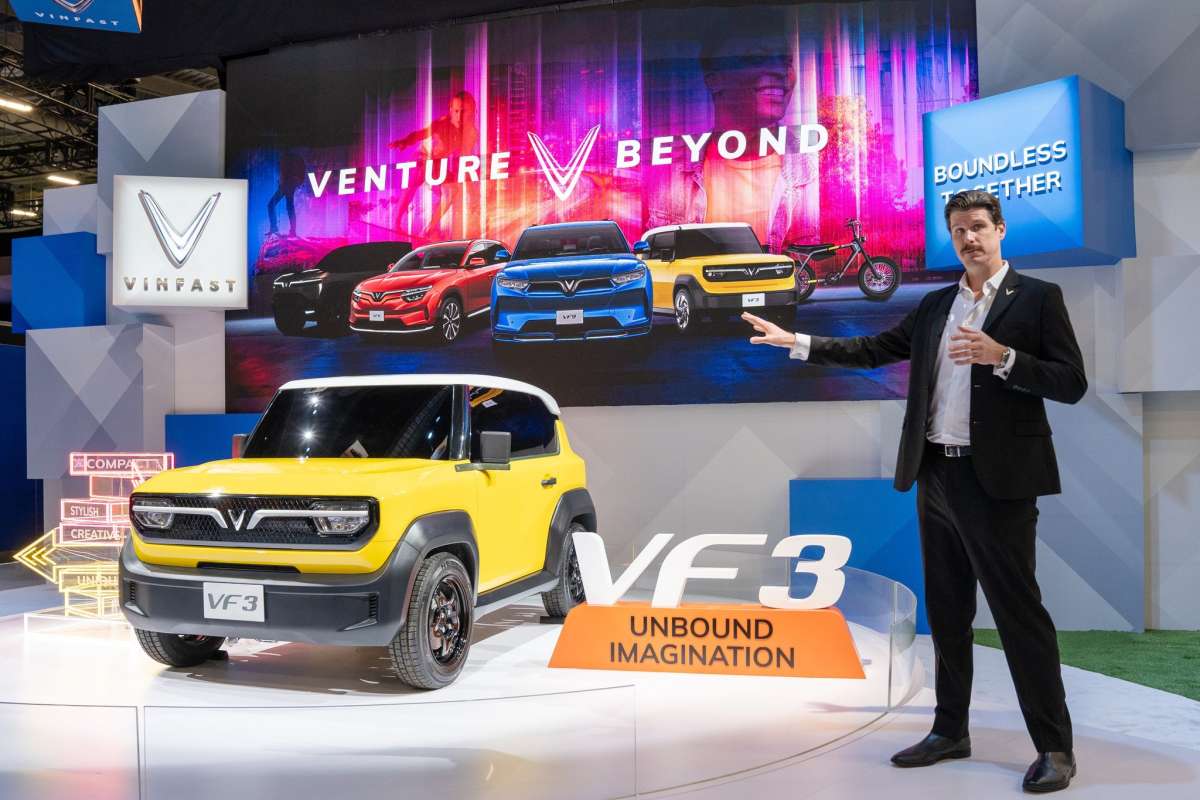
VinFast Auto in Vietnam unveils VF Wild, an eco-friendly electric pickup with top-notch performance and durability…reports Asian Lite News
The Consumer Electronics Show (CES) 2024, held annually in Las Vegas, has once again pushed the boundaries of electric vehicle (EV) innovation and this year, EVs have taken another leap with an array of groundbreaking concepts.
The event showcased a slew of futuristic EV concepts from automakers like Honda, Kia, and Hyundai, each pushing the boundaries of electric mobility and sustainability.
At this year’s event, Honda debuted two ‘0 Series’ EV concept models — Saloon and Space-Hub, with an aim to launch in 2026.
The Saloon is the flagship concept model of the Honda 0 Series. It’s a low-slung sports car with impressive gull-wing doors. In this model, sustainable materials are used throughout the exterior and interior. Inside, the instrument panel features a human-machine interface (HMI) that enables simple and intuitive operations.
The Honda 0 Space-Hub model was developed under the theme of “augmenting people’s daily lives”. It’s a spacious, futuristic minivan that accommodates a variety of passengers and becomes a “hub” that connects people to each other and the outside world.
Now comes Korean car manufacturer Kia, which announced plans at CES 2024 to develop a series of modular electric vehicles (EVs) built for adaptability and versatility. The company outlined three phases as part of its Platform Beyond Vehicle (PBV) strategy.
In phase one, the carmaker plans to introduce the Concept PV5 — a versatile EV optimised for major domains such as hailing, delivery, and utilities that features conversion capability for diverse customer needs.
The Concept PV7 is the largest product in Kia’s PBV lineup. It is designed for customers who require more space and range, perhaps for longer journeys or more cargo. On the other hand, the Concept PV1 is the smallest in the PBV series, created to cater to agile and short-distance logistics transportation needs.
Phase two will see the completion of the dedicated PBV model line-up, with PBVs evolving into AI-based mobility platforms that use data to engage with users and keep vehicles up to date. In phase three, Kia PBVs will evolve into highly customisable, bespoke mobility solutions by integrating with the future mobility ecosystem.
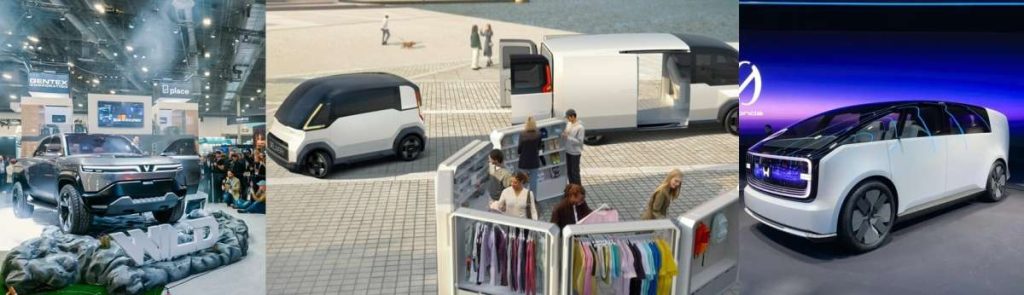
This year’s CES event also saw a concept electric pickup truck.
Vietnam-based leading electric vehicle manufacturer VinFast Auto unveiled the electric pickup truck concept — the VF Wild, the company’s attempt to design a pickup truck that features solid performance while being eco-friendly and innovative without compromising performance or durability.
The vehicle combines the convenience of a power-folding mid-gate with a class-leading bed length that can expand from 5 to 8 feet with the rear seats folded down automatically.
With the functionality of the expanding bed, work and play can be done in style and comfort. The design also incorporates a panoramic glass roof and digital side mirrors to improve aerodynamics.
This year, South Korean carmaker Hyundai redefined innovation at CES with the “MOBION” concept.
Hyundai Mobis, a division of the South Korean automaker specialising in innovation and mobility solutions, has unveiled the MOBION electric vehicle, equipped with the next-generation ‘e-Corner System’ motion technology.
The MOBION’s wheels can rotate more than 90 degrees, enabling lateral movement and intricate manoeuvres that are not possible with conventional four-wheel steering in some modern cars.
This EV stands out due to its advanced In-Wheel technology. This technology involves the installation of a self-contained powertrain in each wheel that consists of an independent electric motor, steering, braking, and suspension functions.
By eliminating the need for traditional axle shafts and additional brake components, the MOBION can seamlessly perform lateral movements.
MOBION also features autonomous driving sensor and lamp technologies. As part of MOBION’s design, three light detection and ranging (lidar) devices have been incorporated as autonomous driving sensors.
Two short-distance lidars are located near the left and right headlamps, with a single long-distance lidar installed in the centre of the vehicle’s front.
ALSO READ-Dispelling Fertility Myths