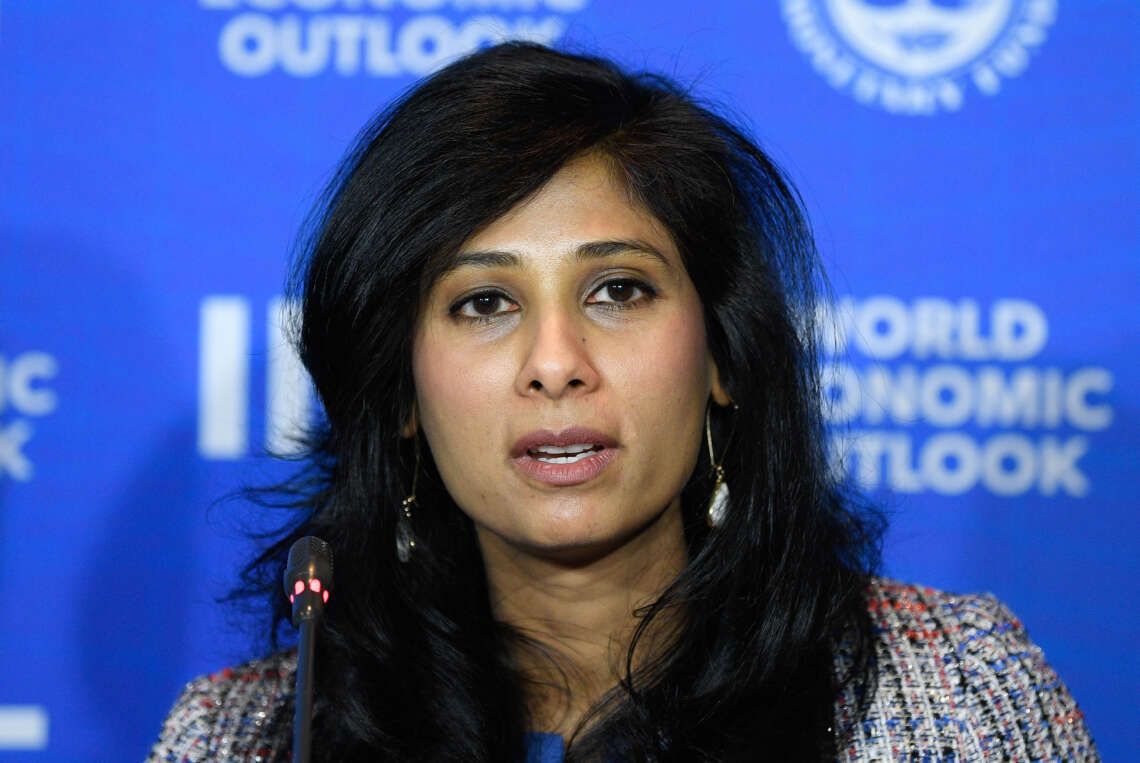
Former IMF chief economist Gita Gopinath has warned that the global AI investment boom could face a significant correction as companies struggle to justify soaring valuations and massive spending….reports Asian Lite News Desk
Former International Monetary Fund (IMF) chief economist Gita Gopinath has warned that the global artificial intelligence (AI) investment boom could face a significant market correction, cautioning that companies may struggle to generate sufficient profits to justify the massive investments being poured into the technology. She said the timing of such a correction remains uncertain but highlighted the risks posed by fierce competition, soaring valuations and the interconnected nature of the global AI ecosystem.
“I personally think that there will be a correction. It’s impossible to tell when that correction will happen,” the Harvard professor said while speaking on Raj Shamani’s podcast.
Nearly $1 trillion is projected to be spent globally on AI infrastructure and development in 2026 alone, with major investments flowing into the technology across countries such as the United States, South Korea and Taiwan.
However, Gopinath questioned whether the returns generated by AI companies would be sufficient to recover the enormous sums being invested in the sector.
“It’s hard to explain how each of these labs and companies who are investing close to a trillion dollars now globally in AI just in 2026 will be able to make the kind of profits that are needed to recover that investment,” she said.
She warned that the increasingly competitive AI landscape could make it difficult for companies to sustain their current valuations, particularly if they fail to deliver the profits expected by investors.
“In a hypercompetitive landscape, it remains difficult to see how all competing firms can generate sufficient profits to justify their current valuations. A significant market correction in AI valuations could heavily impact the US economy—which relies heavily on AI-driven wealth effects—potentially dropping US growth to zero or negative territory,” she added.
Gopinath also pointed to the interconnected nature of global financial markets, warning that a downturn involving a major AI company could have consequences well beyond the technology sector.
Markets such as the United States, Taiwan and South Korea have benefited from rising demand for advanced technology and AI-related infrastructure. However, their close economic and financial links could allow a correction in one market to spread rapidly to others.
She highlighted the circular flow of investments within the AI ecosystem, where companies invest in AI developers that subsequently use the funding to purchase products and services from those same investors.
Citing Nvidia as an example, Gopinath explained how the chipmaker invests in AI laboratories, which then use the funds to purchase Nvidia’s chips.
“If Nvidia were to collapse or any one of the AI labs were to collapse, that would have implications for Nvidia,” she said.
Her comments underline concerns about the sustainability of the current AI investment cycle, particularly as technology companies continue to commit enormous resources to data centres, computing infrastructure and advanced AI development.
Why is Gopinath concerned about AI dependence?
Beyond the financial risks surrounding AI investments, Gopinath also addressed the impact of artificial intelligence on the workforce, particularly among young professionals navigating an increasingly technology-driven job market.
She cautioned against what she described as “cognitive surrender”, urging people not to become overly dependent on AI tools such as ChatGPT and Claude.
Gopinath stressed the importance of developing independent thinking and problem-solving abilities rather than blindly relying on AI systems to perform intellectual tasks.
Her warning comes amid growing adoption of generative AI tools across workplaces, with concerns mounting over how excessive dependence on such technologies could affect critical thinking and professional skills.