Pakistan’s economy is projected to grow by 3.6 per cent in 2026, with the IMF forecasting further improvement to 4.5 per cent by 2031….reports Asian Lite News Desk
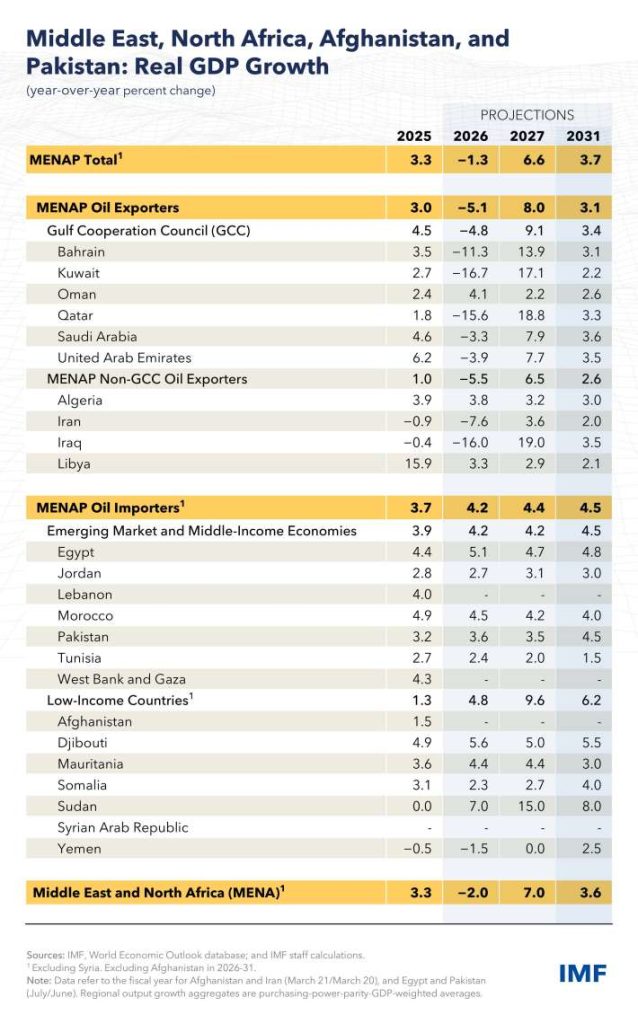
Pakistan’s real GDP growth is projected to rise from 3.2 per cent in 2025 to 3.6 per cent in 2026, before reaching 4.5 per cent by 2031, according to International Monetary Fund (IMF) estimates. The projections also point to significant differences in economic performance across the Middle East, North Africa, Afghanistan and Pakistan (MENAP), with oil-exporting economies facing a sharp slowdown in 2026.
The IMF’s latest regional growth estimates show that MENAP’s overall real GDP growth is expected to fall from 3.3 per cent in 2025 to a contraction of 1.3 per cent in 2026, before recovering sharply to 6.6 per cent in 2027. The region’s growth is projected to moderate to 3.7 per cent by 2031.
The figures, presented in the IMF’s regional economic projections, highlight contrasting growth trajectories between oil-exporting and oil-importing economies.
Oil exporters face sharp slowdown
MENAP oil exporters are projected to record economic growth of 3 per cent in 2025, followed by a contraction of 5.1 per cent in 2026. However, the group is expected to rebound with growth of 8 per cent in 2027, before moderating to 3.1 per cent in 2031.
Among the Gulf Cooperation Council (GCC) economies, Saudi Arabia is projected to grow by 4.6 per cent in 2025, followed by a contraction of 3.3 per cent in 2026. Its growth is expected to recover to 7.9 per cent in 2027 and reach 3.6 per cent by 2031.
The United Arab Emirates is forecast to record growth of 6.2 per cent in 2025, before contracting by 3.9 per cent in 2026. Growth is projected to recover to 7.7 per cent in 2027 and stand at 3.5 per cent in 2031.
Kuwait is expected to experience a contraction of 16.7 per cent in 2026, followed by a strong recovery of 17.1 per cent in 2027. Qatar is projected to contract by 15.6 per cent in 2026 before expanding by 18.8 per cent the following year.
Among non-GCC oil exporters, Libya is projected to record the highest growth in 2025 at 15.9 per cent, while Iraq is expected to experience a 16 per cent contraction in 2026.
Oil importers maintain growth momentum
In contrast, MENAP oil-importing economies are projected to maintain positive growth throughout the forecast period. The group is expected to expand by 3.7 per cent in 2025, 4.2 per cent in 2026 and 4.4 per cent in 2027, reaching 4.5 per cent by 2031.
Egypt’s economy is projected to grow by 4.4 per cent in 2025 and 5.1 per cent in 2026, before moderating to 4.7 per cent in 2027. Morocco is forecast to expand by 4.9 per cent in 2025, followed by 4.5 per cent in 2026 and 4.2 per cent in 2027.
Pakistan is projected to register growth of 3.2 per cent in 2025, rising to 3.6 per cent in 2026 and 3.5 per cent in 2027. Its economy is expected to expand by 4.5 per cent in 2031.
Among low-income economies in the region, growth is projected to increase from 1.3 per cent in 2025 to 4.8 per cent in 2026 and 9.6 per cent in 2027, before settling at 6.2 per cent in 2031.
Sudan is forecast to record growth of 7 per cent in 2026 and 15 per cent in 2027, following no growth in 2025. Afghanistan, meanwhile, is projected to register 1.5 per cent growth in 2025, with no subsequent estimates provided in the table.
The IMF noted that the regional figures are based on purchasing-power-parity GDP-weighted averages. The projections use fiscal-year data for Afghanistan and Iran, running from March 21 to March 20, and for Egypt and Pakistan, running from July to June.