UN Secretary-General António Guterres has warned that artificial intelligence can support conflict resolution but cannot replace human relationships and trust…reports Asian Lite News Desk
United Nations Secretary-General António Guterres has warned that emerging technologies, particularly artificial intelligence (AI), must not replace human relationships and trust in conflict resolution, calling for stronger international safeguards to prevent the technology from undermining global peace and security.
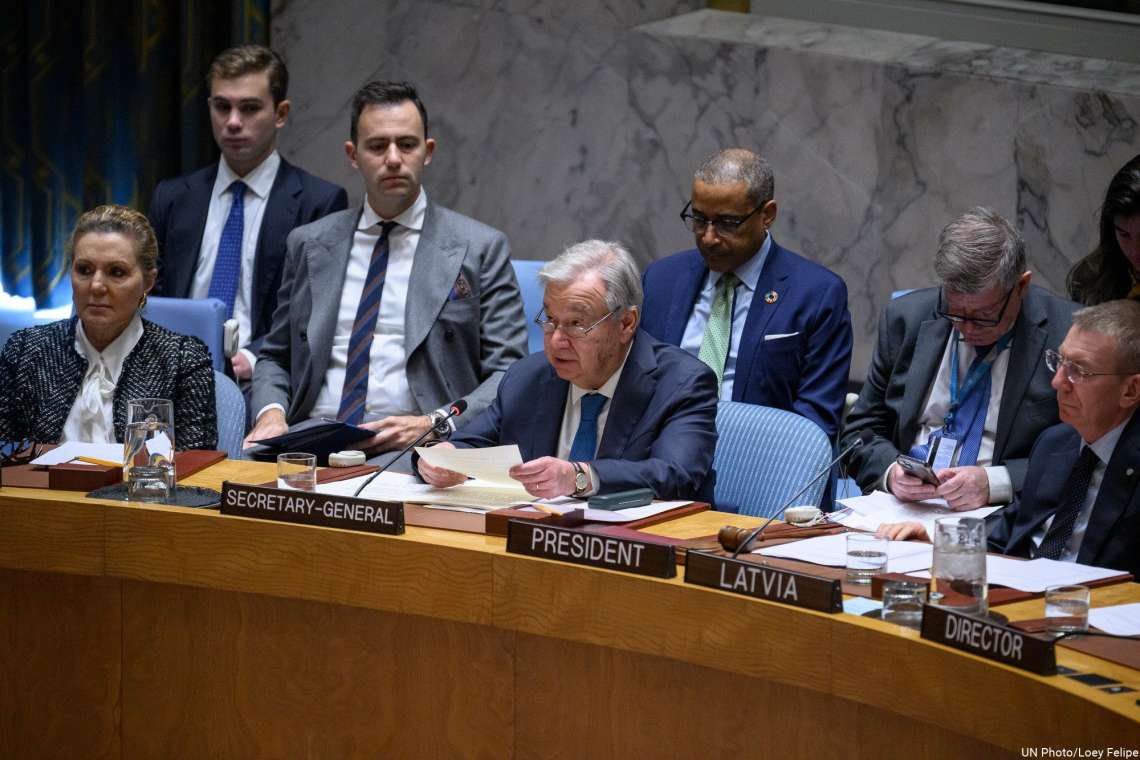
Addressing a high-level public debate of the UN Security Council on conflict resolution amid rapidly evolving technologies in New York, Guterres said AI could improve peacekeeping, mediation and humanitarian responses but stressed that human control, accountability and international law must remain central.
He said emerging technologies offered significant opportunities to help countries affected by conflict and insecurity, including predicting food shortages and climate-related displacement, detecting landmines and using unmanned systems to evacuate wounded people from dangerous areas.
AI could also strengthen UN peacekeeping operations through improved logistics, maintenance, situational awareness and operational planning. Faster analysis of information could support political missions, provide evidence for mediation efforts and improve civilian protection.
Guterres noted that digital tools could also help peace processes engage thousands of people, expanding participation beyond the smaller groups traditionally involved in mediation and negotiations.
However, he cautioned that access to more information did not automatically lead to better decisions.
“While technology can facilitate dialogue and mediation, it cannot replace the human relationships and trust on which peace and conflict resolution depend,” he said.

What risks does AI pose to international peace and security?
Guterres identified three major risks associated with the inadequate regulation of emerging technologies.
The first concerns the growing use of AI in warfare. He warned that conflicts were increasingly becoming testing grounds for AI-powered targeting systems, with algorithms influencing military decisions ranging from intelligence gathering to the selection of targets.
Such capabilities were becoming accessible to both states and non-state armed groups, potentially increasing risks across cyberspace, outer space and the life sciences.
The Secretary-General expressed particular concern about integrating AI into nuclear command, control and communication systems, warning that decisions on the use of nuclear weapons must remain exclusively in human hands.
He said AI must not weaken the fundamental principle of human control over the use of force or provide a convenient way for those responsible for violations to avoid accountability.
When civilians are killed or human rights are violated, responsibility cannot be transferred to an algorithm, he stressed. Governments must ensure that military applications of AI comply with international law, international humanitarian law and human rights standards.
Guterres also renewed his call for urgent negotiations on a legally binding instrument governing lethal autonomous weapons systems.
“The machines that choose their targets and take lives without any human control are morally repugnant and politically unacceptable,” he said.
How is AI-generated misinformation threatening peace?
The second major concern highlighted by Guterres was the rapid spread of misinformation and disinformation generated using AI.
He warned that false information could deepen political polarisation, undermine trust in institutions and weaken social cohesion. Fabricated audio and video content could also derail peace processes or encourage violence.
Women politicians, mediators and leaders were particularly vulnerable to misogynistic attacks designed to intimidate them and silence their participation.
Guterres called for action both online and offline, including direct engagement to ease tensions and rebuild trust. He also urged technology companies to identify and address disinformation campaigns intended to spread falsehoods and incite violence.
Why does AI governance need international cooperation?
The third risk relates to growing competition over AI, driven by commercial interests and geopolitical rivalries.
Guterres said AI development required substantial energy, water, minerals and industrial capacity. Competition for critical minerals, combined with the significant resource demands of data centres, was already creating tensions within and between countries.
He urged the Security Council to ensure that competition over emerging technologies did not threaten international peace and security.
The Secretary-General also warned about the concentration of technological power among a small number of countries and companies, saying it could influence political processes, commercialise warfare and widen inequalities within and between nations.
Many countries, particularly developing states, had limited opportunities to influence the AI technologies that would shape their future, he said.
Guterres called for stronger international cooperation through the Global Dialogue on AI Governance and the Independent International Scientific Panel on Artificial Intelligence.
He said these initiatives could help establish common benchmarks for advanced AI systems, shared methods for assessing risks and safeguards to address potential threats.
He also called for a multilateral framework for managing AI-related risks, supported by a credible and independent monitoring mechanism.
Technology companies developing powerful AI systems must also be held accountable, he added, arguing that technologies with significant public consequences require effective oversight.
Concluding his address, Guterres said the central question was who had the power to shape, control and benefit from artificial intelligence, and who would bear the consequences if that power remained unchecked.
He stressed that technological progress must remain subject to the rule of law, while peace must continue to be a human choice.