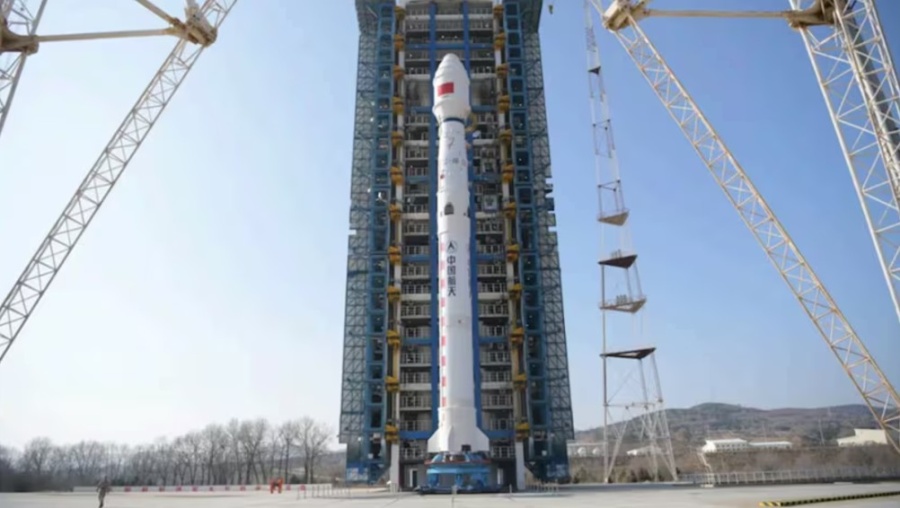
Once operational, the satellites will provide high-resolution radar imagery regardless of weather or lighting conditions, offering valuable data for industries…reports Asian Lite News
China has achieved a significant milestone in its commercial space program by successfully launching the world’s first “self-driving” satellites. Developed by the Shanghai Academy of Spaceflight Technology (SAST), a subsidiary of the China Aerospace Science and Technology Corporation (CASC), these satellites are capable of autonomously adjusting or maintaining their orbits without ground control intervention. This breakthrough is set to redefine satellite operations, particularly in surveying and mapping.
Launched aboard a Long March-2C carrier rocket from the Jiuquan Satellite Launch Centre on November 25, the two satellites, named Siwei Gaojing-2 03 and Gaojing-2 04, feature cutting-edge synthetic aperture radar (SAR) technology and advanced radar payloads. These innovations allow the satellites to perform with remarkable precision, including automatic orbit correction with a 100-meter accuracy and formation flying at sub-meter precision.
Once operational, the satellites will provide high-resolution radar imagery regardless of weather or lighting conditions, offering valuable data for industries such as natural resource management, urban safety monitoring, disaster response, and maritime surveillance. Their advanced imaging capabilities are also expected to enhance China’s databases on surveying, mapping, agriculture, and environmental management.
Unlike traditional optical satellites that rely on visible light, SAR technology allows these satellites to use microwave signals, enabling them to penetrate clouds, fog, and darkness. This ensures consistent monitoring of natural disasters like earthquakes and floods, deforestation tracking, and military reconnaissance.
The Gaojing-2 03 and 04 satellites are part of the broader Siwei commercial remote sensing constellation project, which aims to deploy at least 28 satellites by next year. This constellation will support critical sectors such as land management and marine surveillance with high-resolution data.
This launch follows other achievements in China’s space program, including the August 2023 launch of Ludi Tance 4-01, the first geosynchronous orbit SAR satellite, showcasing China’s expanding capabilities in cutting-edge space technologies.
ALSO READ: Trump threatens new tariffs on Mexico, Canada, China
ALSO READ: Will not ink any loan pact with China, says Nepal PM