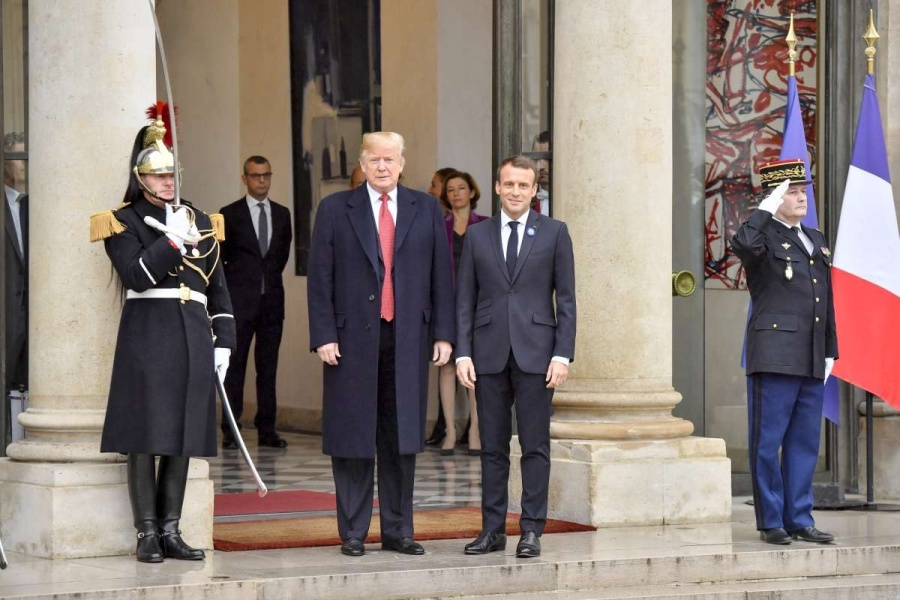
French President Emmanuel Macron voiced concerns, stating, “Trump was elected by the American people. He will defend American interests… The question is whether we are willing to defend European interests. It is the only question.”
With Donald Trump clinching a historic victory in the US presidential election on Wednesday, world leaders, including those across Europe, extended their formal congratulations.
However, beneath these diplomatic gestures, European leaders expressed mixed reactions, considering what Trump’s return might mean for transatlantic ties.
Just a day after Trump’s win, around 50 European leaders gathered in Budapest for the fifth meeting of the European Political Community. Alongside Europe’s pressing agenda, discussions centered around the future of the EU-US alliance under Trump’s leadership.
French President Emmanuel Macron voiced concerns, stating, “Trump was elected by the American people. He will defend American interests… The question is whether we are willing to defend European interests. It is the only question.”
Macron’s pointed remarks highlighted the bloc’s cautious approach as it braces for the complexities of a Trump 2.0 era.
As official congratulations were extended, European leaders have reportedly begun preparing for a potentially unpredictable chapter in EU-U.S. relations.
European Council President Charles Michel emphasised the “enduring alliance and historic bond” between the 27-nation bloc and the United States, while European Commission President Ursula von der Leyen underscored the importance of the “true partnership” that sustains “millions of jobs and billions in trade and investment on each side of the Atlantic.”
Yet von der Leyen’s team has reportedly been preparing contingency plans for months, including potential retaliatory tariffs on U.S. imports should Trump impose new duties on European goods. “We’re ready for any bumps that might appear, it’s not our first rodeo,” a senior European diplomat told Euronews on condition of anonymity.
Despite Trump’s prior threats to pull the United States out of NATO, new NATO Secretary-General Mark Rutte, who previously engaged with Trump as Dutch Prime Minister, offered a message of support, saying Trump’s “leadership will again be key to keeping our Alliance strong.”
Macron pledged readiness to work “with respect and ambition,” and German Chancellor Olaf Scholz affirmed that Germany and the United States would continue to collaborate for “the well-being of our citizens”, Xinhua news agency reported.
Amid these statements, Macron and Scholz reportedly conferred privately, seeking a coordinated European response to Trump’s return, with both leaders emphasising the need for a “stronger Europe within this new context,” European media reported.
Across the channel, British Prime Minister Keir Starmer voiced confidence in the country’s enduring “special relationship” with the United States, though media reports suggest his team is bracing for possible trade frictions akin to those foreseen by EU leaders.
During Trump’s first term, his “America First” doctrine placed considerable strain on US-EU relations, sparking disputes over trade tariffs, NATO funding, and US withdrawals from landmark agreements like the Iran Nuclear Deal and the Paris Climate Accord. Analysts warn that his comeback could become a “Trumpian nightmare” for Europe, especially given the strife of his first administration with the bloc and his campaign promises.
One of Trump’s proposals — a sweeping 10-per cent tariff on all imports — looms as a major concern for Europe’s export-dependent economies, particularly in the automotive, luxury goods, and machinery sectors.
In 2023, the EU exported 502 billion euros (about 542 billion US dollars) in goods to the United States, according to Eurostat.
Goldman Sachs forecast that such tariffs could weaken the euro by up to 10 per cent, further pressuring the eurozone and diminishing Europe’s global competitiveness.
Additionally, Trump has been a staunch critic of Europe’s defence spending, repeatedly urging NATO members to increase their contributions.
Former NATO Supreme Allied Commander James Stavridis suggested that Trump might push European nations to allocate as much as 2.5 per cent or even 3 per cent of GDP to defence — an imposing burden as Europe contends with the prolonged Ukraine crisis, a situation many see as linked to NATO’s eastward expansion under US administrations’ continuous push.
Trump’s ambivalence toward the Ukraine issue has heightened anxiety among European capitals, with Rachel Tausendfreund, a senior fellow at the German Council on Foreign Relations, suggesting that Trump might push for a rapid ceasefire, catching Europe off guard.
Moreover, Trump’s campaign also includes pledges that clash with EU priorities. His support for fossil fuels and potential withdrawal from the Paris Agreement counter Europe’s green agenda, while his protectionist trade policies challenge Europe’s economic sovereignty and commitment to multilateralism.
At Thursday’s gathering, Michel urged Europe to strengthen its self-reliance, asserting, “We have to be more masters of our destiny… not because of Donald Trump or Kamala Harris, but because of our children.”
His words resonated among Europe’s strategic planners. European Parliament President Roberta Metsola deemed Trump’s victory “a perfect moment” for the EU to deepen cooperation on security, migration, and strategic autonomy, affirming that Europe “must set out its own future.”
For many European leaders, Trump’s transactional stance is seen as a “bitter medicine” that could accelerate Europe’s drive toward autonomy.
Calls for European autonomy have grown in recent years as both major US parties prioritize American interests, often at Europe’s expense, Xinhua news agency reported.
Even under President Joe Biden, US policies like the Inflation Reduction Act’s subsidies for US-based green technology have placed strain on European industries. Additionally, Biden’s continuation of Trump-era sanctions on Nord Stream 2 has left Europe vulnerable to energy insecurity, while US pressures to limit Chinese tech investments have tested Europe’s economic sovereignty.
These developments highlight a broader reality: transatlantic ties are likely to face continued strain as the United States undergoes long-term structural shifts that increasingly prioritise domestic concerns over traditional alliance obligations.
Last year, US National Security Advisor Jake Sullivan outlined a “New Washington Consensus” focused on revitalizing domestic industries and strengthening supply chains — a strategy that underscores a structural shift within the US economy. This approach leans toward selective protectionism, reflecting a pronounced emphasis on America’s self-interest.
A recent analysis by Bruegel emphasised that “long-term structural problems” are reshaping US global engagement, with a “crumbling defence industrial base” eroding its ability to uphold commitments to allies. “The US is destined to disengage from the protection it granted Europe,” it said. “Europe must ensure its own security.”
ALSO READ: Starmer covers defence, security in first call with Trump