December 19, 2024
4 mins read

Open letter urges Bangladesh to protect minorities 

The initiative, coordinated by India’s former High Commissioner to Bangladesh Veena Sikri and former ambassador Bhaswati Mukherjee, points out that the worst brunt of the chaotic situation…reports Asian Lite News

An ‘open letter’ signed by nearly 500 people – including dozens of former diplomats, public servants, senior government officials, armed personnel and members of the civil society – has urged all individuals and institutions in Bangladesh to work towards restoring democracy and secularism, including the rights of Hindus and other religious minorities in the country while emphasising that the current situation is “intolerable and unacceptable” to the people of India. 

The initiative, coordinated by India’s former High Commissioner to Bangladesh Veena Sikri and former ambassador Bhaswati Mukherjee, points out that the worst brunt of the chaotic situation prevailing in Bangladesh is being borne by the 15 million strong minority communities of Bangladesh – including Hindus, Buddhists, Christians, as well as the Shias, Ahmadiyyas and others. 

“For over four months, fundamentalist Islamist groups have unleashed violent, terrorist attacks on religious minorities across the country in almost every district, involving desecration and vandalisation of places of worship, abductions and rape, lynchings, extra judicial executions, killings, forced conversions, along with wanton destruction of homes and business establishments. Even where there is irrefutable evidence, no action has been taken against the culprits,” the letter mentions. 

It is to be recalled that Muhammad Yunus had taken over as the Chief Advisor of the Bangladeshi interim government on August 8 following the fall of the government led by former Prime Minister Sheikh Hasina. 

“The series of events in July and August 2024 had initially been described as the result of a spontaneous uprising by students across Bangladesh. However, September 24, 2024, Chief Advisor Muhammad Yunus publicly stated at a gathering of the Clinton Global Initiative in New York that the regime change operation, far from being spontaneous, was “meticulously designed”, planned well in advance and spearheaded by an Advisor in the Interim regime, who is also Special Assistant to Yunus,” the letter details. 

Noted Indian scholars, former diplomats and retired Army Generals, who signed the ‘open letter’ have jointly voiced their alarm and concern at the deteriorating situation in Bangladesh. 

“The agenda of the Islamists appears to be to terrorize and drive the religious minority population out of Bangladesh. It is noteworthy that Hindus and other minority communities across Bangladesh are stoutly resisting such attempts by Islamist groups. They are seeking protection of their rights as citizens of Bangladesh, as assured through the nation’s Constitution,” the letter states. 

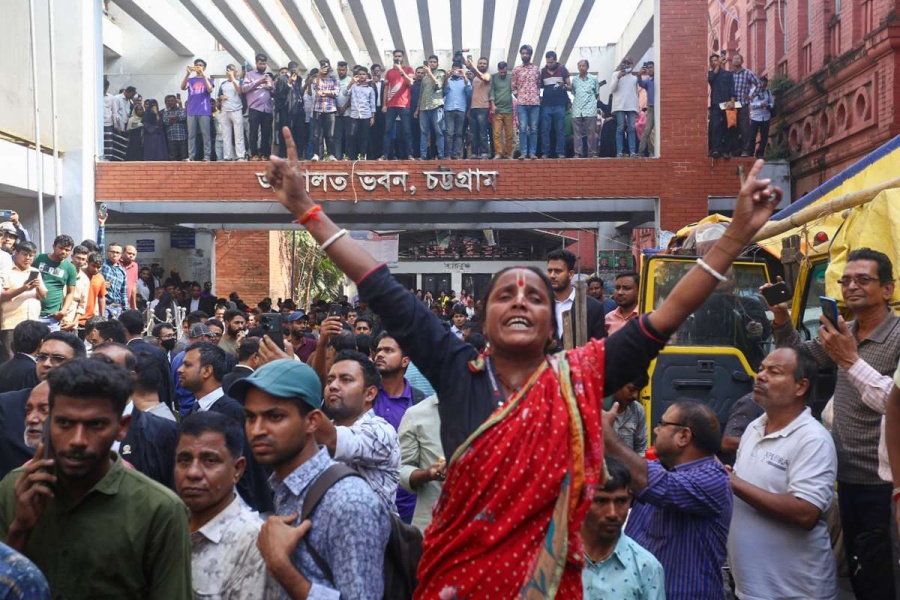
It adds that an “atmosphere of anarchy” prevails in Bangladesh, with “mobocracy the preferred method” of decision making. 

The letter also refers to the arrest and jailing of Chinmoy Krishna Das, formerly with the globally renowned ISKCON spiritual organisation, together with his colleagues in the Sanatani Jagran Jote who had put together an eight-point demand on behalf of the religious minorities of Bangladesh, including seeking the enactment of a minority protection law in Bangladesh and formation of a ministry for the protection of minorities. 

“There is no response from the Yunus administration on these demands. Chinmoy Krishna Das has been arrested on charges of sedition, denied bail without a hearing and his lawyers are facing organised intimidation in their efforts to defend him in court and obtain bail. He is being denied a free and fair trial,” says the ‘open letter’. 

It adds that the attacks on minorities in Bangladesh have aroused deep concern in India, which has a long border with Bangladesh. It states that, apart from the purely humanitarian aspects, there is the danger that the volatile situation in Bangladesh could spill across borders, disrupt communal harmony and create serious law and order problems in India. 

The signatories to the letter also urged the people of Bangladesh not to be swayed by “malicious anti-India campaigns” that seek to weaken the bedrock of mutually beneficial cooperation that has been steadily developed over the last five decades and more. 

“There is concern that the representatives of Islamist political parties and organisations, several of whom have joined the interim administration, are enforcing decisions that go against the very essence of Bangladesh’s 1972 Constitution. Since such groups have seldom received any electoral support from the people of Bangladesh, the present situation is against the larger interest of the public. This crisis facing Bangladesh can only be overcome through early free, fair and inclusive elections,” the letter concludes while calling for an “immediate end” to attacks on minorities, their properties, business establishments and coercion to force them to leave. 

ALSO READ: Trump threatens reciprocal tax on India 
Previous Story

Bangladesh court revises ULFA leader’s verdict 

Next Story

Spin Wizard Ashwin Calls Time 

Previous Story

Bangladesh court revises ULFA leader’s verdict 

Next Story

Spin Wizard Ashwin Calls Time 

Latest from -Top News

Pakistan Risks Overstretching Itself in Yemen War

Pakistan’s expanding military role in Saudi Arabia amid the Yemen conflict could strain its defence resources and fragile finances…reports Asian Lite News Desk Pakistan’s military involvement in the war in Yemen may prove unsustainable because of mounting financial pressures and competing security demands, according to a new report. Islamabad’s growing military presence in Saudi Arabia risks stretching its defence resources while exposing the country to greater strategic and economic challenges. An article by Andrew Wilson in One World Outlook describes Pakistan’s involvement as a case of “fiscal and strategic overreach”, arguing that the country lacks the financial flexibility to sustain an expanded military commitment. Pakistan’s external finances depend heavily on an International Monetary Fund (IMF) programme, financial support from Gulf countries and remittances from Pakistani workers in the region. The report argues that deeper military involvement in the conflict could place additional pressure on these sources of financial stability. It also warns that deploying troops and military equipment abroad could weaken Pakistan’s capacity to address security challenges along its eastern border and deal with two domestic insurgencies. The move could also draw Islamabad into a conflict it has sought to approach cautiously. A Reuters report in May, citing Pakistani security and government sources, said Islamabad had deployed around 8,000 troops, a squadron of approximately 16 aircraft, mostly JF-17 fighter jets, two drone squadrons and a Chinese HQ-9 air-defence battery to Saudi Arabia. According to those sources, Riyadh was financing the deployment, with Pakistani personnel operating the equipment. The sources also said a confidential agreement contemplated the possibility of deploying up to 80,000 troops. Islamabad has not confirmed those figures, although it has acknowledged its military presence in Saudi Arabia, including the deployment of fighter jets at King Abdulaziz Air Base from April. The One World Outlook article argues that Saudi financial support can cover allowances and operating expenses but cannot easily replace military equipment needed elsewhere or resolve the political and strategic challenges of participating in the Yemen conflict. Pakistan’s defence budget is another concern. For the 2026-27 financial year, the federal government allocated PKR 3 trillion, or approximately $10.8 billion, to defence services. The allocation represents an 18 per cent increase from the original PKR 2.55 trillion provision and amounts to around 2.1 per cent of projected gross domestic product (GDP). Defence spending accounts for approximately 16 per cent of the federal government’s PKR 18.8 trillion expenditure. Military pensions are budgeted separately at PKR 822 billion, while debt servicing costs stand at approximately PKR 8 trillion, more than two-and-a-half times the defence allocation. The report argues that these competing financial obligations leave little room for additional military expenditure without placing further pressure on public finances. Pakistan’s reliance on IMF assistance also limits its fiscal flexibility. The country must meet the conditions attached to the programme, including a primary budget surplus target of 2 per cent of GDP and continued restraint on development spending. According to the article, these requirements make it difficult for Islamabad to finance an additional military commitment without compromising other budgetary priorities. Pakistan’s economic indicators offer limited reassurance. Economic growth for the 2025-26 financial year is estimated at between 3.6 and 3.7 per cent, while inflation reached approximately 10.3 per cent in September following an energy price shock. Foreign exchange reserves stood at around $21.5 billion at the end of September. Although this marks an improvement from the low levels recorded in 2023, the report notes that the reserves cover only a few months of imports. Financial assistance from Gulf partners remains central to Pakistan’s external stability. The article says Islamabad holds approximately $8 billion in Saudi deposits at its central bank. In July, the State Bank of Pakistan said Riyadh had extended the maturity of $5 billion in deposits to December 2028, easing the country’s immediate external financing requirements. A further $3 billion deposit was also extended in the spring. However, the article argues that these arrangements provide temporary relief rather than long-term financial independence, particularly as regional conflict threatens the stability of the Gulf economies on which Pakistan relies. The report concludes that Pakistan faces a difficult balance between supporting Saudi Arabia militarily and preserving the financial and military resources needed to address its domestic and regional challenges.

UK and Germany Ratify Kensington Treaty

Britain and Germany ratify the Kensington Treaty, agreeing new cooperation on AI, quantum research, defence and security while targeting investment, jobs and Russian hybrid threats…reports Asian Lite News Desk Britain and Germany

Economic tide is turning in Bangladesh

If there is one thing that can bring some comfort to the struggling Bangladeshi economy, it is good relations with India. Bangladesh should remember that Delhi’s backing, through easy supplies of essentials
Go toTop

Don't Miss

G-23 to field candidate in Congress Prez poll?

Last date of withdrawal is October 8 and date of

‘I’ll Give It My All’

Kamboj, a right-handed batter and a right-handed medium pacer, first