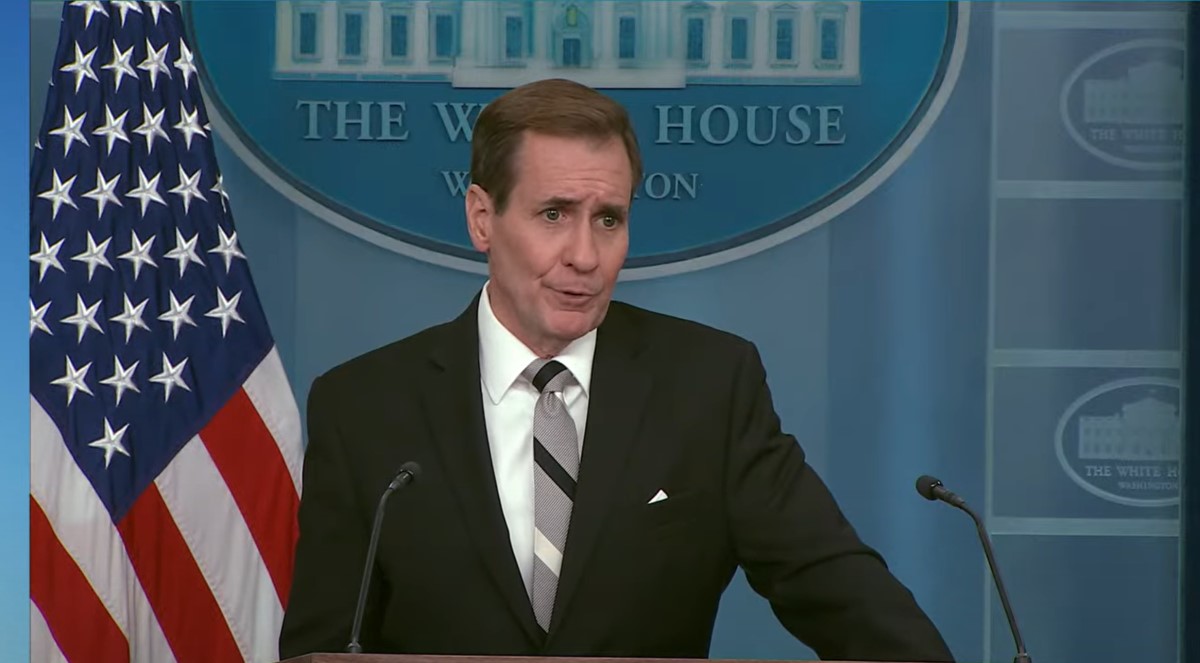
White House National Security Communications Advisor John Kirby said the US is closely monitoring this Russian activity…reports Asian Lite News
The White House has confirmed that Russia is developing a capability to target satellites in space and called Moscow’s pursuit of this particular capability “troubling.”
White House National Security Communications Advisor John Kirby said the US is closely monitoring this Russian activity and will continue to take it seriously amid reports of Moscow reportedly developing a space-based nuclear weapon designed to disable or destroy satellites.
While addressing a press briefing on Thursday (local time), John Kirby said, “While I am limited by how much I can share about the specific nature of the threat, I can confirm that it is related to an anti-satellite capability that Russia is developing. I want to be clear about a couple of things right off the bat.”
According to the intelligence presented to Congress, the US military “cannot counter such a weapon and defend its satellites,” according to a report in the New York Times.
“First, this is not an active capability that’s been deployed. And though Russia’s pursuit of this particular capability is troubling, there is no immediate threat to anyone’s safety. We are not talking about a weapon that can be used to attack human beings or cause physical destruction here on Earth. That said, we’ve been closely monitoring this Russian activity and we will continue to take it very seriously,” added Kirby.
He noted that US President Joe Biden has been regularly informed by his national security team. Kirby said Biden has directed a series of initial actions, including additional briefings to congressional leaders, and direct diplomatic engagement with Russia. He said that the intelligence community has serious concerns about a broad declassification of this intelligence.
Kirby said, “President Biden has been kept fully informed and regularly informed by his national security team, including today. He has directed a series of initial actions, including additional briefings to congressional leaders, direct diplomatic engagement with Russia, with our allies and our partners as well, and with other countries around the world who have interests at stake. The intelligence community has serious concerns about a broad declassification of this intelligence. They also assess that starting with private engagement rather than immediately publicizing the intelligence could be a much more effective approach.”
“We agree with that, which is consistent, of course, with how we have conducted downgrades of information in the past. This administration has put a lot of focus on strategically doing that, in a deliberate way and in particular, when it comes to Russia. And there are two things that we always do first when we consider downgrades. One, we work with the intelligence community to conduct a thorough scrub of that intelligence to make sure that we are protecting sources and methods. And, two, we sequence our private diplomacy with our public disclosure to ensure the maximum effect,” he added.
Asked whether it is a nuclear weapon or nuclear-powered weapon, Kirby responded, “I’m not going to be able to go into any more detail than I did in my opening statement. It is an anti-satellite capability that they’re developing. And beyond that, I will not go.”
John Kirby said that the US has been aware of the Russian pursuit of this kind of capability for many months. However, he added that the intelligence community in recent weeks has been able to assess it with a sense of confidence on exactly how Russia continues to pursue it.
Asked when US President Joe Biden was informed about Russia developing this capability, Kirby said, “I don’t have a specific date on a calendar. He has been kept informed throughout. And our general knowledge of Russian pursuit of this kind of capability goes back many, many months, if not a few years. But only in recent weeks now has the intelligence community been able to assess with a higher sense of confidence exactly how Russia continues to pursue it.”
Kirby’s remarks come after the head of the US House Intelligence Committee, Mike Turner, revealed that members of Congress had access to information about an unspecified “serious national security threat. He even urged US President Joe Biden to declassify all information related to the threat, CBS News reported.
According to CBS News report, Turner said, “I am requesting that President Biden declassify all information relating to this threat so that Congress, the administration, and our allies can openly discuss the actions necessary to respond to this threat.”
Notably, orbital nuclear weapons are currently banned due to the Outer Space Treaty of 1967. A nuclear detonation in space could have both immediate and long-lasting effects in Earth’s orbit.
In the immediate aftermath, nuclear explosions could cause a multitude of damaging effects; pulses of high-energy radiation such as heat, x-rays and other radiation can “can damage nearby satellites and blind their sensors,” according to a 2023 study by the Center for Strategic & International Studies (CSIS). (ANI)