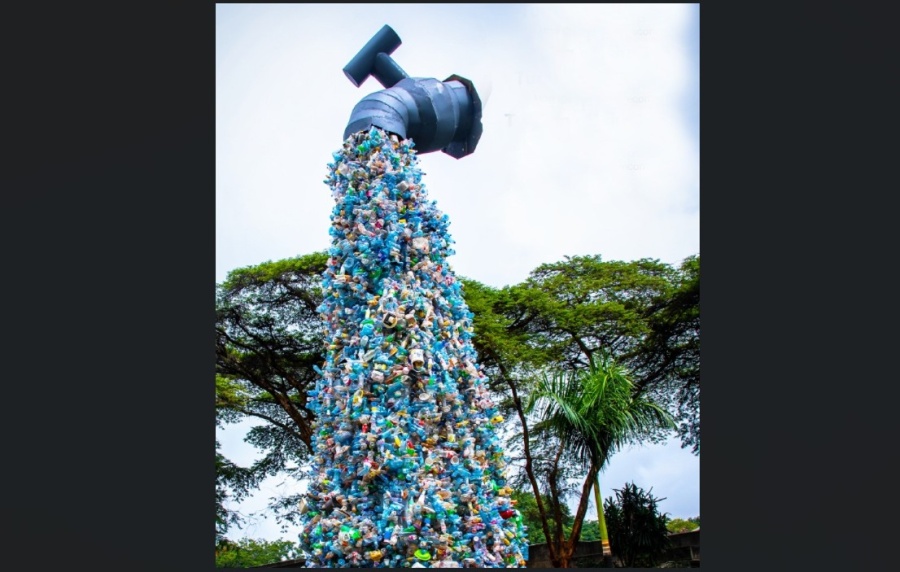
South Korea is hosting the fifth and final UN Intergovernmental Negotiating Committee meeting to agree on globally binding rules on plastics this week
Negotiators at the fifth round of talks aimed at securing an international treaty to curb plastic pollution were striving on Friday to speed up sluggish proceedings and reach a deal by a Dec. 1 deadline.
South Korea is hosting the fifth and final U.N. Intergovernmental Negotiating Committee (INC-5) meeting to agree globally binding rules on plastics this week.
Until Thursday, several delegates from around 175 countries participating had expressed frustration about the slow pace of the talks amid disagreements over procedure, multiple proposals and some negotiations even returning to ground covered in the past.
In an attempt to speed up the process, INC Chair Luis Vayas Valdivieso is holding informal meetings on Friday to try and tackle the most divisive issues.
These issues include curbing plastic products and chemicals of concern, managing the supply of primary polymers, and a financial mechanism to help developing countries implement the treaty.
Petrochemical-producing nations such as Saudi Arabia strongly oppose efforts to target a cap on plastic production, over the protests of countries that bear the brunt of plastic pollution such as low- and middle-income nations.
While supporting an international treaty, the petrochemical industry has also been vocal in urging governments to avoid setting mandatory plastic production caps, and focus instead on solutions to reduce plastic waste, like recycling.
Record numbers of plastic industry lobbyists are attending global talks that are the last chance to hammer out a treaty to cut plastic pollution around the world.
The key issue at the conference will be whether caps on global plastic production will be included in the final UN treaty. Lobbyists and leading national producers are furiously arguing against any attempt to restrain the amount that can be produced, leaving the talks on a knife-edge.
New analysis by the Center for International Environmental Law (CIEL) shows 220 fossil fuel and chemical industry representatives – more plastic producers than ever – are represented at the UN talks in Busan, South Korea.
Taken as a group, they would be the biggest delegation at the talks, with more plastic industry lobbyists than representatives from the EU and each of its member states, (191) or the host country, South Korea (140), according to the Centre for International Environmental Law. Their numbers overwhelm the 89 delegates from the Pacific small island developing states (PSIDs), countries that are among those suffering the most from plastic pollution.
Sixteen lobbyists from the plastics industry are at the talks as part of country delegations. China, the Dominican Republic, Egypt, Finland, Iran, Kazakhstan and Malaysia all have industry vested interests within their delegations, the analysis shows.
The plastic producer representatives outnumber delegates from the Scientists’ Coalition for an Effective Plastics Treaty by three to one.
Approximately 460m tonnes of plastics are produced annually, and production is set to triple by 2060 under business-as-usual growth rates.
More than 900 independent scientists have signed a declaration calling UN negotiators to agree on a comprehensive and ambitious global plastics treaty, based on robust scientific evidence, to end plastic pollution by 2040.
According to the Scientists’ Declaration, the harm caused by plastic pollution cannot be prevented by improvements in waste management alone.
But the world’s plastic producers have lobbied repeatedly against caps. Countries with large fossil fuel industries such as Saudi Arabia, Russia and Iran, called the “like-minded” group, have eschewed production cuts and emphasised waste management as the main solution to the crisis.
Delphine Levi Alvares, the global petrochemical campaign coordinator at CIEL, said: “From the moment the gavel came down … to now, we have watched industry lobbyists surrounding the negotiations with sadly well-known tactics of obstruction, distraction, intimidation and misinformation.
“Their strategy – lifted straight from the climate negotiations playbook – is designed to preserve the financial interests of countries and companies who are putting their fossil-fuelled profits above human health, human rights, and the future of the planet.”
She said the mandate for the treaty was clear: to end plastic pollution. “Ever-growing evidence from independent scientists, frontline communities, and Indigenous peoples clearly shows that this won’t be achieved without reducing plastic production. The choice is clear: our lives or their bottom line.”
Graham Forbes, the head of Greenpeace’s delegation, said: “The analysis exposes a desperate industry willing to sacrifice our planet and poison our children to protect its profits. Fossil fuel and petrochemical lobbyists, aided by a handful of member states, must not dictate the outcome of these critical negotiations.
“The moral, economic, and scientific imperatives are clear: by the end of the week, member states must deliver a global plastics treaty that prioritises human health and a livable planet over CEO payouts.”
Plastic waste has more than doubled from 156m tonnes in 2000 to 353m tonnes in 2019, and only 9% was ultimately recycled, according to an OECD report.
ALSO READ: Bangladesh Hindu Crisis: Diaspora Appeals to Biden