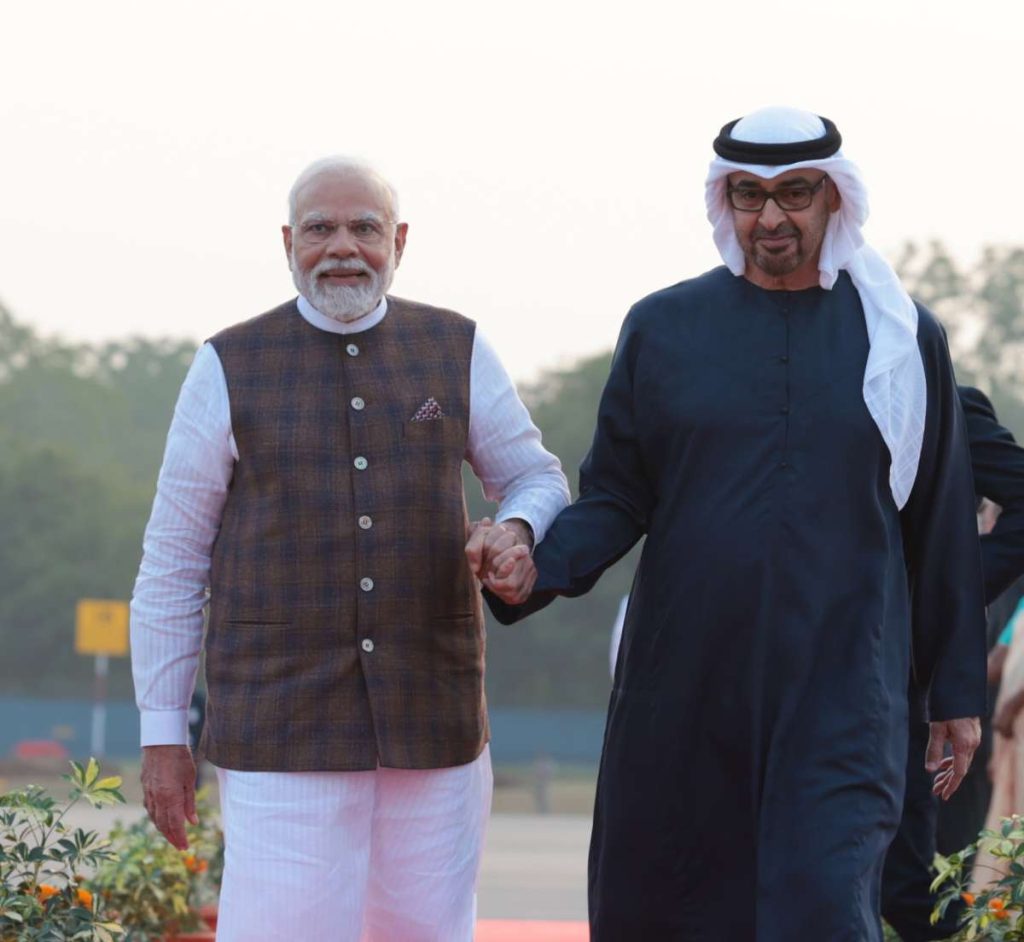
Indian PM Modi’s seventh visit to Abu Dhabi signifies a transformative shift in the India-UAE relationship, evolving from voluntary cooperation to mutual indispensability. This unique bond blends cultural celebration and pragmatic collaboration, with the inauguration of the first Hindu temple in the UAE symbolizing a commitment to pluralism. The vibrant Indian diaspora plays a crucial role, contributing to the UAE’s global hub status and India’s economic prowess. Looking forward, the UAE emerges as the new Gateway to India, fostering talent, trade, and finance connections on a global scale. … writes Dr Maheep
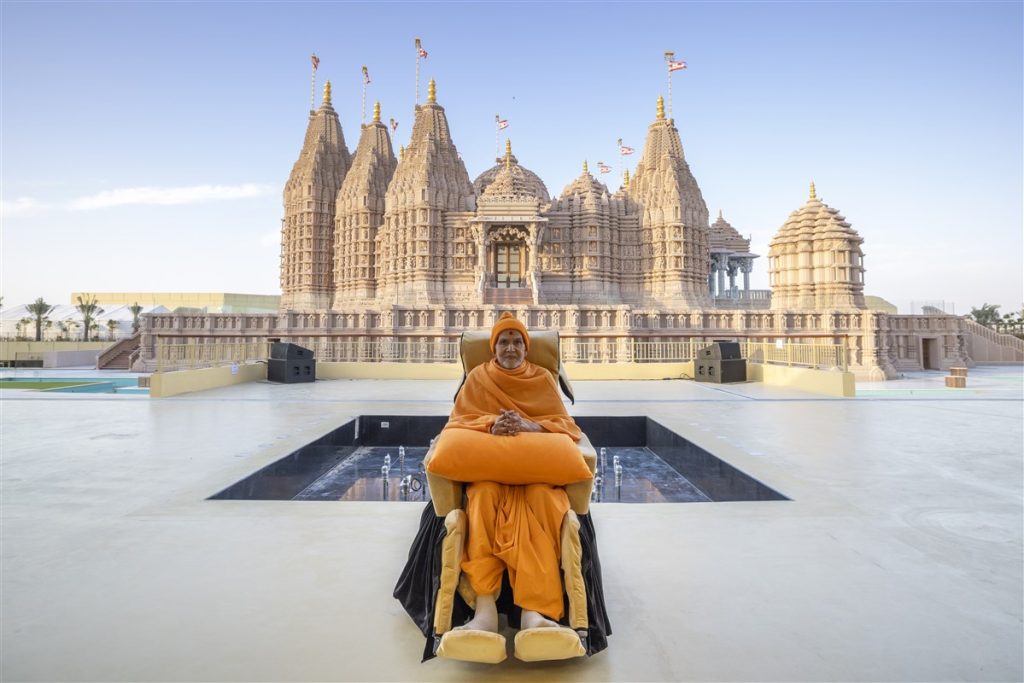
Excitement fills the air as the opening of the Abu Dhabi BAPS Hindu Mandir draws near. Hundreds of community members and devotees have gathered at the temple to warmly welcome their spiritual leader, His Holiness Mahant Swami Maharaj. Arriving as a state guest on a special flight, Mahant Swami Maharaj will perform the sacred Vedic ceremony to inaugurate the first traditional stone temple in the Middle East. The temple was described as a “spiritual oasis for global harmony” and a “timeless testament” to the vision of the late leader Pramukh Swami Maharaj, made possible by the collaboration and generosity of the UAE government, India, and BAPS itself.
Meanwhile, a huge crowd of over 60,000 expatriate Indians living in the UAE are eagerly waiting for the Indian Prime Minister Narendra Modi’s visit, packing into the Zayed Sports City Stadium to hear his address. The event, called “Ahlan Modi,” became so popular that registration had to be closed early due to overwhelming demand.
This two-day visit by Prime Minister Modi highlights the strong ties between India and the UAE. He is also scheduled to attend the World Government Summit in Dubai and make history by inaugurating the BAPS Swaminarayan Sanstha temple in Abu Dhabi, the capital of the United Arab Emirates, on February 14.
The day marks the auspicious occasion of Basant Panchami, a Hindu festival celebrating the arrival of spring and the worship of Saraswati, the goddess of knowledge, wisdom, and arts. This makes it a particularly fortunate day for new beginnings, especially for starting children’s education. Further adding to the specialness of the day, February 14th also coincides with the birth anniversary of Shastriji Maharaj, the founder of BAPS Sanstha, according to the lunar calendar. Therefore, it presents a unique and auspicious opportunity for the opening of the BAPS Hindu Mandir, combining celebration with a commitment to knowledge and cultural heritage.
The temple, a monument to the growing religious tolerance in the region, marks a significant moment for the Hindu community in the UAE. Inspired by the graceful lotus flower, the BAPS Sanstha temple will serve as a beacon of faith and heritage for the Indian diaspora. Hand-carved stonework from India will adorn its intricate design, creating a visually stunning haven for prayer, meditation, and spiritual connection.
Beyond its religious significance, the temple embodies the strong friendship between India and the UAE. Prime Minister Modi’s acceptance of the invitation to its opening highlights this deep bond, further strengthening the ties between the two nations. Indeed, the relationship between India and the UAE goes back centuries, woven around threads of culture, religion, and trade. This kinship found new life with the rise of Sheikh Zayed bin Sultan Al Nahyan and the formation of the UAE, and has only grown stronger over time. Today, a vibrant partnership flourishes between the two nations, a testament to their enduring friendship.
India and the United Arab Emirates (UAE) have seen increasing dynamism in their relationship over the past few years. The UAE is currently India’s third-largest trading partner and second-largest export market, with trade volume expected to double to $100 billion within the next decade. This growth is aided by several interconnected developments. Since 2016, the quality of relations between the two countries has significantly improved, rising to an unprecedented warmth with the signing of the UAE-India Comprehensive Economic Partnership Agreement (CEPA) in February 2022. Over 3.5 million Indian citizens currently live in the UAE, more than in any other country abroad. This strong human connection fosters economic and cultural exchange. Finally, Prime Minister Modi’s historic visit to the UAE in 2015, the first by an Indian premier in over four decades, marked a turning point, leading to closer cooperation and mutual investment.
February 14th, the day of the inauguration of the BAPS temple by Prime Minister Modi, the day will begin with a sacred morning ceremony where the temple will be officially consecrated and blessed. Later in the evening, at 5 pm, Modi himself is expected to arrive at the temple. He will then embark on a tour of the impressive site, immersing himself in its cultural significance. Following this, the Prime Minister is scheduled to address the gathered crowd in an amphitheatre located within the temple complex.
Authorities emphasized that tolerance and harmony are the key values upon which this historic landmark stand. This intricately crafted temple, constructed from pink sandstone and white marble for $95.3 million, symbolizes the inclusivity and openness of the UAE. Swami Brahmaviharidas, head of international relations for the Baps Swaminarayan Sanstha, the organization behind the temple’s construction, eloquently told the correspondent of the Nation, that “harmony and tolerance are the very soul of this nation.”
Swami Brahmaviharidas expressed his belief that the new temple would serve as a symbol of peace and strengthen the relationship between the UAE and India. He commended the UAE’s welcoming attitude and highlighted the positive example set by its leaders, from the nation’s founder, Sheikh Zayed bin Sultan Al Nahyan, to the current president, Sheikh Mohamed. He recalled Sheikh Mohamed’s act of generosity in granting land for the temple when he was still the Crown Prince of Abu Dhabi, and described him as a kind and understanding leader. Swami Brahmaviharidas also shared an anecdote about Sheikh Mohamed’s reaction when presented with two design options for the temple, one modern and one traditional.
In 2018, Swami Brahmaviharidas presented president, Sheikh Mohamed, in a meeting where Prime Minister Narendra Modi also participated, with two design options for a new Hindu temple. One was a contemporary, conventional building, while the other was a grand, traditional structure carved from stone, echoing 10,000 years of art and culture but requiring a longer construction time. The UAE President, who was the Crown Prince then, smiled and simply said, “Your Holiness, if you are building a temple, it should look like a temple.” This wise response, shared by Swami Brahmaviharidas, emphasized the importance of honouring tradition and cultural heritage in the design of the sacred space.
Nestled in Abu Mureikha, a district within the emirate, the magnificent new temple was originally planned on 5.4 hectares of land. Its footprint eventually doubled to 11 hectares to accommodate community halls and ample parking. Artisans from Rajasthan, India, meticulously hand-carved intricate designs onto sandstone and marble, which were then shipped across the Arabian Sea and assembled on site like a giant jigsaw puzzle. Remarkably, this architectural marvel adheres to ancient Indian traditions, avoiding iron and steel altogether, relying instead on the precise fitting of stones for its structural integrity.
Skilled Indian sculptors are currently putting the final touches on intricate sandstone carvings depicting revered deities and elaborate stories from ancient epics like the Ramayana and Mahabharata. Inside the temple, artisans meticulously polished white marble pillars adorned with rows of musicians, dancers, and carvings of seashells, the sun, and the moon. Each of the seven towering spires, capped with gleaming brass, symbolizes an emirate of the UAE. These grand structures will soon house beloved Hindu deities, with the main spires showcasing scenes from the lives of revered gods like Rama, Krishna, and Shiva, in a breathtaking fusion of cultural and artistic expression.
While the temple will officially open its doors on February 14th following the grand inauguration, authorities are requesting UAE residents to wait until March 1st for their visit. In anticipation of this high demand, online registrations were launched last year to allow visitors to secure their spot. Temple project head, Pujya Swami Brahmaviharidas, highlighted the significant registration numbers from overseas visitors and kindly requested UAE residents who haven’t yet registered to consider visiting after March 1st to allow international guests initial access. To accommodate everyone, a week-long celebration filled with prayers and talks promoting harmony and peace will take place at the temple from February 15th to 21st, allowing residents to participate in the festivities later.
Modi’s seventh visit to Abu Dhabi signifies a transformative shift in the India-UAE relationship, evolving from voluntary cooperation to mutual indispensability. This unique bond blends cultural celebration and pragmatic collaboration, with the inauguration of the first Hindu temple in the UAE symbolizing a commitment to pluralism. The vibrant Indian diaspora plays a crucial role, contributing to the UAE’s global hub status and India’s economic prowess. Looking forward, the UAE emerges as the new Gateway to India, fostering talent, trade, and finance connections on a global scale. Modi and Sheikh Mohamed bin Zayed architect a prosperous Arabian Sea community, reviving its historical role as a fountainhead of inclusive globalisation.
(Dr Maheep is a leading analyst in India’s Foreign Affairs and Global Politics with a specialization in the Arab World and Islamic studies)