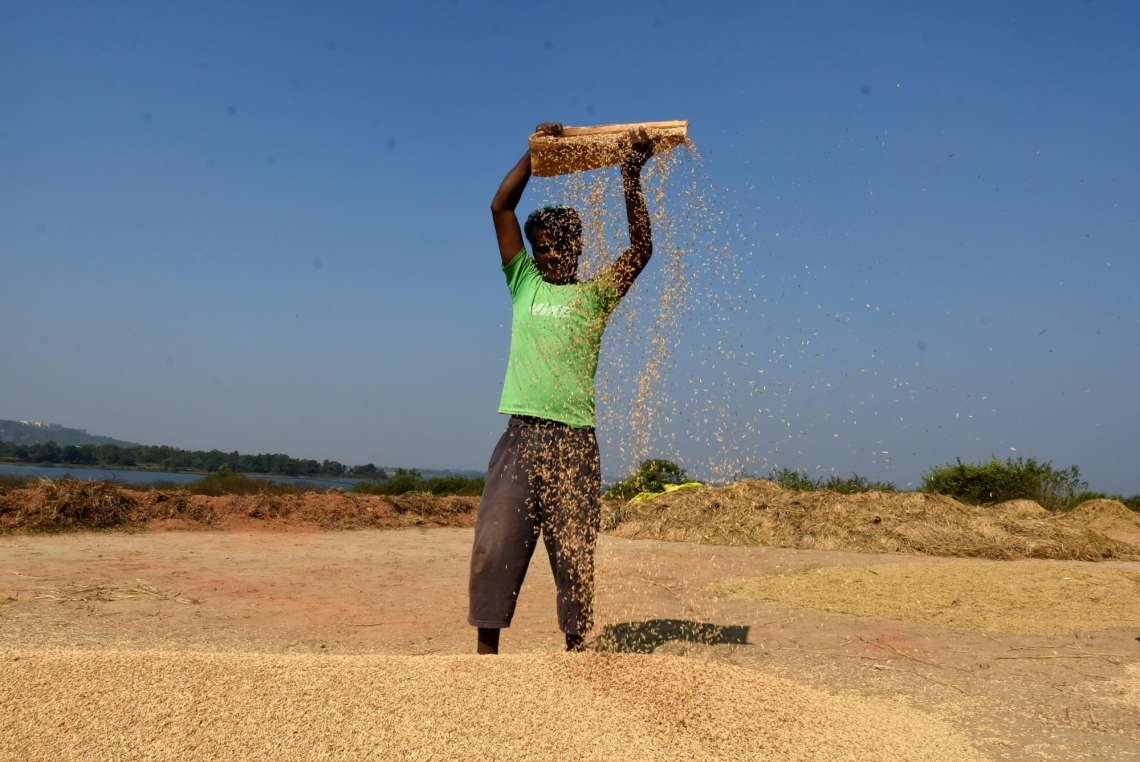
India anticipates a record Kharif harvest while consumption remains strong beyond the festive season, supported by digital payments, rising industrial output and policy measures boosting household confidence.
India is on course for a bumper Kharif harvest, with fresh government estimates pointing to record output across key food grains, coarse cereals, oilseeds and sugarcane. Releasing the first advanced estimates for the 2025–26 season on Tuesday, Union Agriculture Minister Shivraj Singh Chouhan said total food grain production was expected to rise to 173.33 million tonnes, marking an increase of 3.87 million tonnes over last year.
Despite pockets of crop damage caused by excessive rainfall, the minister said most regions benefited from a favourable monsoon, enabling strong yield performance. The Ministry of Agriculture and Farmers Welfare said ongoing sectoral gains reflected “continuous positive progress” under Prime Minister Narendra Modi’s leadership, crediting stable policies, expanded irrigation and better access to inputs for the steady rise in output.
Rice and maize are poised to lead the gains. According to the estimates, Kharif rice production is projected at 124.504 million tonnes, up 1.732 million tonnes from last year, while maize output is expected to jump to 28.303 million tonnes, a sharp rise of 3.495 million tonnes over the previous season.
Coarse cereals, pulses and oilseeds show broad-based rise
The ministry’s projections suggest a strong performance across the cereal basket. Total Kharif coarse cereals are estimated to reach 41.414 million tonnes, further strengthening India’s food security buffer at a time of global supply strains triggered by geopolitical conflicts and climate instability.
Pulses output—crucial for domestic protein needs—also reflects positive momentum. The estimates peg total Kharif pulses production at 7.413 million tonnes. Within this, tur (arhar) is forecast to reach 3.597 million tonnes, urad at 1.205 million tonnes, and moong at 1.720 million tonnes. Higher domestic production may ease inflationary pressure on retail pulse prices, which have stayed elevated over the past two years.
Oilseeds have also posted notable gains. The ministry expects total Kharif oilseed production at 27.563 million tonnes, underpinned by a healthy soybean harvest. Groundnut production is expected to rise to 11.093 million tonnes, while soybean output is projected at 14.266 million tonnes, helping reduce India’s heavy reliance on imported edible oils.
India’s sugarcane crop, meanwhile, is set for a strong rebound, with output estimated at 475.614 million tonnes, an increase of 21.003 million tonnes from last year. Though several sugar mills are grappling with cash flow challenges and lower export opportunities, the expanded crop signals improved availability for ethanol blending, a key government priority. Cotton production is projected at 29.215 million bales, while Patson and Mesta output is pegged at 8.345 million bales.
The ministry underscored that the projections are based on yield trends, local inputs and state data, and may be revised as actual crop-cutting experiment results arrive.
Demand stays firm well after festive season
Alongside the farm sector’s upbeat outlook, India’s consumption engine is also showing strong signs of resilience. A fresh assessment by financial services firm Prabhudas Lilladher suggests that domestic demand has remained robust even after the festive period, defying expectations of a post-Diwali slowdown.
The report—based on spending patterns across FY2024 to FY2026—found that increased consumption was not merely a festive blip but backed by broader economic momentum. It highlighted a surge in digital transactions as a key indicator. UPI payments, it noted, jumped from ₹8,400 billion in FY2025 to ₹11,500 billion so far in FY2026, signalling sustained household spending activity.
Credit card usage has also remained strong, rising from ₹527 billion in FY2025 to ₹579 billion in FY2026. Analysts say the durability of these trends points to increased consumer confidence, particularly among urban and semi-urban buyers.
Industrial indicators reflect confidence
The report also cited broader industrial and manufacturing indicators to reinforce the strength of domestic demand. India’s manufacturing PMI climbed to 59.2 in October 2025—well above the expansion threshold—while the Index of Industrial Production (IIP) for September rose 4% year-on-year. Manufacturing output expanded 4.8%, suggesting producers are gearing up for a period of continued demand.
According to the firm, India’s short- to medium-term consumption outlook is buoyed by several supportive factors, including expected tax relief, proposed GST rationalisation, the likely rollout of the 8th Pay Commission, and higher rural incomes on the back of this year’s strong monsoon and robust Kharif and Rabi harvests.
Looking ahead to FY26 and FY27, it expects private final consumption expenditure (PFCE) to stay resilient, helped by policy-driven boosts such as anticipated rate cuts totalling 100 basis points, reductions in income tax, and lower GST slabs.
Global headwinds remain a risk
However, the report cautioned that global economic uncertainty—including US trade tariffs and external demand weakness—could temper the pace of domestic expansion. Despite this, India’s resilient payment trends, healthy agricultural outlook and improving industrial activity together paint a broadly positive picture for the country’s economic trajectory in the coming quarters.