The IMF, in its October update, had already revised India’s growth forecast upward to 6.6 per cent from 6.4 per cent, citing firm momentum that helped offset the impact of higher US tariffs on Indian exports…reports Asian Lite News
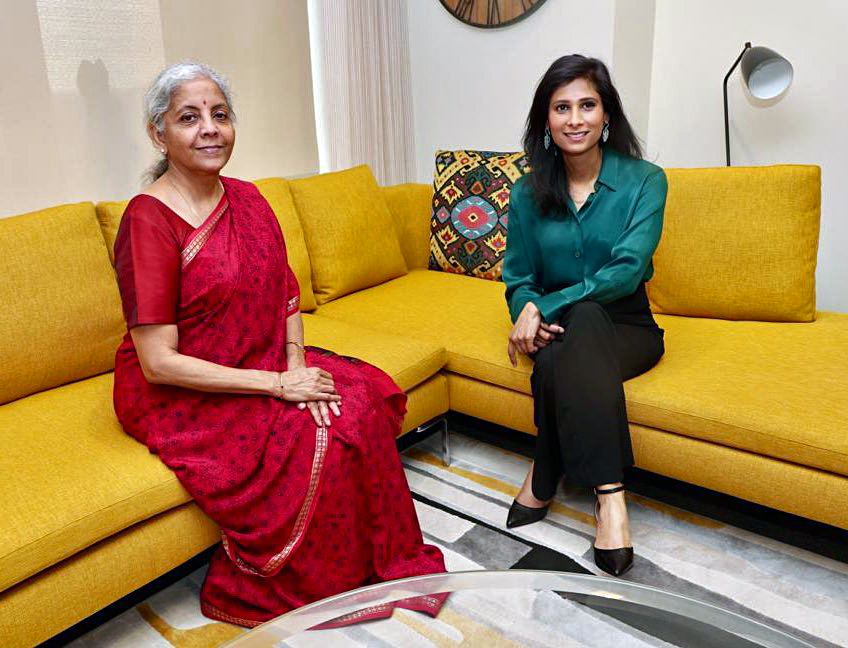
India’s growth story may end the year on a stronger note than earlier estimates suggested. Former IMF chief economist Gita Gopinath said the Indian economy is likely to grow at around 7 per cent in the current fiscal, slightly above the 6.6 per cent projected by the International Monetary Fund (IMF) in October.
Gopinath explained that the IMF projection was made before official data showed a sharper expansion in the July–September quarter. “I would say that the IMF number (India’s growth projection) was 6.6 per cent that came out in October. But their forecast for the second quarter of the current fiscal, in terms of what the growth would be, was much lower than what it turned out to be at over 8 per cent. Just doing math, I would expect that India’s GDP growth would go up close to 7 per cent,” she said.
Her assessment comes after the Reserve Bank of India earlier this month raised its own growth estimate for the current fiscal to 7.3 per cent from 6.8 per cent. The revision followed strong output numbers in the July–September quarter, when GDP expanded by 8.2 per cent, the fastest pace in six quarters, supported by domestic demand even as global trade and policy uncertainty continued.
The IMF, in its October update, had already revised India’s growth forecast upward to 6.6 per cent from 6.4 per cent, citing firm momentum that helped offset the impact of higher US tariffs on Indian exports.
Gopinath, now a Gregory and Ania Coffey Professor of Economics at Harvard University, placed India’s short-term momentum within a longer horizon. Sustained high growth, she said, would be key to meeting the country’s long-term ambitions.
“But it is not easy to maintain even 8 per cent growth for a 20-year period on a sustained basis. That is going to require sustained reforms,” she said. She added that India’s current performance has exceeded expectations formed before tensions escalated between New Delhi and Washington.
On global trade, Gopinath said tariff levels have risen sharply in recent years, but suggested the worst may be over, at least from the US side. “I do think that at least from the US perspective, we are past peak tariffs in the US. 2026 is a year of mid-term elections in the US. I do not think there is anybody who wants to have a lot of uncertainty in the run-up to the elections, tariffs have raised prices in the US,” she said.
According to her, higher tariffs have fed into inflation and increased living costs, which has affected affordability and reduced the appetite for further hikes. On India–US trade talks, Gopinath stressed the importance of cooperation between the two countries.
“Therefore, I think it is very important that both countries, both India and the US, work together to come up with a mutually agreeable solution,” she said.
Ties between New Delhi and Washington have been strained since US President Donald Trump doubled tariffs on Indian goods to 50 per cent in August, including an additional 25 per cent duty linked to India’s purchase of Russian crude oil.
The situation has been compounded by repeated criticism of India by officials in the Trump administration. Gopinath also addressed questions on the IMF’s engagement with Pakistan and concerns about accountability.
She said the Fund’s mandate is to support countries facing economic distress, regardless of the multiple factors behind that crisis. “And countries that are in economic crisis are in crisis for multiple reasons. It is not just because of macroeconomic policies that go wrong, but there is social conflict, conflicts at their borders,” she said.
She pointed out that it is the affected country that approaches the IMF for assistance, and any support follows careful deliberation. “…therefore, it is always an important and careful decision that has to be made about, can you help the country? Can you truly improve its macroeconomic situation?” she said.
Gopinath underlined that IMF programmes are not unilateral decisions by its leadership but are approved by its full membership. “So there is a defined set of policies that are accepted, and you have to implement it based on that,” she said.