August 8, 2025
4 mins read

Putin says UAE could host Trump summit

Putin proposes UAE as venue for Trump meeting as ceasefire deadline looms, while Moscow and Abu Dhabi deepen ties through prisoner swaps and trade deals.

Russian President Vladimir Putin has revealed that the United Arab Emirates could play host to a landmark meeting between himself and former US President Donald Trump — a summit that could decide the fate of ongoing peace talks in Ukraine.

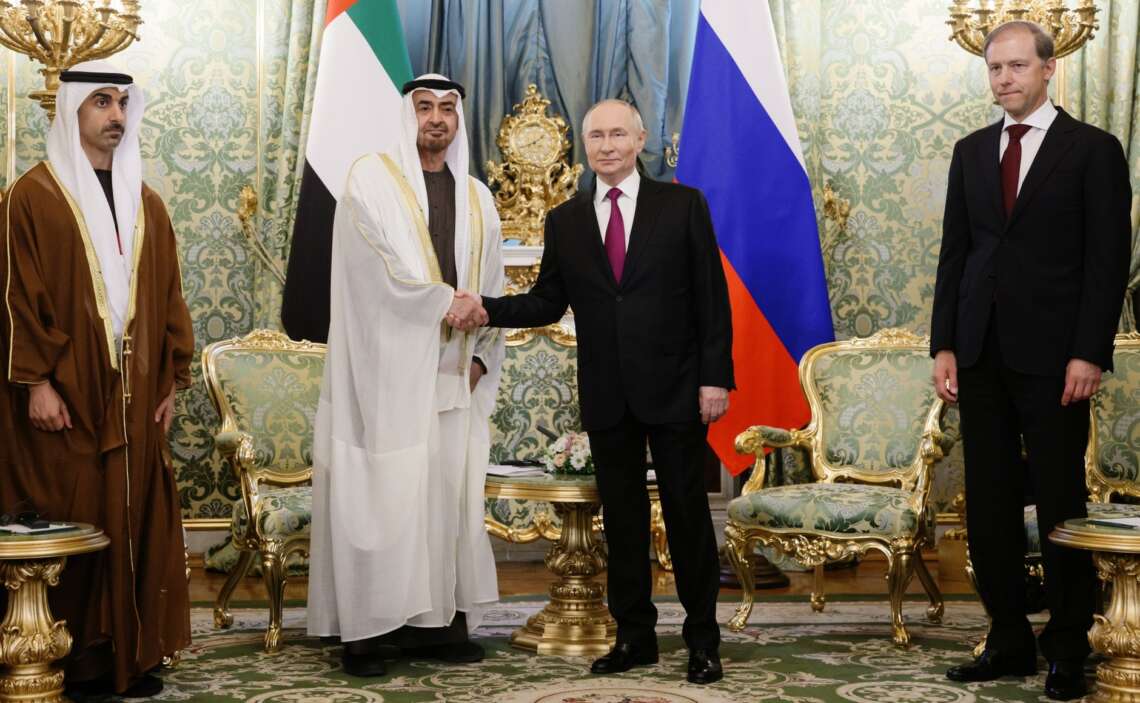
Speaking alongside UAE President His Highness Sheikh Mohamed bin Zayed Al Nahyan during an official visit to Moscow, Putin described the Gulf nation as one of Russia’s most trusted partners and a willing mediator in high-stakes diplomacy.

“We have many friends who are willing to help us organise such events,” Putin told reporters. “One of our friends is the president of the United Arab Emirates.” He also praised UAE Foreign Minister Sheikh Abdullah bin Zayed Al Nahyan for his role in building strong bilateral ties and for facilitating dialogue in times of crisis.

The comments come just days before a critical deadline — set for Friday — for Russia and the United States to agree on a Ukraine ceasefire deal or face sweeping new sanctions. Russian foreign policy advisor Yuri Ushakov confirmed that, at the suggestion of Washington, both sides have agreed “in principle” to hold a bilateral meeting at the highest level “in the coming days.”

The New York Times has reported that Trump intends to meet Putin as early as next week, with a possible follow-up trilateral summit involving Ukrainian President Volodymyr Zelensky. Plans reportedly began taking shape after Putin’s three-hour meeting on Wednesday with Trump’s special envoy, US businessman Steve Witkoff.

Strategic talks in Moscow

Sheikh Mohamed bin Zayed’s visit to Moscow was already scheduled as part of ongoing UAE–Russia diplomatic engagement. The two leaders met at the Kremlin to review their countries’ growing strategic partnership, spanning trade, investment, space, energy, and other key economic sectors.

The UAE President described UAE–Russia relations as built on “mutual trust, respect, and deep-rooted constructive engagement” that has endured for more than half a century. He reaffirmed his country’s commitment to “building effective partnerships and enhancing international cooperation to address global challenges.”

Putin, in turn, hailed the UAE as a valued partner whose role in global mediation has been “highly constructive.” He specifically thanked Sheikh Mohamed for facilitating prisoner exchanges between Russia and Ukraine — efforts that have so far seen more than 4,000 detainees returned to their respective countries.

Both sides also discussed the upcoming Russia–Arab Summit, scheduled for October, which Putin described as an opportunity to deepen Moscow’s engagement with the Arab world.

The Kremlin talks extended to regional stability, with both leaders underscoring the importance of achieving a just and lasting peace in the Middle East. Sheikh Mohamed reiterated the UAE’s support for a two-state solution between Israel and Palestine, stressing that stability and prosperity in the region depend on comprehensive diplomatic resolutions.

The meeting also touched on the ongoing war in Ukraine. While neither side disclosed details, the UAE leader’s presence alongside Putin at such a critical juncture is being interpreted by diplomats as a signal that Abu Dhabi may play a broader role in facilitating US–Russia–Ukraine dialogue.

Strengthening economic ties

On the sidelines of the visit, the UAE and Russia signed several landmark agreements, including the Trade in Services and Investment Agreement (TISIA). Signed by UAE Minister of Foreign Trade Dr Thani bin Ahmed Al Zeyoudi and Russian Minister of Economic Development Maxim Reshetnikov, the deal aims to expand cooperation in financial technology, healthcare, transportation, logistics, and professional services.

The TISIA complements the UAE’s existing Economic Partnership Agreement with the Eurasian Economic Union (EAEU) — comprising Armenia, Belarus, Kazakhstan, Kyrgyzstan, and Russia — further embedding the Gulf nation into the region’s trade network.

In another key development, UAE Minister of Energy and Infrastructure Suhail Mohamed Al Mazrouei and Russian Minister of Transport Andrey Nikitin signed a Memorandum of Understanding to boost collaboration in land transport infrastructure.

Putin hosted an official luncheon for Sheikh Mohamed and his delegation after a ceremonial welcome at the Kremlin. National anthems were played, and both leaders reviewed an honour guard before moving indoors for the high-level talks.

While the UAE leader’s visit was originally framed as part of ongoing bilateral cooperation, the sudden possibility of the Gulf nation becoming the stage for Putin–Trump negotiations has added significant diplomatic weight to the trip.

If the meeting does take place in Abu Dhabi, it could mark one of the most politically charged summits in recent years — drawing together two powerful but controversial leaders, with the fate of Ukraine’s war and Western sanctions hanging in the balance.

For now, all eyes remain on whether Friday’s deadline will pass without agreement, and if the UAE will step into the global spotlight as a host for what could be a defining moment in 21st-century geopolitics.
Newsdesk

Newsdesk

Aravind Rajeev is Deputy News Editor at Asian Lite, mostly covering the Middle East and GCC. He has over eight years of experience as a journalist, with a background in ground-level reporting, crime reporting, as well as international and regional news.

Previous Story

UN: Gaza wastes away in hunger hell

Next Story

Trump pushes ‘strong economy’ message

Previous Story

UN: Gaza wastes away in hunger hell

Next Story

Trump pushes ‘strong economy’ message

Latest from -Top News

Pakistan Risks Overstretching Itself in Yemen War

Pakistan’s expanding military role in Saudi Arabia amid the Yemen conflict could strain its defence resources and fragile finances…reports Asian Lite News Desk Pakistan’s military involvement in the war in Yemen may prove unsustainable because of mounting financial pressures and competing security demands, according to a new report. Islamabad’s growing military presence in Saudi Arabia risks stretching its defence resources while exposing the country to greater strategic and economic challenges. An article by Andrew Wilson in One World Outlook describes Pakistan’s involvement as a case of “fiscal and strategic overreach”, arguing that the country lacks the financial flexibility to sustain an expanded military commitment. Pakistan’s external finances depend heavily on an International Monetary Fund (IMF) programme, financial support from Gulf countries and remittances from Pakistani workers in the region. The report argues that deeper military involvement in the conflict could place additional pressure on these sources of financial stability. It also warns that deploying troops and military equipment abroad could weaken Pakistan’s capacity to address security challenges along its eastern border and deal with two domestic insurgencies. The move could also draw Islamabad into a conflict it has sought to approach cautiously. A Reuters report in May, citing Pakistani security and government sources, said Islamabad had deployed around 8,000 troops, a squadron of approximately 16 aircraft, mostly JF-17 fighter jets, two drone squadrons and a Chinese HQ-9 air-defence battery to Saudi Arabia. According to those sources, Riyadh was financing the deployment, with Pakistani personnel operating the equipment. The sources also said a confidential agreement contemplated the possibility of deploying up to 80,000 troops. Islamabad has not confirmed those figures, although it has acknowledged its military presence in Saudi Arabia, including the deployment of fighter jets at King Abdulaziz Air Base from April. The One World Outlook article argues that Saudi financial support can cover allowances and operating expenses but cannot easily replace military equipment needed elsewhere or resolve the political and strategic challenges of participating in the Yemen conflict. Pakistan’s defence budget is another concern. For the 2026-27 financial year, the federal government allocated PKR 3 trillion, or approximately $10.8 billion, to defence services. The allocation represents an 18 per cent increase from the original PKR 2.55 trillion provision and amounts to around 2.1 per cent of projected gross domestic product (GDP). Defence spending accounts for approximately 16 per cent of the federal government’s PKR 18.8 trillion expenditure. Military pensions are budgeted separately at PKR 822 billion, while debt servicing costs stand at approximately PKR 8 trillion, more than two-and-a-half times the defence allocation. The report argues that these competing financial obligations leave little room for additional military expenditure without placing further pressure on public finances. Pakistan’s reliance on IMF assistance also limits its fiscal flexibility. The country must meet the conditions attached to the programme, including a primary budget surplus target of 2 per cent of GDP and continued restraint on development spending. According to the article, these requirements make it difficult for Islamabad to finance an additional military commitment without compromising other budgetary priorities. Pakistan’s economic indicators offer limited reassurance. Economic growth for the 2025-26 financial year is estimated at between 3.6 and 3.7 per cent, while inflation reached approximately 10.3 per cent in September following an energy price shock. Foreign exchange reserves stood at around $21.5 billion at the end of September. Although this marks an improvement from the low levels recorded in 2023, the report notes that the reserves cover only a few months of imports. Financial assistance from Gulf partners remains central to Pakistan’s external stability. The article says Islamabad holds approximately $8 billion in Saudi deposits at its central bank. In July, the State Bank of Pakistan said Riyadh had extended the maturity of $5 billion in deposits to December 2028, easing the country’s immediate external financing requirements. A further $3 billion deposit was also extended in the spring. However, the article argues that these arrangements provide temporary relief rather than long-term financial independence, particularly as regional conflict threatens the stability of the Gulf economies on which Pakistan relies. The report concludes that Pakistan faces a difficult balance between supporting Saudi Arabia militarily and preserving the financial and military resources needed to address its domestic and regional challenges.

UK and Germany Ratify Kensington Treaty

Britain and Germany ratify the Kensington Treaty, agreeing new cooperation on AI, quantum research, defence and security while targeting investment, jobs and Russian hybrid threats…reports Asian Lite News Desk Britain and Germany

Economic tide is turning in Bangladesh

If there is one thing that can bring some comfort to the struggling Bangladeshi economy, it is good relations with India. Bangladesh should remember that Delhi’s backing, through easy supplies of essentials
Go toTop

Don't Miss

Trump and Putin to meet in Alaska for Ukraine talks

The location is symbolic – Alaska lies less than 90