Bangladesh’s ruling BNP and opposition alliance led by Jamaat-e-Islami are locked in a growing dispute over constitutional reforms proposed under Mohammed Yunus, with disagreements over the reform process, the balance of presidential and prime ministerial powers, and implementation of measures endorsed through a February referendum…writes Dr Sakariya Kareem
The fundamentalist Bangladesh Jamaat-e-Islami is on the rise again and this poses a threat for India. This is substantiated by the results of the last general elections in Bangladesh and some recent political developments.
The Jamaat-e-Islami, the major Islamic fundamentalist party in Bangladesh, had played an important role in the so-called July Uprising of 2024 that brought down the Awami League government of Sheikh Hasina. During the succeeding Interim Government led by Mohammed Yunus, Jamaat could strengthen its organization.
Though the Jamaat-e-Islami was nowhere near the majority mark to form the government after the general elections in February 2026, it managed to win the maximum number of seats ever in any election of the Jatiya Sangsad, the Bangladesh parliament. Jamaat could also increase its vote share substantially.
The Jamaat-e-Islami won 10 seats in the 1986 parliamentary election, and 20 in 1991. In the election in 1996 Jamaat could win only three seats while in 2001 it bagged 17 seats and was a partner in the BNP government. In 2008, when the Awami League formed the government, Jamaat could win only two seats. Between 2013 and 2026, Jamaat could not contest in elections as the Sheikh Hasina government had banned the party.
In 2026, the tally of Jamaat increased to 68 seats; making the party a strong opposition against the BNP government. Allies of Jamaat won nine more seats, bringing the total tally of the Jamaat-led 11-party alliance to 77.
Notably, in the northern and south-western districts of the country bordering India, Jamaat-e-Islami secured significant electoral victories in the 2026 elections; in Khulna and Rangpur securing the majority of the seats. It won 58 of the 208 seats in the six divisions bordering India. Of these, 36 were in districts bordering the Indian state of West Bengal and 16 in districts bordering the state of Assam.

In Khulna in the south-west Jamaat and its allies won the majority of the 36 seats and in the Rangpur division in the north 18 of the 33 seats. Both these divisions are bordering West Bengal. The vote share of Jamaat was 48.26 percent in Khulna and 39.78 percent in Rangpur.
In these two divisions, there is a preponderance of Hindus. In the Rangpur division the percentage of Hindu population is around 13 and in the Khulna division around 12.
According to analysts, Muslim voters could have united in voting for the extremist Jamaat in the areas where the proportion of Hindus was higher than the national average of about eight percent. This could be a sign of polarization on religious lines in Bangladesh.
The Sylhet division in north-east Bangladesh, also bordering India, was an exception. At 13.5 percent, Sylhet has the highest representation of Hindus among all the administrative divisions of Bangladesh. The Moulavi Bazar district in the Sylhet division has a particularly high share of Hindus in the total population, nearly 25 percent. Yet, the Jamaat could win only one seat in Sylhet.
In Sylhet, however, the relations between the Muslims and Hindus are traditionally cordial. As against 1710 mosques, there are 391 temples in Sylhet. Even among the Muslims, there is a strong influence of the Sufi school of moderate Islam.
Sylhet has a strong economic foundation, too. This is based on remittances in foreign currency of a large expatriate community living especially in the UK, tea plantations and natural gas and energy. Tourism provides another foundation of a strong economy. Agriculture thrives on the fertile land of Sylhet.
The incidence of poverty is comparatively lower, with about 18.5 percent of the population in Sylhet being below the poverty line. In the economically advanced Chittagong division, too, the Jamaat cut a sorry figure in the elections. Here, the Jamaat and its allies could win only five seats while the BNP and its allies captured 48.
This lends credence to the belief that Islamic fundamentalism thrives amid poverty and economic backwardness. The Chittagong division has the lowest incidence of poverty in Bangladesh, with 15.2 percent of the people below the poverty line.
Taking advantage of the patronage it had received from the Mohammed Yunus government, the Jamaat-e-Islami could entrench its position in the major centres of learning in Bangladesh like the Dhaka University and the Chittagong University through its student wing: the Islamic Chhatra Shibir. The Jamaat is now using its student wing to spread pro-Pakistan feelings among the student community in Dhaka.
The Dhaka University Central Students Union, now affiliated to Islamic Chhatra Shibir, had lately displayed in the university museum photographs and speeches of founder of Pakistan Mohammed Ali Jinnah. Of particular concern was one of his speeches delivered at the Race Course Maidan in Dhaka in 1948 when Jinnah declared that “Urdu and Urdu alone” would be the state language of Pakistan; ignoring the sentiments of the Bengalis of East Pakistan. He repeated his position in an address at Dhaka University three days later.
Notably, the Jatiyatabadi Chhatra Dal, the student wing of the ruling BNP, condemned the display; calling it a “disgraceful act” that tarnished the image of the university. The Dhaka University authorities have since formed a committee to investigate how these photographs were put on display.
A snowballing flash point between the ruling BNP and the opposition 11-party alliance led by the Jamaat-e-Islami is a proposed constitutional reforms chalked out under Mohammed Yunus government. The essence of this planned reform is to undermine the secular character of the constitution of Bangladesh and to curtail the power of the Prime Minister and increase that of the President so the government is in a perpetual turmoil, say observers.
The BNP members of parliament of Bangladesh had refused to join a constitutional reforms council on the ground that the constitution of Bangladesh had no provision for the formation of such a council. The BNP wanted to form a parliamentary committee to examine the issue of constitutional reforms. Members of Parliament of the Jamaat and its allies have, however, refused to join such a parliamentary committee.
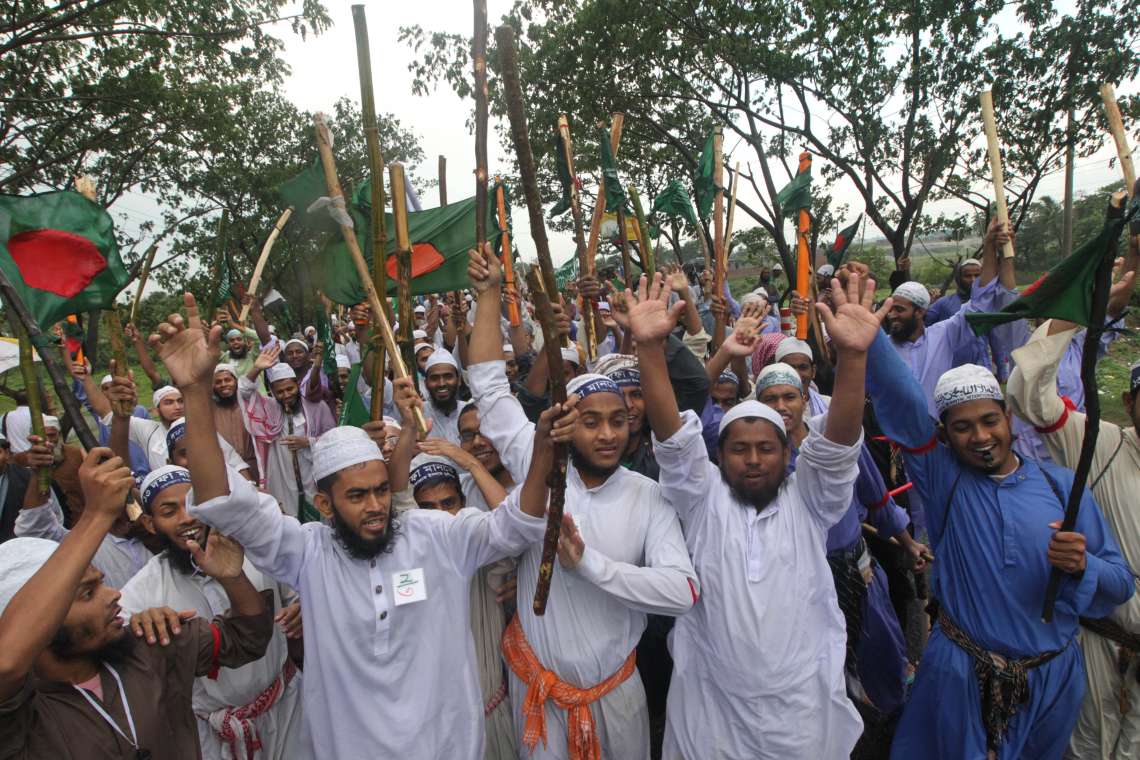
Now Jamaat and its allies are taking to the streets the issue of constitutional reforms mandated through a referendum that was held along with the elections in February last. On April 4, the 11-party alliance held a crowded rally in Dhaka, demanding immediate implementation of constitutional reforms. One more rally has been planned in the coming weeks, according to reports.
With the Jamaat-e-Islami gaining in strength in areas bordering the Indian states of West Bengal and Assam, New Delhi of course has cause for concern. To curb the growing influence of the communal Jamaat, one of the answers may lie in India helping BNP to develop the economically backward border regions through a hand-holding approach.