At Davos, TRENDS and global partners urge the Abraham Accords to be embraced as a living framework for coexistence, development and people-driven peace beyond political agreements….reports Asian Lite News
The Abraham Accords should be seen not only as a diplomatic breakthrough but as a long-term framework for development, coexistence and human-centred peace, according to speakers at a high-level session held on the sidelines of the World Economic Forum in Davos.
The discussion, titled From Agreements to Outcomes: The Abraham Accords and the Path to Peace and Prosperity, was organised by the Inter-Parliamentary Coalition for Global Ethics in partnership with the International Committee on Countering Extremist and Hate Speech (ICCEHS). It brought together decision-makers, policymakers, academics, media professionals and civil society representatives from more than 20 countries, reflecting growing international interest in how the accords can be translated into tangible social and economic outcomes.
TRENDS Research & Advisory played a prominent role in the session, with its CEO Dr Mohammed Abdullah Al-Ali delivering a keynote address that framed the Abraham Accords as a transformational moment in the Middle East’s modern history. He argued that the agreements go beyond formal political normalisation, representing instead a new ethical and cultural framework for redefining peace in a region long shaped by conflict.
Dr Al-Ali said the accords signal a shift from the traditional logic of conflict management to one focused on building coexistence, mutual understanding and shared prosperity. He noted that peace is most sustainable when it is rooted in human relationships rather than solely in state-to-state agreements, and when it is reinforced through education, culture and economic cooperation.
TRENDS Research & Advisory played a prominent role in the session, with its CEO Dr Mohammed Abdullah Al-Ali delivering a keynote address that framed the Abraham Accords as a transformational moment in the Middle East’s modern history.
Drawing on historical experience, Dr Al-Ali stressed that lasting peace cannot be imposed from above, but must be cultivated from the grassroots through sustained societal engagement. He highlighted the importance of empowering young people through cross-border projects, exchange programmes and innovation-driven partnerships that allow new generations to experience cooperation firsthand.
He also underlined what he described as the “Abrahamic dimension” of the accords, noting that shared moral values such as respect for human dignity, recognition of diversity and commitment to dialogue form a foundation for long-term stability. This ethical framework, he said, provides a common language for societies seeking to move beyond cycles of mistrust and polarisation.
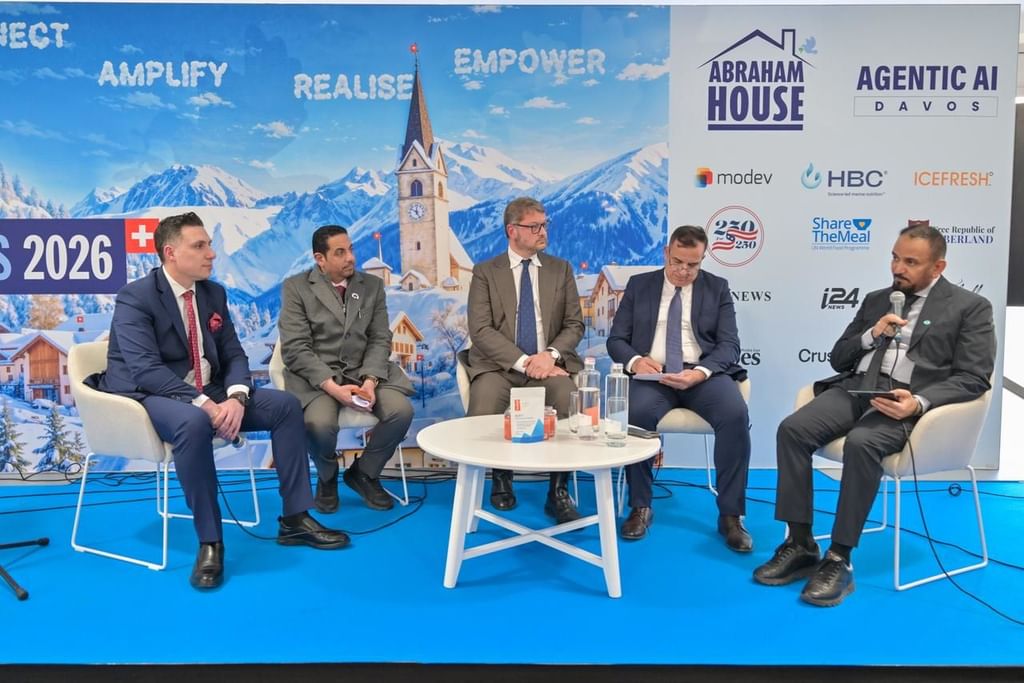
The panel discussion, hosted by Abraham House in Davos, explored how the Abraham Accords can evolve from a diplomatic milestone into a practical model for regional and international cooperation. Participants examined the role of media, education, civil society and private enterprise in ensuring that normalisation delivers visible benefits to people’s daily lives.
A central theme of the discussion was the need to translate political agreements into integrated public policies that support social cohesion and inclusive development. Speakers agreed that without tangible societal impact, peace risks remaining symbolic rather than transformative.
Dr Nidal Shuqair, Executive Director of ICCEHS, described the Abraham Accords as a historic turning point for the region, emphasising that peace is a continuous process rather than a single event. “Peace is not a moment, but a journey. Prosperity is not a promise, but a responsibility,” he said, calling for sustained investment in people, institutions and cooperation.
During the session, Dr Shuqair officially announced the launch of the ICCEHS Abrahamic Coexistence Programme, a new initiative aimed at promoting people-to-people engagement, countering extremist narratives and building a culture of tolerance. He described the programme as an innovative effort to transform agreements into practical realities through education, dialogue and joint action.
The Davos session reflected a broader push to position the Abraham Accords as a global model for peace-building that can be adapted beyond the Middle East. Participants concluded that the true success of the accords will be measured not by signatures alone, but by their ability to create opportunity, dignity and stability for future generations.