India’s BRICS presidency puts the Global South’s development needs centre stage, advancing digital infrastructure, finance, trade, sustainability and a stronger voice in global governance…reports India Daily News Desk
India’s year at the helm of BRICS has put the concerns of the Global South firmly on the international agenda, with New Delhi using its presidency to push practical cooperation on digital infrastructure, development finance, trade, health, agriculture and sustainable growth.
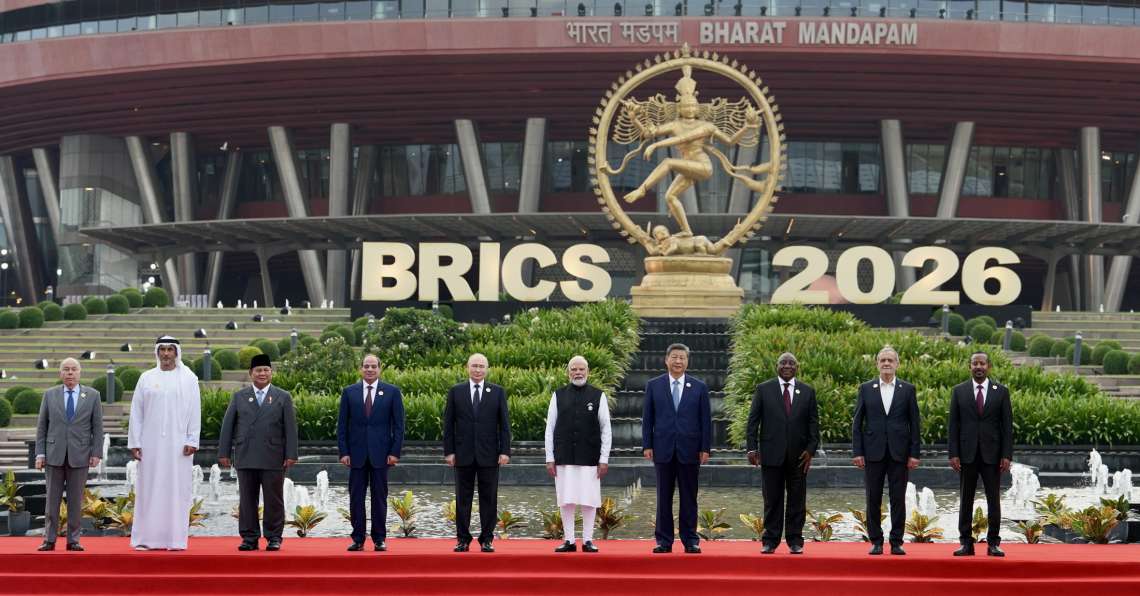
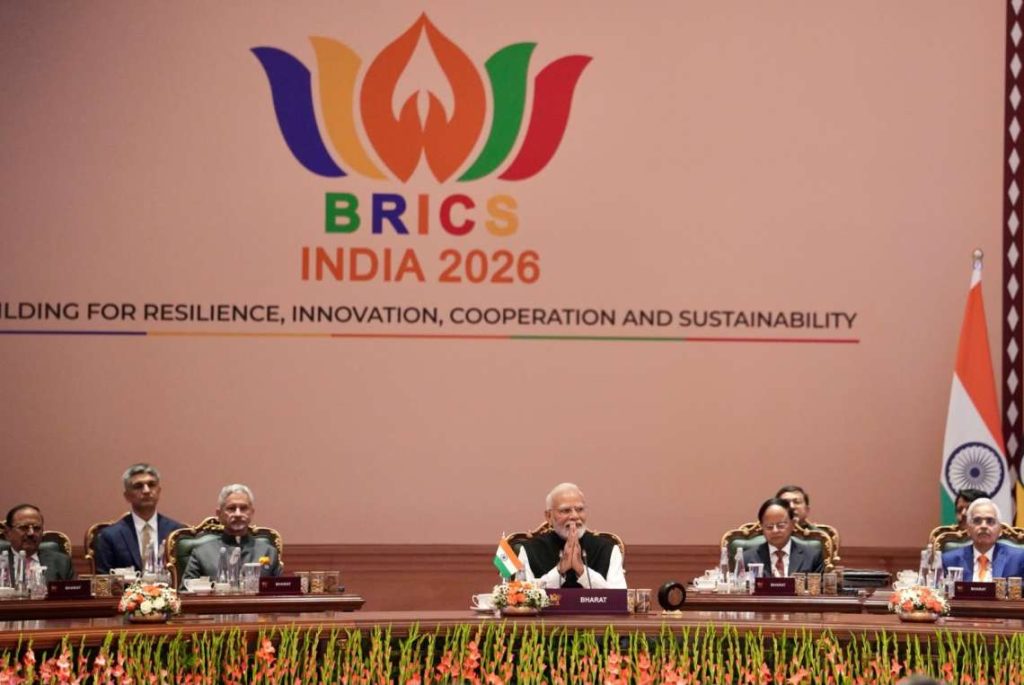
The 18th BRICS Summit in New Delhi concluded this week with the adoption of the New Delhi Declaration, a 140-point document that calls for greater representation for developing countries in global institutions and deeper cooperation among emerging economies.
For India, the presidency was an opportunity to move the grouping beyond its traditional identity as a forum of emerging economies and towards a platform capable of addressing some of the everyday development challenges facing countries across Asia, Africa and Latin America.
BRICS has also changed significantly since its original formation. The expanded grouping now has 11 members, including Brazil, Russia, India, China, South Africa, Egypt, Ethiopia, Indonesia, Iran and the UAE. Together, the bloc accounts for nearly half of the world’s population and around 40 per cent of global economic output measured at purchasing power parity.
India’s digital blueprint
One of India’s strongest contributions has been its experience with digital public infrastructure.
Over the past decade, Aadhaar, the Unified Payments Interface and the wider India Stack have created a digital ecosystem used for payments, identity verification, banking and public services at enormous scale.
UPI has increasingly become an international reference point for interoperable digital payments, with linkages and services extending to countries including the UAE, Sri Lanka and France. At the New Delhi summit, BRICS leaders backed deeper cooperation on digital public infrastructure and noted an Indian proposal for a repository of digital public infrastructure solutions, alongside pilot projects for digital transformation.
The significance extends beyond technology. For developing economies, affordable digital systems can reduce barriers to financial services, improve public-service delivery and bring small businesses and previously underserved communities into the formal economy.
The challenge now is to translate India’s experience into solutions that can be adapted to different national systems rather than simply exporting a single model.
Finance for development
Finance is another central pillar of India’s BRICS agenda.
For much of the Global South, the problem is not simply a lack of investment. High borrowing costs, currency risks and limited access to long-term finance can make essential infrastructure projects difficult to fund, particularly where returns are social and economic rather than immediately commercial.
The New Development Bank, established by BRICS in 2015 and headquartered in Shanghai, was created to provide an additional source of infrastructure and sustainable-development finance.
India has already been a significant beneficiary. NDB’s first India project supported the upgrading of more than 1,500 km of major district roads in Madhya Pradesh. The completed project improved connectivity for rural communities and helped link villages with wider road networks, markets, schools, healthcare and employment opportunities.
The bank has continued backing Indian infrastructure. In 2024, it approved financing for the Madhya Pradesh State Highways Improvement Project, aimed at upgrading road links between district headquarters, commercial centres, agricultural areas and industrial corridors.
The bigger question is whether BRICS finance can increasingly reach beyond major state-backed infrastructure and support MSMEs, entrepreneurs and smaller economic actors.
India has argued that BRICS cooperation should produce tangible benefits for ordinary people, rather than remaining confined to government-to-government agreements.
That approach puts MSMEs, employment, entrepreneurship and access to finance closer to the centre of the development debate.
The same principle applies to digital technology. A payment system matters not because it demonstrates technological sophistication, but because it can allow a small trader to receive money instantly, help a migrant family send funds home or give a previously excluded citizen access to formal financial services.
This is where India’s BRICS approach could have its greatest impact across the developing world.

Trade, currencies and the dollar question
BRICS has also continued discussions around greater use of local currencies and stronger links between national payment systems.
At the New Delhi summit, members backed deeper financial cooperation and the use of local currencies in trade and investment. However, the latest declaration did not establish a common BRICS currency, despite years of speculation about whether the bloc could directly challenge the dominance of the US dollar.
That points to a more gradual strategy: reducing transaction costs, improving cross-border payment connectivity and expanding the ability of member states to conduct more trade in their own currencies.
India’s UPI and Brazil’s Pix illustrate the potential. Both are major domestic instant-payment systems, and BRICS countries are exploring greater cross-border connectivity, although differences in currencies, capital controls and trade structures remain significant obstacles.
India’s presidency has also pushed BRICS towards health, agriculture, sustainability, innovation and energy security.
The New Delhi Declaration calls for an orderly and inclusive energy transition while recognising the continuing importance of fossil fuels to emerging and developing economies. It also highlights energy security, resilient supply chains, critical minerals and digitalisation of energy systems.
Agriculture has emerged as another area for practical cooperation, including initiatives involving ecological sustainability and digital farming.