UN chief described 2025 as a “profoundly challenging year for international cooperation and the values of the United Nations
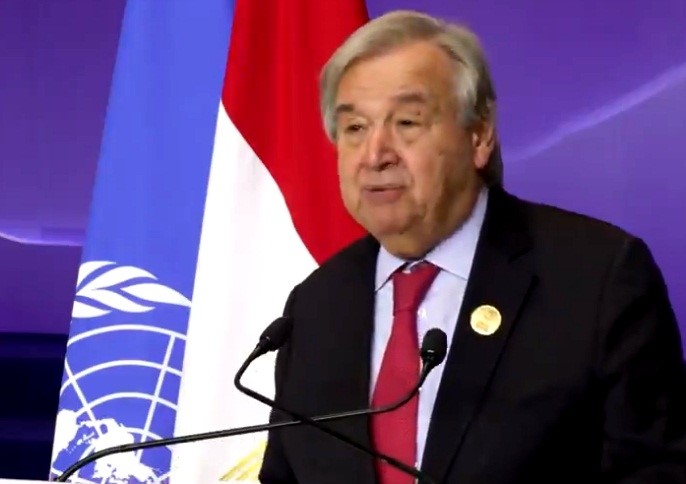
UN Secretary-General António Guterres on Saturday warned that global cooperation is under growing threat, as he marked the 80th anniversary of the first United Nations General Assembly with a speech in London. He cautioned that “powerful forces” are actively working to undermine multilateralism, even as the world faces overlapping crises that demand collective action.
Speaking at the Methodist Central Hall, where representatives of 51 nations gathered on January 10, 1946, for the UN General Assembly’s inaugural session, Guterres reflected on the organisation’s origins and its evolving role. The meeting was held in London because the UN’s permanent headquarters in New York had not yet been constructed. Guterres paid tribute to Britain’s decisive role in the creation of the United Nations and praised the country for continuing to champion the institution eight decades later.

However, he described 2025 as a “profoundly challenging year for international cooperation and the values of the United Nations.” “We see powerful forces lining up to undermine global cooperation,” he said, acknowledging rising geopolitical tensions, weakened trust between nations and increasing pressure on multilateral institutions. “Despite these rough seas, we sail ahead,” he added, striking a note of resilience.
Guterres pointed to recent diplomatic successes as evidence that international cooperation, though strained, remains possible. He cited the newly adopted treaty on marine biological diversity, which establishes the first legal framework for conserving and sustainably using biodiversity in the two-thirds of the world’s oceans that lie beyond national jurisdictions. “These quiet victories of international cooperation — the wars prevented, the famine averted, the vital treaties secured — do not always make the headlines,” he said. “Yet they are real. And they matter.”
Turning to global economic shifts, the UN chief said the rapid growth of developing economies compared with developed nations underscores the urgent need to reform global governance structures. “Every day, the share of global GDP held by developed economies shrinks, bit by bit,” he said. “Every day, emerging economies grow in size, in strength and in influence.” He argued that institutions created in 1945, including the UN Security Council and major international financial bodies, no longer reflect today’s realities.
Reforming the Security Council is essential, Guterres said, as is updating the power structures of international financial institutions. A recent UN report on the world economy showed that developing countries grew by 4.2 per cent last year, compared with 2.9 per cent growth among developed economies. India, which has long sought a permanent seat on a reformed Security Council, was the fastest-growing major economy, recording growth of 7.4 per cent.

This address marked Guterres’s final annual speech to the General Assembly outlining his priorities, as his second and final term as secretary-general ends on December 31. While he acknowledged the severity of global crises, he also pointed to areas of progress. “Even in this turbulence, we have succeeded in claiming space for the United Nations where it was not a given,” he said.
Without naming specific countries, Guterres criticised the actions of some permanent Security Council members whose use of veto powers has paralysed the body. “Some seek to put international cooperation on deathwatch,” he warned, saying such actions are shaking the foundations of multilateralism. “I can assure you: we will not give up.”
He also highlighted the UN’s worsening financial crisis, again without naming the United States, which has fallen behind on its mandatory contributions. “Today’s situation is totally unsustainable,” Guterres said, calling on all member states to honour their financial obligations or agree on reforms to prevent a budget breakdown. At the same time, he said the UN is streamlining its structure to improve efficiency and reduce costs.