Pakistan, Saudi Arabia and Türkiye sign a mutual defence pact, strengthening regional security cooperation as conflicts involving Iran, Israel, Gaza and Lebanon intensify, reports Asian Lite News Desk
Pakistan, Saudi Arabia and Türkiye have signed a landmark defence agreement aimed at strengthening military cooperation and collective deterrence amid escalating tensions and conflicts across West Asia.
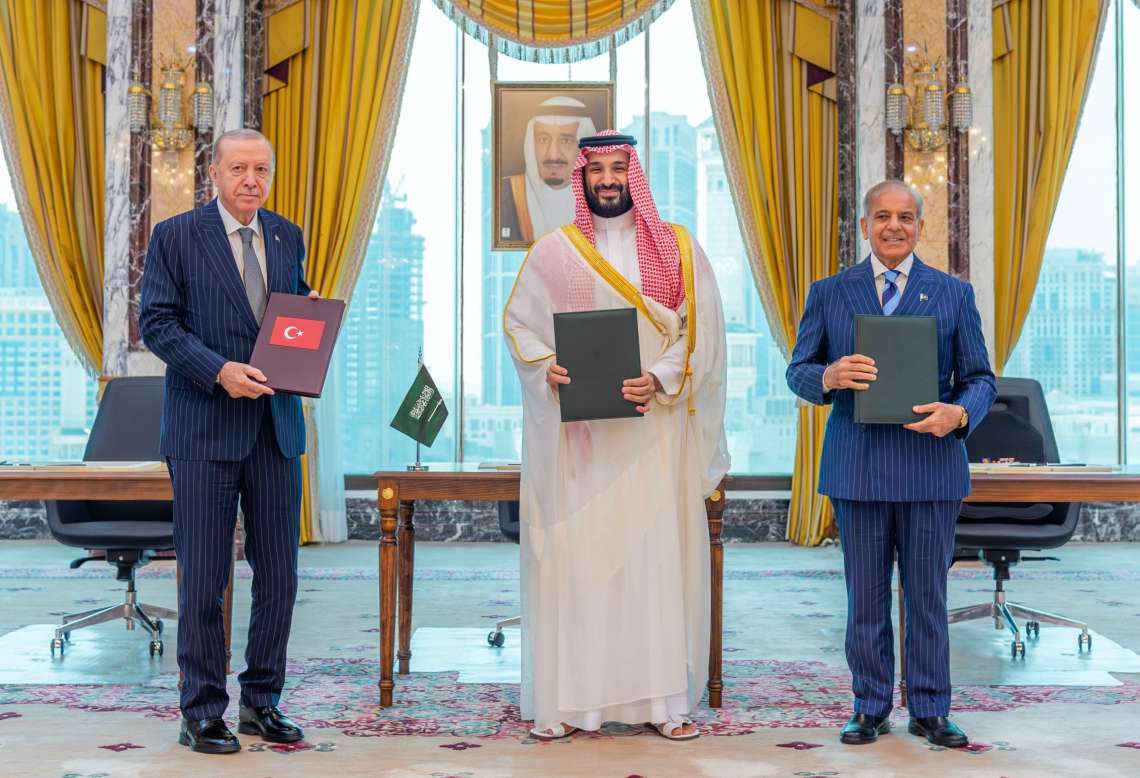
The Mecca Joint Defence Agreement, signed on Friday during a meeting between Saudi Crown Prince Mohammed bin Salman, Turkish President Recep Tayyip Erdoğan and Pakistan Prime Minister Shehbaz Sharif in Saudi Arabia, declares that an armed attack against any one of the three countries will be considered an attack against all three.
According to the summit statement, the agreement is designed to strengthen collective deterrence against aggression while expanding cooperation across a broad range of defence areas. The pact comes as regional security tensions remain high, with conflicts involving Iran, Israel, Gaza and Lebanon reshaping alliances across West Asia.

Saudi Arabia has faced repeated drone and missile attacks during the wider regional conflict, with key infrastructure and petroleum facilities among the targets of operations attributed to Iran and regional groups including the Houthis and Iraqi militia organisations. Riyadh has consequently been seeking to broaden its security partnerships beyond its traditional alliances.
The agreement also comes amid increasingly strained relations between Türkiye and Israel over the war in Gaza and wider regional hostilities. Ankara has taken a strongly critical position on Israel’s military operations in Gaza, while tensions have also been heightened by the broader conflicts involving Iran and Lebanon.
The three-way pact has fuelled speculation about the emergence of a broader security grouping among major Muslim-majority countries, with some observers describing the concept as a potential “Islamic NATO”. Reuters had previously reported, citing two regional sources familiar with the discussions, that Pakistan, Saudi Arabia and Türkiye were preparing to deepen their defence cooperation.
The agreement builds on a bilateral security framework established last year, when Pakistan and Saudi Arabia signed a Strategic Mutual Defence Agreement during Prime Minister Shehbaz Sharif’s state visit to Riyadh. That agreement similarly stated that aggression against either country would be treated as aggression against both.

The latest pact expands that security framework by bringing Türkiye into the arrangement. Pakistan Defence Minister Khawaja Asif had previously suggested that the Islamabad-Riyadh security partnership could eventually include Türkiye and Qatar.
Speaking to Pakistani media outlet Hum News in May, Asif said a broader economic and defence arrangement among countries in the region could reduce dependence on powers outside the region. He stressed that such cooperation would not be directed against any particular country, but would instead aim to protect peace and stability within the region.
The development is being closely watched by regional and global powers, including India, given its potential implications for the strategic balance in South Asia and West Asia.
Following the Pakistan-Saudi bilateral defence agreement last year, India’s Ministry of External Affairs said New Delhi would assess its implications for national security and regional and global stability.
MEA spokesperson Randhir Jaiswal said India had taken note of the formalisation of the long-standing arrangement between Pakistan and Saudi Arabia, adding that the government would study its consequences for India’s national security and regional stability.