A surge in militant attacks in Pakistan, particularly in Balochistan, is raising fresh concerns over the security of China’s multi-billion-dollar investments under the China-Pakistan Economic Corridor. ..reports Asian Lite News Desk
A sharp rise in militant attacks in Pakistan has intensified concerns over the security of China’s multi-billion-dollar investments in the country, with analysts warning that escalating violence could undermine the future of the China-Pakistan Economic Corridor (CPEC), according to a report.
The report by US-based Radio Free Europe/Radio Liberty (RFE/RL) said the Baloch Liberation Army (BLA) has increasingly targeted Chinese interests in recent years, accusing Beijing of exploiting the natural resources of Pakistan’s Balochistan province.
“For China, Pakistan’s Balochistan represents a massive investment that’s a crucial part of its touted Belt and Road Initiative (BRI). Its flagship project, the China–Pakistan Economic Corridor (CPEC), has garnered some USD 65 billion in funding from Beijing for everything from infrastructure development to energy generation and mineral extraction,” the report said.
It noted that Balochistan, which borders Afghanistan and Iran, has long been affected by an insurgency led by ethnic Baloch militant groups that have carried out attacks on gas pipelines, electricity infrastructure and railways over several decades.

“But the resource-rich region, which borders Afghanistan and Iran, is also home to a long-simmering insurgency by ethnic Baluch militants marked by decades of attacks on gas pipelines, electricity towers, and railways. And in recent years, militant violence in Balochistan has seen a sharp increase, with Chinese projects a frequent target — putting a strain on relations between the traditionally strong allies and the future of investments in the country,” the report added.
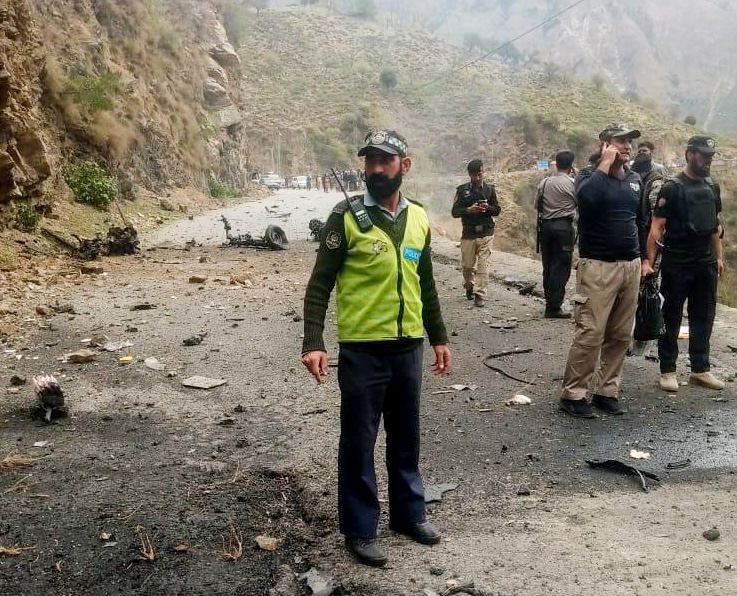
According to RFE/RL, the BLA carried out more than 100 attacks in Balochistan during the first six months of this year. Foreign investment projects, along with Pakistani police, military and paramilitary personnel, were among the primary targets.
Analysts cited in the report said the unrest stems largely from longstanding political and economic grievances in the province.
Baloch militant groups, which seek an independent Balochistan, accuse Pakistan of exploiting the province’s abundant natural resources while failing to deliver economic development. Despite its vast territory, strategic location, access to the Strait of Hormuz through Gwadar Port and borders with Iran and Afghanistan, Balochistan remains Pakistan’s least developed province.
The report said persistent security threats, political instability, bureaucratic hurdles and economic challenges have delayed the implementation of several CPEC projects.
“CPEC has lost much of its initial momentum,” RFE/RL quoted Islamabad-based analyst Khalid Sultan as saying.
He said the prevailing security situation had made it increasingly difficult for Pakistan to attract new foreign investment.
“If the current security environment persists, China is likely to adopt a more cautious approach by slowing the pace of new investments, reassessing existing projects, and demanding stronger security guarantees before committing additional resources,” Sultan added.
The report also noted that security and terrorism continue to dominate discussions between senior Chinese and Pakistani officials as militant violence intensifies across Pakistan.
Political scientist Ayesha Siddiqa, author and senior fellow at King’s College London, said the security situation was unlikely to improve in the near future and could deteriorate further.
“Given the current global geopolitical conditions, this threat is bound to increase,” she told RFE/RL, citing the rise in militant violence in Pakistan and the country’s indirect involvement in developments in the Middle East.
“There are multiple forces which are responsible for a continuous turmoil in the region and conditions are not going to be favourable,” she added.