Declaration reflects growing alignment against unilateral sanctions and Western-led global structures…reports Asian Lite News Desk
The Shanghai Cooperation Organisation (SCO) has condemned military strikes on Iran, called for a comprehensive and just resolution to the Palestinian question, backed the formation of an inclusive government in Afghanistan and opposed unilateral coercive economic measures, as the bloc reaffirmed its commitment to building a representative and equitable multipolar world order.
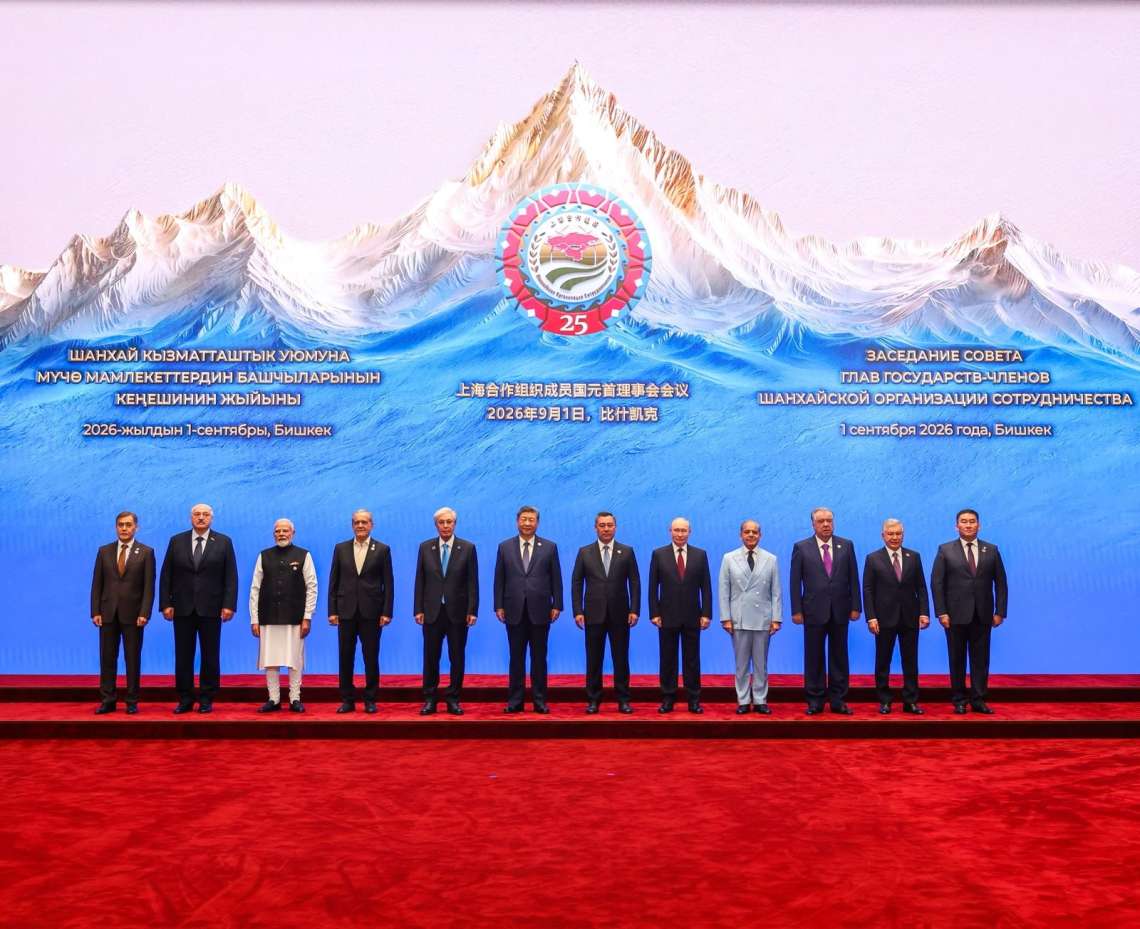
Prime Minister Narendra Modi, along with fellow leaders of SCO member states, signed the Bishkek Declaration at the conclusion of the organisation’s summit in Kyrgyzstan, as the 10-member grouping marked 25 years since its establishment.
The joint declaration, adopted following the 26th meeting of the SCO Council of Heads of State held in Bishkek between August 31 and September 1, outlined the bloc’s positions on a range of geopolitical, security, economic and technological issues.
The leaders, including Russian President Vladimir Putin and Chinese President Xi Jinping, agreed to continue efforts to strengthen the SCO and advance the objectives outlined in the organisation’s Development Strategy through 2035.
The Council of Heads of State is the SCO’s highest decision-making body and meets annually on a rotational basis. The organisation’s members are Russia, China, India, Pakistan, Iran, Belarus, Uzbekistan, Kazakhstan, Tajikistan and Kyrgyzstan.
In the Bishkek Declaration, the member states reaffirmed their commitment to what they described as a representative, democratic and equitable multipolar world order. The leaders also expressed concern over the growing militarisation of Information and Communication Technologies and warned against threats to critical information infrastructure.
On the situation in Iran and the wider Middle East, SCO members said they were deeply concerned by recent developments and reiterated their previously stated condemnation of military strikes on Iranian territory that resulted in civilian casualties and caused significant economic damage.
The declaration said such actions violated the principles and norms of international law and the United Nations Charter and created serious risks for international peace, security and stability.
The member states also expressed condolences to the Iranian people and government over the death of Supreme Leader Seyyed Ali Khamenei and to the families of those killed.
SCO leaders reaffirmed their support for Iran’s sovereignty and territorial integrity and said the conflict should be resolved exclusively through political and diplomatic means. They also welcomed efforts aimed at reducing tensions and preventing further escalation in the region.
The grouping further backed Iran’s rights under the Treaty on the Non-Proliferation of Nuclear Weapons, stressing the need for strict adherence to its provisions and balanced implementation of its principles.
Member states called for strengthening the global nuclear disarmament process and the international non-proliferation regime while emphasising the inalienable right of countries to conduct research, produce and use atomic energy for peaceful purposes.
They also supported equitable, sustainable and mutually beneficial international cooperation in the nuclear field without discrimination, arguing that restrictive measures imposed in this area run contrary to international law.
On West Asia, the SCO said a comprehensive and just settlement of the Palestinian question remained the only viable path towards ensuring lasting peace and stability in the region.
The declaration also addressed Afghanistan, with member states reaffirming their commitment to the establishment of the country as an independent, neutral and peaceful state free from terrorism, war and narcotics.
The SCO said the formation of an inclusive government involving broad participation from all ethno-political groups in Afghan society was essential to achieving sustainable peace and stability in the country.
On global economic governance, member states noted the increasing importance of the SCO region in the world economy and sustainable development and called for further reforms to make the international economic system more representative and equitable.

They pledged support for an open, transparent, fair, inclusive and non-discriminatory multilateral trading system based on internationally accepted principles and rules, promoting global economic growth, ensuring fair market access and providing special and differential treatment for developing countries.
The SCO members also strongly opposed unilateral coercive measures that they said contravened the UN Charter, international law and the principles and rules of the World Trade Organisation.
Such measures, the declaration said, undermine international security, including food, energy and humanitarian security, and have a damaging impact on the global economy.
The member states said they would continue implementing the SCO Economic Development Strategy through 2030 to deepen regional economic cooperation, expand and balance trade, maintain stable production and supply chains and promote sustainable economic growth.
The leaders also supported greater cooperation on antimonopoly policy and said relevant agencies would increase practical coordination.
Recognising the growing importance of e-commerce, SCO members said they intended to improve cross-border digital trade infrastructure, reduce costs and increase trust among businesses across the region.
They also called for greater cooperation in using digital technologies to protect consumer rights and developing common approaches for resolving cross-border commercial disputes online.
On security, the SCO reaffirmed its commitment to combating what the organisation describes as the “three evils” — terrorism, separatism and extremism.
The leaders strongly condemned terrorism in all its forms and manifestations and said double standards in combating terrorism were unacceptable. They called on the international community to intensify cooperation against terrorism, including efforts to prevent the cross-border movement of terrorists.
The member states also noted the consensus adoption of the Comprehensive Convention on International Terrorism and reiterated that the SCO would continue contributing to regional peace, security and prosperity.
The organisation announced the practical launch of the Universal Center for Countering Security Challenges and Threats in Tashkent, which will include specialised centres focusing on information security and anti-drug coordination.
The declaration also approved the establishment of an Information Security Center and a Center for Combating Transnational Organised Crime, along with regulations governing the Executive Committee of the SCO Anti-Drug Center.
Expressing concern over what they described as the militarisation of Information and Communication Technologies, SCO leaders opposed threats targeting critical information infrastructure.
The declaration specifically raised concerns about unauthorised satellite internet services, stating that their provision without national licences could violate international telecommunications law.
Member states stressed the importance of ensuring equal rights for all countries in regulating the internet and reaffirmed the sovereign right of states to manage their respective national segments of cyberspace.
The leaders also called for a legally binding international instrument aimed at preventing an arms race in outer space and condemned what they described as the unlimited expansion of global missile defence systems by certain groups of states.
The declaration further highlighted the importance of intercivilisational and intercultural dialogue in promoting mutual respect, tolerance and the protection of tangible and intangible cultural heritage.
In this context, the SCO welcomed India’s proposal to hold a Forum of Civilizations under the organisation’s auspices in the autumn of 2026. The leaders also acknowledged the significance of the International Day of Dialogue among Civilizations.
Besides the Bishkek Declaration, participants at the SCO summit signed 27 additional documents covering cooperation across security, economic and institutional areas.
The SCO was founded in July 2001 by China, Russia, Kazakhstan, Kyrgyzstan, Tajikistan and Uzbekistan. India became a full member in 2017.
Apart from its 10 full members, the organisation has two observer states — Afghanistan and Mongolia — and 15 dialogue partners: Azerbaijan, Armenia, Cambodia, Laos, Nepal, Turkey, Sri Lanka, the United Arab Emirates, Kuwait, Maldives, Bahrain, Myanmar, Egypt, Saudi Arabia and Qatar.
The 24th SCO Summit was held in Astana in July 2024 under Kazakhstan’s presidency, while the 25th summit took place in Tianjin, China, in 2025.