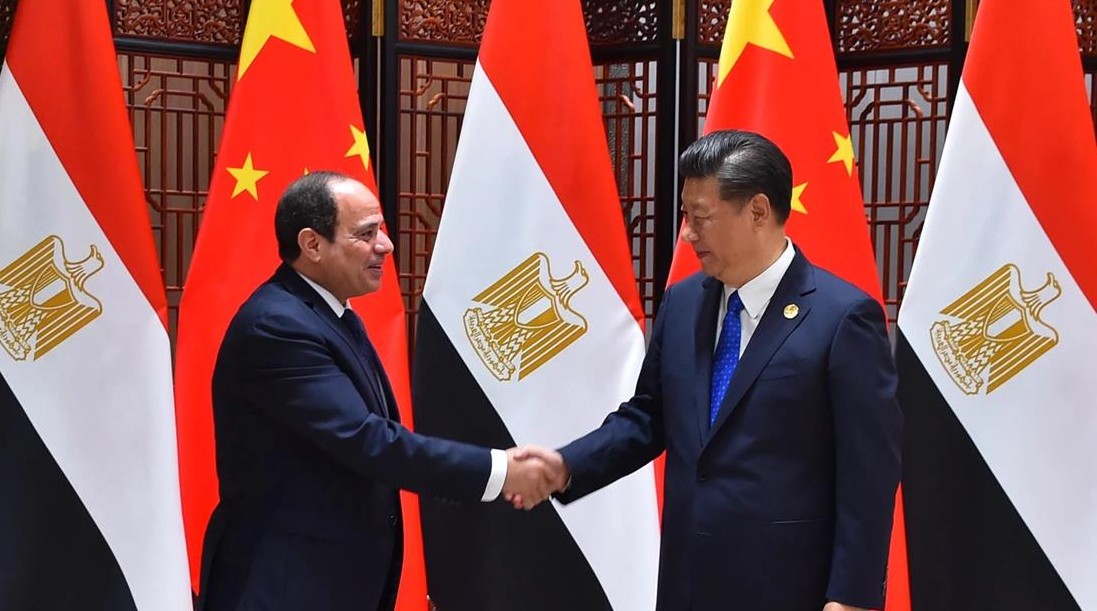
Xi Jinping’s Egypt visit marks 70 years of ties as Cairo and Beijing seek deeper investment, technology, infrastructure and coordination on regional issues, reports Asian Lite News Desk
Chinese President Xi Jinping arrived in Egypt on Tuesday for a state visit aimed at deepening one of Beijing’s most important partnerships in the Arab world, as Cairo and Beijing mark 70 years of diplomatic relations.
Xi was received by Egyptian President Abdel Fattah El-Sisi during his official visit, which comes a decade after the Chinese leader’s previous trip to Egypt. The two sides are expected to discuss bilateral cooperation as well as regional and international issues, with economic development, investment, technology and the role of the Global South among the broader themes shaping the relationship.
The visit comes at a significant moment for both countries. Egypt has increasingly positioned itself as a major economic and logistical hub connecting Africa, the Middle East and Europe, while China has expanded its commercial and infrastructure presence in the country.
The relationship was elevated to a Comprehensive Strategic Partnership in 2014, providing a framework for expanding cooperation across infrastructure, trade, investment, technology and other sectors. Chinese companies have since become prominent participants in major Egyptian development projects, including the Suez Canal Economic Zone and infrastructure projects linked to Egypt’s new administrative capital.
Xi highlighted the economic dimension of the partnership in a signed article published in Egyptian newspapers ahead of his visit. He said bilateral trade reached $20.97 billion in 2025, compared with $17.37 billion in 2024, while Chinese investment in Egypt has also grown, particularly through the Suez Canal Economic Zone, where around 200 Chinese companies are based, according to the Egyptian State Information Service.
Infrastructure has emerged as one of the most visible areas of cooperation. Chinese companies have been involved in construction of the Iconic Tower in Egypt’s New Administrative Capital, while Chinese financing and expertise have supported an electric rail connection between Cairo and the new capital.
The two countries are now looking to move beyond traditional infrastructure projects towards higher-value industries and technology. Areas identified for greater cooperation include electric vehicles, energy-storage batteries, renewable energy, electronics, telecommunications, artificial intelligence and space technology.
For Cairo, closer economic ties with China fit into a broader strategy of attracting investment and developing domestic manufacturing while using Egypt’s geographical position to strengthen its role as a regional logistics and industrial centre.
For Beijing, Egypt offers an important gateway to African and Arab markets, as well as a strategically located partner near the Suez Canal, one of the world’s most important trade routes.
The political dimension of the relationship is also significant. Egypt and China have maintained broadly aligned positions on several international issues and have promoted greater representation for developing countries in global institutions.
Xi used his pre-visit article to call for stronger cooperation among countries of the Global South and reiterated China’s support for Palestinian statehood and a two-state solution. Egyptian officials have likewise stressed the importance of diplomacy, sovereignty and peaceful solutions to conflicts in the Middle East.
The anniversary also carries historical significance. Egypt established diplomatic relations with the People’s Republic of China on May 30, 1956, becoming the first Arab and African country to do so. The two countries have since developed political, economic and cultural ties that have expanded considerably over the past seven decades.
Both governments are using the 70th anniversary to frame the relationship as a long-term strategic partnership rather than a series of individual economic projects.
Xi described China-Egypt ties as a model for cooperation among developing countries and a benchmark for China’s relations with both the Arab world and Africa.
The visit therefore comes with expectations that the two governments will seek to translate their established political relationship into deeper cooperation in advanced industries, technology and investment, while coordinating more closely on regional crises and the wider interests of the Global South.