With Fiscal management under the Yunus administration facing criticism, funds were redirected to politically symbolic initiatives, most notably the conversion of the Prime Minister’s official residence, Ganabhaban, into the “July Mass Uprising Memorial Museum”…writes Dr Rakesh Sharma
Dr Muhammad Yunus’s one-and-a-half-year rule is widely seen as one of the more turbulent phases in Bangladesh’s recent history. Critics argue that his administration normalised mob pressure as a political instrument. From the judiciary to the media, few institutions remained untouched by intimidation or coercion. Militant and extremist elements, long on the margins, appeared to gain space during this period, with concerns—often voiced privately—about their growing networks. By the time Tarique Rahman’s government assumed office in February, the economy was widely described as fragile and overstretched.
Fiscal management under the Yunus administration drew sustained criticism. The government relied heavily on borrowing and monetary expansion to meet expenditure, leading to a sharp rise in public debt—estimated by analysts to have increased by nearly 18–20 per cent in 18 months. Several large infrastructure projects initiated under Sheikh Hasina slowed or stalled. At the same time, funds were redirected to politically symbolic initiatives, most notably the conversion of the Prime Minister’s official residence, Ganabhaban, into the “July Mass Uprising Memorial Museum.”
Ganabhaban itself carries layered historical significance. Planned by Bangladesh’s founding leader Sheikh Mujibur Rahman as the Prime Minister’s Office, it later functioned as a state guest house before being turned into the residence of Sheikh Hasina. Archival materials related to Bangladesh’s political history were originally meant to be housed within the National Museum framework. The Yunus administration’s decision to relocate these to Ganabhaban, critics argue, was not merely administrative but deeply political—seeking to recast competing narratives of the nation’s past.
The project soon became contentious. Islamist political forces, particularly Jamaat-e-Islami, were seen by many observers as influential in shaping its ideological direction. The museum’s narrative reportedly attempted to elevate the July protests to the level of the 1971 Liberation War—implicitly recasting Sheikh Hasina as a principal antagonist while downplaying the historical role of groups that had opposed independence. This reframing sparked unease among historians and political commentators alike.
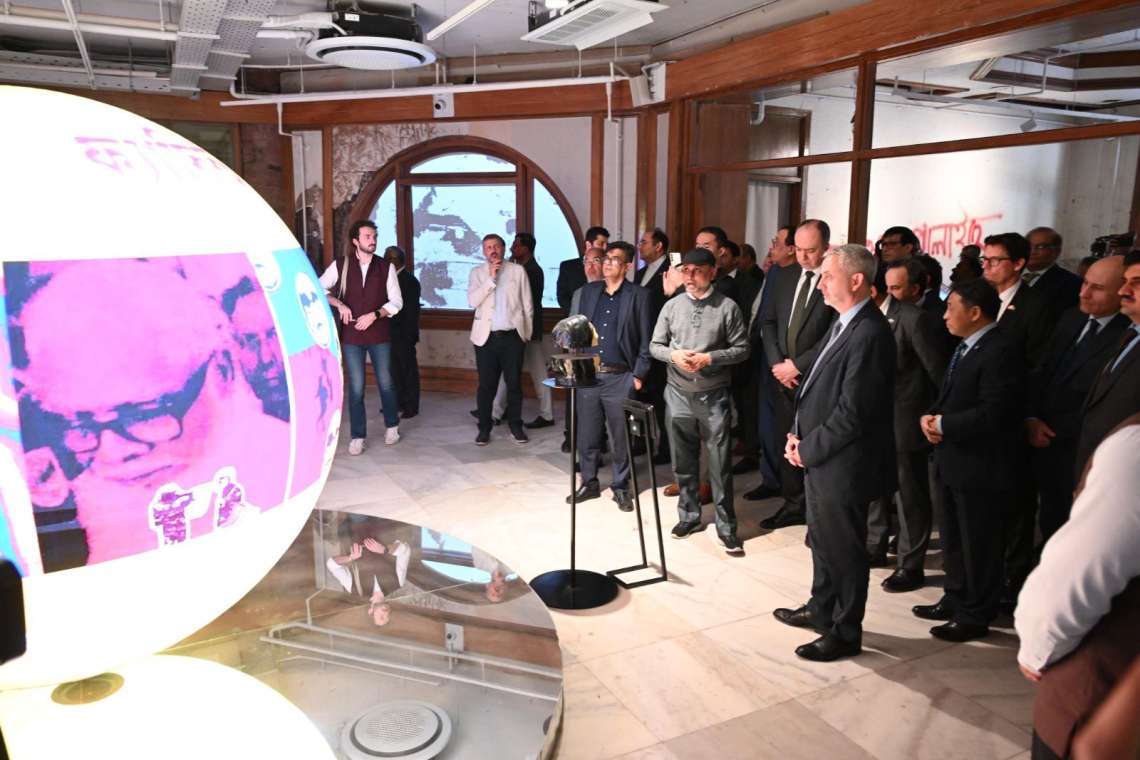
The controversy deepened after the museum’s inauguration in January 2026. Social media reactions were unexpectedly critical. Images of Sheikh Hasina’s personal belongings displayed in the museum led many users to remark on the apparent simplicity of her lifestyle, cutting against prevailing political narratives. What began as a symbolic project quickly turned into a reputational challenge.
Matters escalated further after the BNP government took office. Investigations reportedly uncovered significant financial irregularities in the museum project. Allegations ranged from inflated or duplicated billing to payments for infrastructure that did not exist. Contracts were said to have been awarded without transparent tendering processes, including high-value media production assignments given to agencies with little prior experience. While official probes are ongoing, the scale of alleged discrepancies has intensified public scrutiny.
A particularly contentious issue involved Mostofa Sarwar Farooki, then cultural affairs minister under Yunus. He appointed himself chairman of the museum’s governing board shortly before the election and initiated recruitment for high-cost positions, reportedly bypassing established procedures. The subsequent cancellation of his appointment by the BNP government triggered protests from Islamist groups, further politicising the issue.
The museum controversy is not an isolated episode. Allegations of financial misconduct surfaced during the Yunus period against several figures, including student leaders who later became associated with the National Citizen Party (NCP). Claims—yet to be fully adjudicated—were also directed at senior aides within the interim administration. These controversies contributed to a growing perception of opacity and weak institutional oversight.
Questions were also raised about decisions affecting Grameen Bank, founded by Yunus. Policy changes relating to ownership structures and licensing for affiliated businesses were criticised by opponents as presenting potential conflicts of interest, though supporters argued they were legally valid and aimed at institutional expansion. Courts, notably, cleared Yunus and associated entities in several tax-related cases initiated during the previous administration.
Over time, the initial euphoria surrounding the July protests appeared to dissipate. Sections of the public began to reassess the movement’s outcomes, with some viewing it less as a spontaneous democratic uprising and more as a politically mediated transition with unintended consequences. Trust deficits widened, particularly as expectations of governance reform and accountability remained unmet.
The alleged corruption in a memorial dedicated to those who died during the protests struck a particularly sensitive nerve. For many, it symbolised a broader erosion of moral authority. Civil society groups and ordinary citizens alike called for a comprehensive inquiry and accountability for those responsible.
The BNP government now faces a dual challenge: addressing the immediate controversies surrounding the museum project while restoring institutional credibility after a period marked by turbulence and polarisation. Whether it can do so will shape not only its own legitimacy but also the trajectory of Bangladesh’s democratic institutions in the years ahead.