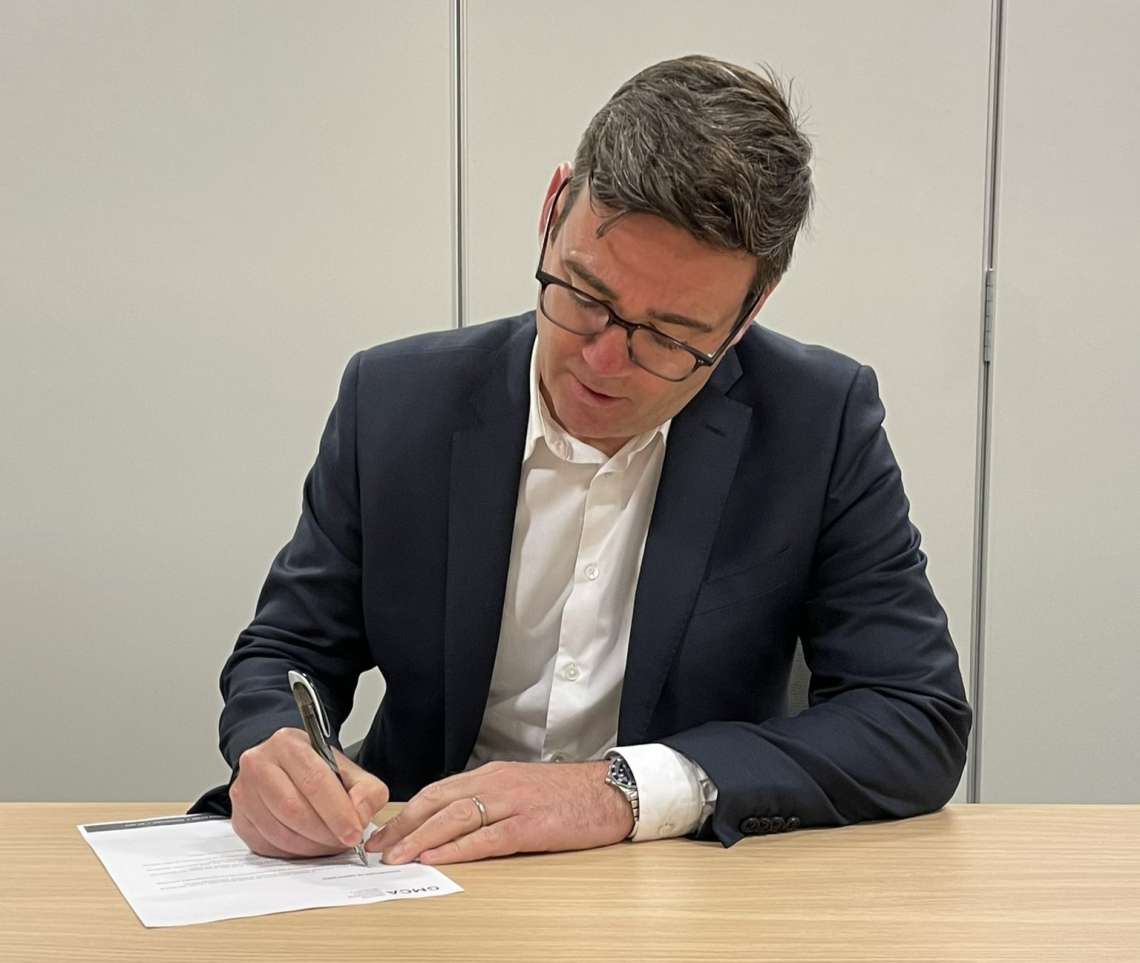
A senior Labour figure has said Andy Burnham should be allowed to stand as a parliamentary candidate, arguing the party should welcome strong local leaders into Westminster amid internal debate over selections, reports Asian Lite Newsdesk
The comments come as Labour’s ruling body continues to consider whether the Greater Manchester mayor can contest a seat at the next general election, with tensions emerging over party rules and candidate eligibility.
Lisa Nandy has said Andy Burnham should be allowed to run as a Labour MP, describing him as a “huge asset to the party”, as a dispute over candidate selection continues within the party’s national executive committee.
Burnham, the mayor of Greater Manchester, was blocked by Sir Keir Starmer from standing in the Gorton & Denton by-election last month. The seat was won by the Greens, with Labour third, behind Reform UK.
The prime minister used his majority on the national executive committee, Labour’s ruling body, to bar Burnham from standing as the Labour candidate amid concerns he would present a threat to his leadership.
Nandy, MP for Wigan, told The Times that she would support him standing in the future. “He’s a friend of mine, he’s my mayor and he was my neighbouring MP for seven years,” she said. “I think he’s a huge asset to the party. I’ll support him in whatever he wants to do.”
She added she would have voted for Burnham to be able to stand. “I think it is right that members are allowed to make their own choices about who they want to be their candidates in elections. I’ve always thought that,” she said.
While she said she respected colleagues’ views on the national executive committee, she said it would have been preferable for the decision to be taken locally. “I do understand the argument that there’s the mayor of Greater Manchester, and he’s a very good mayor, and he’s got a term to see out,” she said. “But she said that Labour members “deserve to be in the driving seat of their own lives, and it offends me when people are not, and I think that goes for our members as much as everybody else”.
Starmer is facing a growing challenge from the soft left of his party. Last week Angela Rayner, the former deputy prime minister, warned that Labour looked like “the establishment” and criticised the government’s plans to make it harder for migrants to claim permanent residence in the UK. Labour MPs believe that Starmer will face a leadership challenge if the party performs badly at elections in May.
Nandy said, “The sense I get from home and all around the country is that people want us to succeed. They need us to succeed, but it’s been so hard for so long that people are running out of it — it’s not patience, because there’s a real recognition things can’t be solved overnight. They are running out of hope.”
In the interview Nandy said she was “cautious” about the BBC moving to a paywall subscription-based model to bolster the corporation’s funding. She said: “It is absolutely right that we explore subscriptions, but if you believe, as I do, that one of the greatest strengths of the BBC is its ability to unite the nation that has found multiple ways to divide itself, then I think you’ve got to be cautious about the use of subscriptions and paywalls.”
She was also critical of the idea that the BBC did not need to fight to be “properly seen as vital”. “The BBC is one of the few civic spaces we have in this country and one of the most important,” she said.
Nandy highlighted last year’s coverage of the 80th anniversary of VE Day. “There was a moment [when] everything stopped and put down what they were doing, we came together with a shared experience,” she said. “Now I think sports is one of those shared experiences and the BBC is second to none in the way that they do it. So I would be cautious about saying the BBC doesn’t need sport and sport doesn’t need the BBC.”
On artificial intelligence, Nandy said the government had made a “mistake” in suggesting artists and publishers would automatically hand over rights to their material to train AI models unless they chose to “opt out”. The government has since dropped the proposals. She said: “Eighteen months ago we tried to start a conversation about the creative industries and what options companies were we set out that opt-out was our preferred option. That was a mistake and we heard loud and clear through the consultation that was not the right approach. So we have listened and responded.”
She added: “There’s enormous potential in AI, we want to unlock that potential, as do creative industries … but copyright law in this country is based on one very fundamental principle, which is that people should own their own work. Now, we’re a Labour government and that is a fundamental principle and a hill on which we will die.”