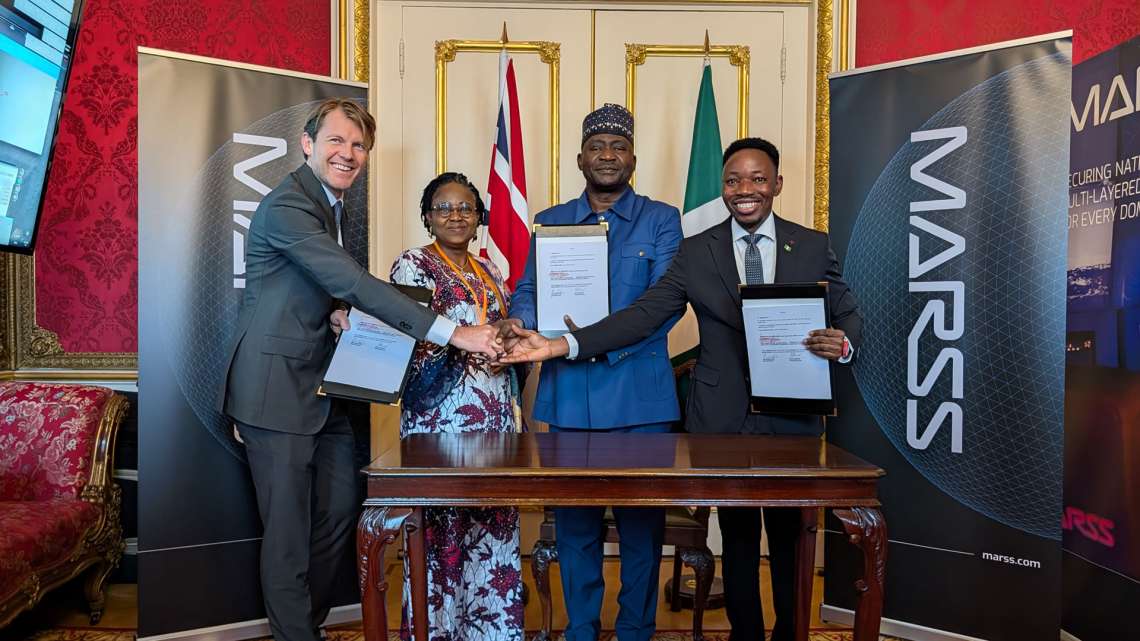
The programme represents one of the first large scale deployments of AI enabled C4I systems in Africa, Newsdesk reports
A new defence partnership between the United Kingdom and Nigeria is set to transform the country’s security architecture, following the signing of a memorandum of understanding in London on 19 March 2026.
The agreement brings together British defence technology firm MARSS, Nigeria’s Ministry of Defence, and local partners to deliver what officials describe as Nigeria’s first fully integrated national defence system. The programme is aimed at strengthening the country’s response to rising threats from terrorism and organised insurgency, which continue to challenge security across Nigeria and the wider West African region.

Under the deal, MARSS will deploy its NiDAR artificial intelligence powered C4I system, alongside a comprehensive package covering training, spare parts, and long term operational support. A new national command centre will also be established, including a state of the art Centre of Excellence designed to provide continuous training for Nigerian personnel and ensure sustained operational readiness.
The initiative is expected to build sovereign defence capabilities while enabling closer coordination among Nigeria’s security agencies. By integrating advanced surveillance, command, and control systems, the programme aims to enhance counter terrorism operations and improve situational awareness across multiple domains.

UK Minister for Defence at the House of Lords, Lord Coaker, said the agreement reflects the deep and longstanding security relationship between the two countries. He noted that the partnership highlights the UK’s ability to deliver combat proven defence technologies to support Nigeria’s fight against terrorism.
The programme represents one of the first large scale deployments of AI enabled C4I systems in Africa. Its scope includes a fleet of expeditionary platforms equipped with a mix of sensors and operational systems, all connected through MARSS’s NiDAR network.
Unmanned aerial vehicles will play a key role, providing intelligence and reconnaissance capabilities in high risk environments where deploying ground forces may be unsafe. These systems will be integrated through MARSS’s Autonomous Mission Management technology, allowing for more efficient and intelligent mission planning and execution.
In addition, new regional command centres and a central national headquarters will be established, linked to receive real time data from both existing infrastructure and newly deployed assets. This network will deliver a unified, multi domain operational picture covering both air and land environments, improving response times and decision making.

Rob Balloch, Chief Growth Officer at MARSS, said the system will integrate vehicles, command centres, and national level coordination into a single operational framework. He added that the technology is designed to deliver a layered defence capability that can adapt to evolving threats.
The programme will also incorporate the latest upgrades to the NiDAR system, including the Nation Shield capability, which enables personnel across different operational levels to work from a shared real time picture. This is expected to enhance coordination and support faster, more accurate decisions at tactical, operational, and strategic levels.
Another key feature is the Autonomous Mission Management system, which allows operators to deploy and manage uncrewed assets across air, land, and maritime domains. This transforms platforms such as drones and unmanned vehicles into intelligent components within a broader defence network.
Balloch said support from the UK government, along with collaboration between local and international partners, was instrumental in advancing the project. He described the agreement as a strong endorsement of the UK’s leadership in artificial intelligence driven defence technologies.
The NiDAR system is already in operation at more than 60 sites worldwide, protecting military bases and critical infrastructure. The Nigeria project marks a significant expansion of its application, demonstrating how AI enabled defence systems can be scaled to support national level security operations.