A language-right activist from the adjoining Sindurpur village, Bengu Thakur, echoes Raju’s views, highlighting that skill training would also help families earn more and ultimately enable them to fund their children’s education…reports Praduman Choubey
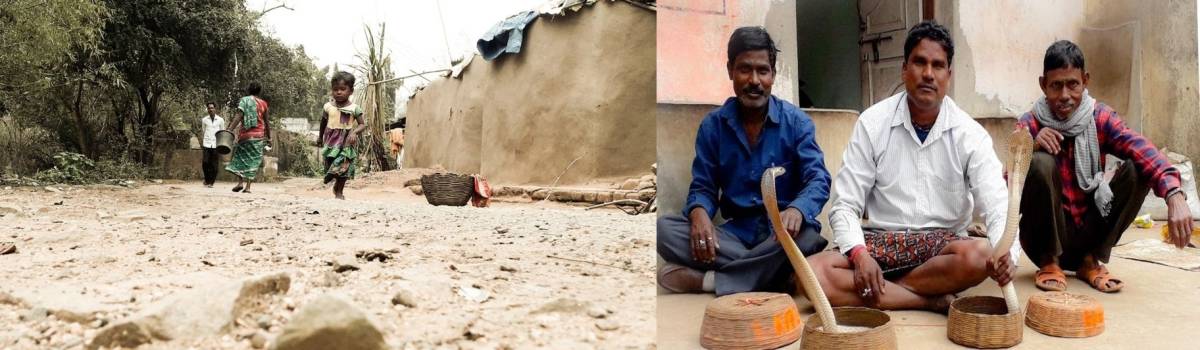
Srikant Bedia started playing with snakes when he was just 13, not knowing that these reptiles would one day become the only means to feed his family. The 54-year-old resident of Bedia Tola village in Dhanbad, Jharkhand, took up snake charming as a profession at the age of 20, after his father’s death, earning in rice or other foodgrains from villagers.
However, technological and other advances have had a detrimental effect on snake charming in Bedia Tola. Here, a majority of the 55 families were once snake charmers by profession, but the number has dwindled down to just 12 to 15 at present. All others have turned to daily-wage work.
“In urban areas, nobody — not even children — are interested in snakes nowadays. They prefer clinging to their mobile phones. Such apathy has left us with no choice but to visit rural pockets, where most of the time, we get rice and foodgrains instead of money,” says Srikant, a father of four sons, who works at construction sites as daily-wage earner to support the family.
“We are forced to eat nothing but ‘maad bhaat’ (gruel rice) and ‘chokha’ (mashed potatoes) as we can’t afford vegetables that cost Rs 50 per kg or more,” he adds. “Also, after working as a snake charmer to feed my family for so many years, the forest department is pressuring us to leave the snakes in the woods.”
Stressing his distress further, Srikant points out the lack of government alternatives to his current profession, questioning what he’d do if the forest department forced him to give up snake charming. He adds that they don’t have the money to refill the LPG cylinders he procured under the Ujjawala scheme. Instead, the women of the family cook using the dry wood they collect from the forest.
“Lack of education and sources of livelihood are the biggest challenges for residents of Bedia Tola,” he emphasises.
Jitendra Nath Bedia, another resident of the village, relies on his daily wages, earning Rs 5,000 to Rs 12,000 per month. But even so, he says they are no better off than snake charmers due to lack of education. In fact, he attributes the dearth of government jobs in Bedia Tola to this illiteracy.
“Even Sanjay and Manik Kumar Bedia, two bright young men of the village, had to drop out after Class 11 due to the pressure to start earning for their family,” Jitendra says, adding that they were also deprived of basic amenities like a source of safe drinking water. “The lone hand pump here often fails to meet the water needs of the 55 families, compelling many of us to lug water from adjoining villages. We requested authorities to dig a pond in the village to help us meet our drinking water needs.”
Sapan Bedia is another daily wager of Bedia Tola who gave up snake charming two decades ago because of the paltry sum it earned him. He, too, stresses the destitute conditions all residents of Bedia Tola live in because no one could complete their studies, further accusing authorities of never having visited the village, leaving them to fend for themselves.
“Some NGOs and social workers visit us during occasions like Diwali to hand out clothes and sweets to children, but it’s all an appearance,” claims Raju Bedia, another resident of the village. “Unless some training in useful skills is imparted to the youth and women, we’ll have no choice but to continue to work as unskilled labourers, earning far lower than skilled labourers.”
A language-right activist from the adjoining Sindurpur village, Bengu Thakur, echoes Raju’s views, highlighting that skill training would also help families earn more and ultimately enable them to fund their children’s education.
“This, in turn, will improve their socio-economic status as it will help them secure jobs,” explains Thakur, who founded the Bangla Bhasa Unnayan Samiti.
Moreover, the families in Bedia Tola are often landless because they face eviction at the hands of forest or railway department authorities, Thakur claims.
“Due to their landless status, they earlier faced difficulty in getting caste certificates. But after we raised the issue on various platforms, they got their certificates, which can help them seek reservation benefits because they fall under Scheduled Castes.”