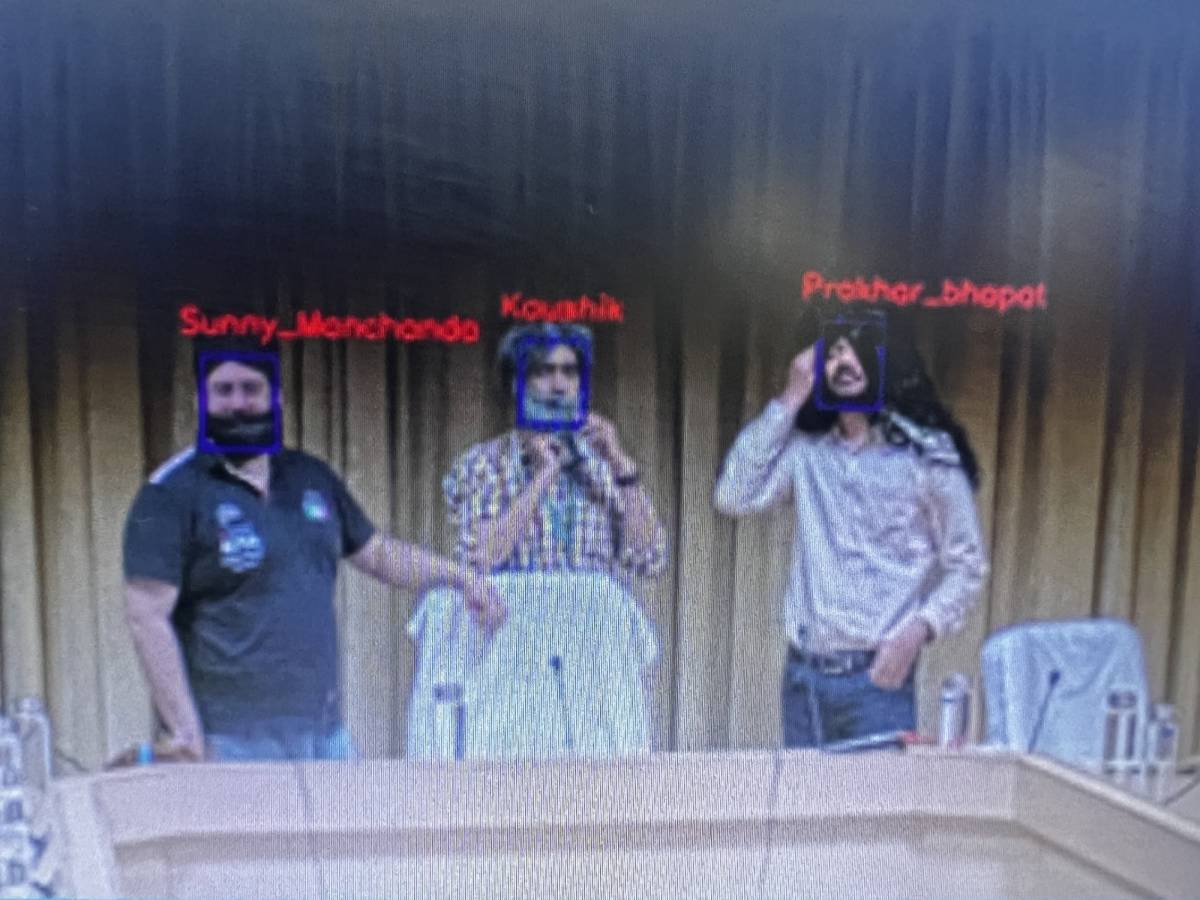
Apart from the disguises, the system also considers different lighting conditions, shadows on face, crowd occlusions, etc….reports Asian Lite News
The Indian government has developed a facial recognition system that can identify anti-social elements with or without disguise, with face masks or monkey caps on, even in low-resolution images at restricted zones as well as public places.
The Ministry of Defence (MoD), in its latest report titled ‘AI in Defence’, revealed the Face Recognition System under Disguise (FRSD), along with other AI-based systems, chiefly developed for the Indian Army.
‘Face recognition in the wild’ on surveillance camera feeds is a difficult problem to solve due to the low resolution of the images captured from the cameras.
This problem becomes even more challenging to solve with the added complexity of various facial disguises, crowd occlusions and varied illuminations.
According to the MoD report, the FRSD algorithm has been trained in such a way that the face recognition system can see through several disguises like face-masks, beard, moustache, wigs, sunglasses, head-scarves, monkey caps and hats, etc.
Apart from the disguises, the system also considers different lighting conditions, shadows on face, crowd occlusions, etc.
“The system can be deployed at restricted/secure zones for the purpose of live video surveillance. It can also be deployed at public places to recognise anti-social elements,a the report mentioned.
The algorithm can also be used by security agencies for robust face search across large repositories.
The system is designed to ensure scalability across multiple graphics processing units (GPUs) and servers. In addition, the system is optimized to ensure maximum utilisation of GPUs and thus can support multiple surveillance cameras on a single GPU.
The system comes with a flexible video analytics suite with a number of additional surveillance applications like people counting, geo-fencing, fire detection and collision detection, the report explained.
Another AI-based solution called the seeker system is a self-contained, facial recognition, surveillance, monitoring, and analysis system for identification and tracking of threats for counter terrorism, continuous surveillance, and monitoring of disturbed areas.
Additionally, the system can be employed for ensuring state-of-the-art security of critical military/civilian establishments and monitoring at border-crossing points.
“The AI-powered analytics module enables processing of Intelligence data from various sources to identify and track movement of terrorists and anti-national elements aided by accurate information collection,” said the MoD report.
The Defence industry is taking concrete steps in transforming the armed forces into one of the most advanced in the world.
The introduction of autonomy in weapon systems, in ISR (intelligence, surveillance and reconnaissance), data management, can be a huge asset in stopping terrorism, installing counter-terrorism measures, protecting soldiers.
“In fact, AI in defence can change combat and conflict at the deepest levels,” the report said.