The Chinese economy has fallen short of expectations as the euphoria over China’s reopening after the COVID-19 pandemic in December last year is fast dissipating…reports Asian Lite News
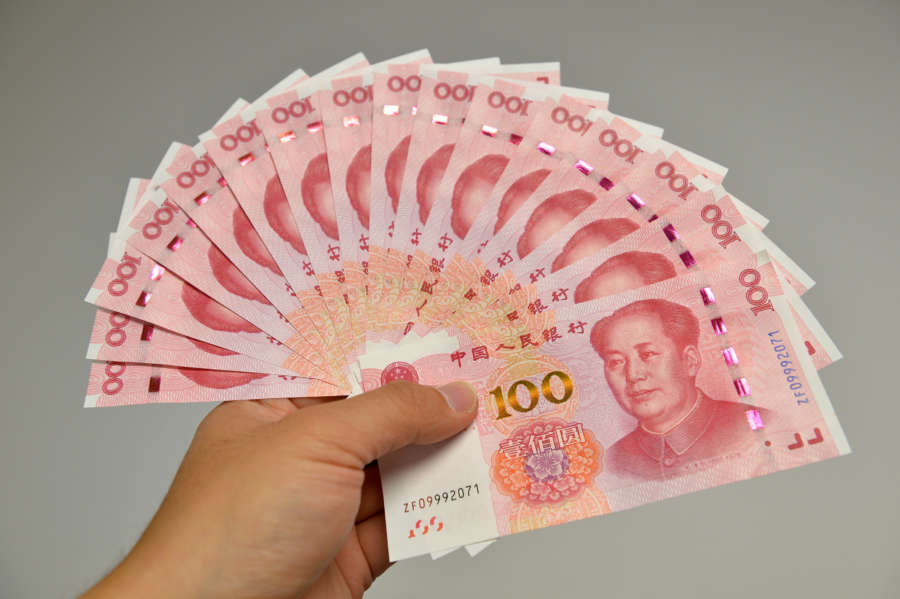
The tightly controlled Chinese uan has crossed the closely scrutinised 7-per-dollar level and fallen to multi-month lows.
On June 21, the yuan, usually known as the renminbi (RMB), fell to below 7.2 versus the dollar. Foreign investors have pulled out of China’s markets as concerns about the robustness of its economic recovery deepen, and since January, the value of the yuan has dropped 4 per cent against the dollar. According to the prediction made by Market analysts, wider monetary policy differences between China and the US as well as subpar Chinese growth would lead to more weak spots.
The Chinese economy has fallen short of expectations as the euphoria over China’s reopening after the COVID-19 pandemic in December last year is fast dissipating. Consequently, the US dollar index has witnessed a considerable rise since the beginning of last year. Notably, the US dollar index surge has closely coincided with the renminbi’s depreciation during this period.
It’s interesting how this pattern has obscured real problems with the Chinese economy. The US dollar index has significantly dropped since June 1 of this year, having an impact on all major currencies. The US dollar’s exchange rate with the renminbi, however, has only increased over this time, rising to a level of 7.20.
This depreciation can be attributed to China’s own economic slowdown. To stimulate the economy, the Chinese Communist Party (CCP) intends to implement interest rate cuts. While other countries worldwide are tightening monetary policies to combat inflation, the CCP stands out by loosening its own monetary policy. This decision underscores the unique economic situation of China compared to other countries, according to predictions made by Market analysts.
Despite the relatively small interest rate cut, only ten basis points or 0.1 per cent, it has led to a drop in the RMB exchange rate from 7.1 to 7.20. This indicates the weakness of the Chinese economy. It is worth noting that any policies the CCP implements carry inherent risks and complexities, making manoeuvring through them challenging.
According to a Bloomberg report on June 14, senior officials of the Chinese Communist Party (CCP) and business leaders have held six emergency meetings to address concerns regarding stimulating the economy and restoring confidence.
China’s industrial firms above a certain scale saw a meagre 3.5 per cent gain year over year, marking a fall of 2.1 percentage points in growth rate. Additionally, the growth rate of all consumer goods retail sales decreased by 5.7 percentage points. In addition, the Producer Price Index (PPI) decreased by 4.6 per cent year over year, showing that prices are still falling
The official unemployment rate remains at 5.2 per cent, unchanged from the previous month, but the unemployment rate among young people aged 16 to 24 has reached a record high, soaring to 20.8 per cent.
These statistics have generated public discussion, particularly regarding the methodology for calculating unemployment rates.
Notably, the official definition considers individuals who work for just one hour per week as employed, which has attracted some humorous commentary.
In conclusion, the recent discussions between CCP officials and business executives emphasise how urgent it is to boost the economy and rebuild confidence. The May data showed negative trends in a number of industries, which raises questions about the state of the economy as a whole.
Additionally, the discussion surrounding unemployment rates has drawn attention to the official methodology and its implications. With the economy facing dire circumstances, there is a prevailing sense that the Chinese Communist Party (CCP) has yet to make significant moves to address the situation.
The public’s interest in any significant initiatives or methods that the CCP may announce to address these concerns is growing as the economic woes continue. (ANI)