At the UN, China’s Premier Li Qiang warns against a “Cold War mentality,” urging global unity, free trade, and peace through dialogue over tariffs, blocs, and confrontation.
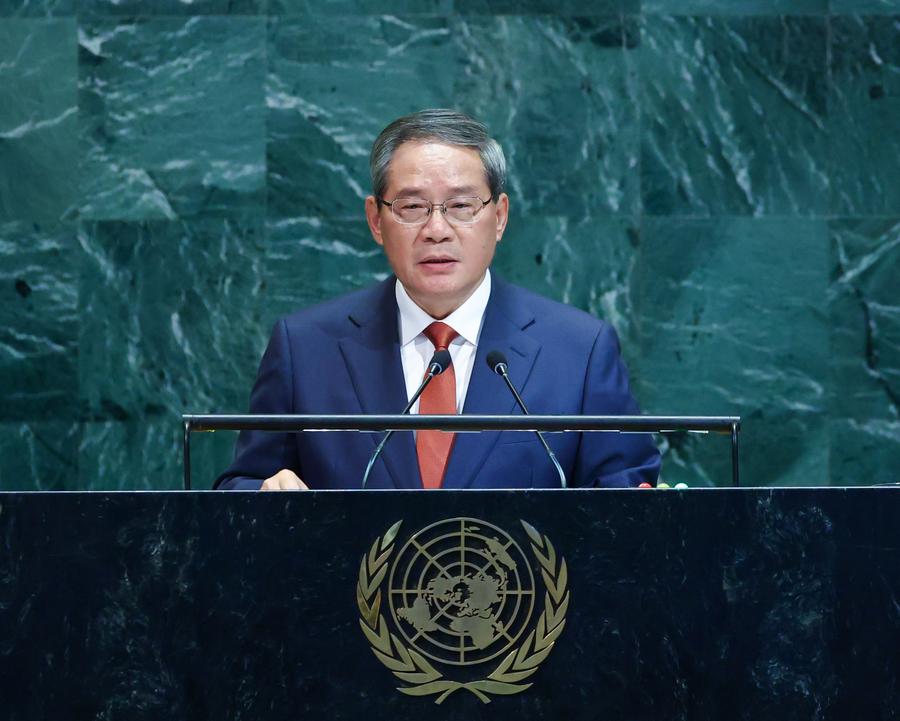
Chinese Premier Li Qiang used his address at the United Nations General Assembly on Friday to warn the world against a dangerous return to “Cold War mentality,” urging nations to choose multilateralism, free trade, and shared security over confrontation and protectionism. In remarks that stopped short of directly naming the United States but carried a pointed undertone, Li sought to cast China as a defender of the international order, even as global power rivalries deepen.
“The world has entered a new period of turbulence and transformation,” Li told world leaders at the 80th session of the UNGA in New York. “Unilateralism and the Cold War mentality are resurfacing. The international rules and order built over the past 80 years are under serious challenge, and the once effective international system is constantly disrupted.” He warned that humanity once again stood “at a crossroads.”
Although the Chinese premier did not explicitly mention US President Donald Trump, his criticism clearly targeted Washington’s trade and foreign policies. Trump has made tariffs and economic nationalism the cornerstone of his approach, repeatedly imposing steep duties on Chinese goods and accusing Beijing of unfair practices. While Li did not personalise the critique, he condemned the use of tariffs and trade barriers, arguing they have become a major drag on global growth.
“A major cause of the current global economic doldrums is the rise in unilateral and protectionist measures such as tariff hikes and the erection of walls and barriers,” Li said. “China has consistently opened its door wider to the world. We hope to work with the rest of the world to uphold the ideals of the UN.”
His remarks came at a moment when the US and its Pacific allies are pressing Beijing to respect international law, particularly in the South China Sea, where China has overlapping territorial claims with several Southeast Asian nations. The US has long stressed freedom of navigation in the region, but under Trump, Washington shifted towards a strategy emphasising raw power projection rather than international consensus.
Li, standing in for Chinese President Xi Jinping, broadened his speech beyond trade disputes. He urged member states to recognise their interdependence and to recommit to peaceful dialogue. “All countries belong to the same global village and rely on each other for security. We should uphold the vision of common, comprehensive, cooperative and sustainable security, and respect the legitimate security concerns of all countries,” he said.
He cautioned against bloc politics and confrontational approaches, saying: “Persisting in camp-based confrontation or willful resort to force only drives peace further away.” Instead, Li appealed for dialogue and consultation as the primary tools for resolving disputes.
The premier highlighted China’s record in contributing to international peacekeeping efforts, positioning Beijing as a constructive actor in global security. “China has all along acted as a staunch defender of world peace and security,” he said. “China is the second-largest contributor to the UN peacekeeping budget and the largest provider of peacekeepers among the permanent members of the Security Council. We have been working actively to promote peace talks on hotspot issues such as the Ukraine crisis and the Palestinian-Israeli conflict.”
China’s message reflects its broader diplomatic strategy: portraying itself as a stabilising force amid global upheaval, even as critics accuse Beijing of assertiveness in its own region. By emphasising multilateralism and warning against “Cold War mentality,” Li sought to contrast China’s approach with what he framed as US-driven unilateralism.
The speech also comes as many countries grapple with balancing relations between the world’s two largest economies. For developing nations especially, China’s call to resist protectionism and preserve the multilateral trading system may resonate at a time of global uncertainty.
As Li concluded, he stressed that the world faced a stark choice. “The question is whether we move forward together in solidarity, promoting inclusive globalisation, or retreat into division and confrontation,” he said. “The path we choose will define the future of generations to come.”