Exiled Bangladeshi writer Taslima Nasreen has renewed her support for a Uniform Civil Code based on equal rights, arguing that religion-based personal laws discriminate against women…reports Asian Lite News Desk
Exiled Bangladeshi writer and activist Taslima Nasreen has called for the implementation of a Uniform Civil Code (UCC) based on equal rights rather than religion, while urging Bangladesh to lift the ban on the Awami League and allow former Prime Minister Sheikh Hasina to return to active politics.
Speaking to reporters during a visit to the grave of Bengali feminist writer and social reformer Begum Rokeya in Panihati, West Bengal, Nasreen argued that religion-based personal laws prevent women from enjoying equal rights.
“If religious laws exist, women would not get equal rights. That’s why a Uniform Civil Code based on equal rights should be established,” she said.
Nasreen said women from different religious communities continue to face discrimination under personal laws, particularly in matters such as inheritance and family rights.
“Even Hindu women in Bangladesh are under religious laws where they do not get equal rights or inheritance; they face various forms of discrimination. All such discrimination will disappear if a Uniform Civil Code is implemented,” she said.
She added that many developed countries have adopted civil laws founded on equality and human rights rather than religion.
“Every civilised country in the world has a Uniform Civil Code. Laws should not be based on religion. In those countries, family or personal laws are not religious; they are based on equal rights,” she said.
Turning to Bangladesh’s political situation, Nasreen said she believed democracy required all political parties to be allowed to participate freely and called for the ban on Sheikh Hasina’s Awami League to be removed.
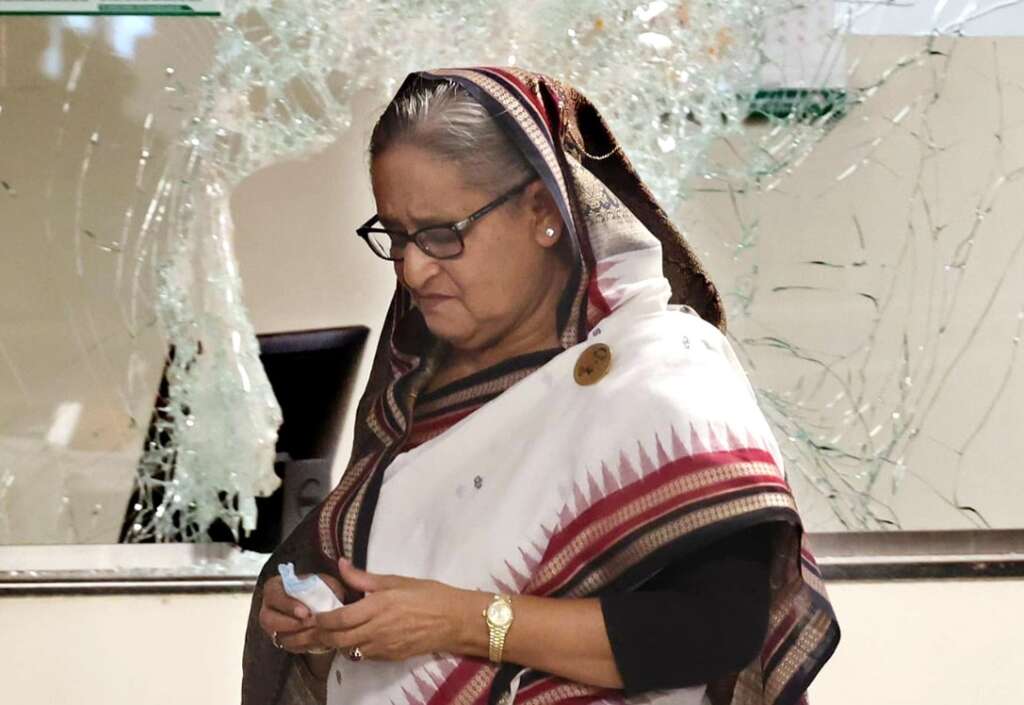
“I believe in democracy. Let the ban on Sheikh Hasina’s party be lifted, and let her participate in politics. This ban should be removed, and every political party should have the right to practice politics. I want Sheikh Hasina to return,” she said.
At the same time, Nasreen reiterated her opposition to religion-based politics, arguing that such movements often undermine women’s rights.
“I am against religious politics. Politics based on religion is not truly good politics because it is always misogynistic,” she said.
Referring to Bangladesh Jamaat-e-Islami, she said she would not object if restrictions on the party remained, arguing that its support for Sharia law would threaten the rights of women and minorities.
“If Jamaat-e-Islami’s politics are banned, I will not object because they want Sharia law and anti-women laws. If they come to power or gain political rights, minorities will have no right to live. Women will have no rights at all; forget equal rights, they won’t even get the most basic rights,” she said.
Asked about returning to Bangladesh, Nasreen said she continued to hope she would be able to go back to her homeland.
“I always have plans to return home, but I am just not allowed to return,” she said.
Nasreen said her visit to Panihati was intended to honour Begum Rokeya, whom she described as a pioneer of women’s education and a symbol of resistance against religious fundamentalism.
“When Begum Rokeya died in 1932, the Muslim fundamentalists of Kolkata did not give her a place; they did not allow her to be buried. Because she was a feminist writer, she struggled against fundamentalism, campaigned for women’s education, and established schools,” she said.
The visit marks Nasreen’s first public visit to Kolkata since she was forced to leave the city in 2007 following protests over her writings, including her memoir Dwikhondito. She has lived in exile since 1994.
Her remarks also come weeks after the West Bengal government constituted a nine-member expert committee, headed by retired Supreme Court judge Justice Ranjana Prakash Desai, to examine and finalise the draft Uniform Civil Code before its proposed introduction in the state Assembly. The state government has said the proposed legislation would exempt indigenous communities.