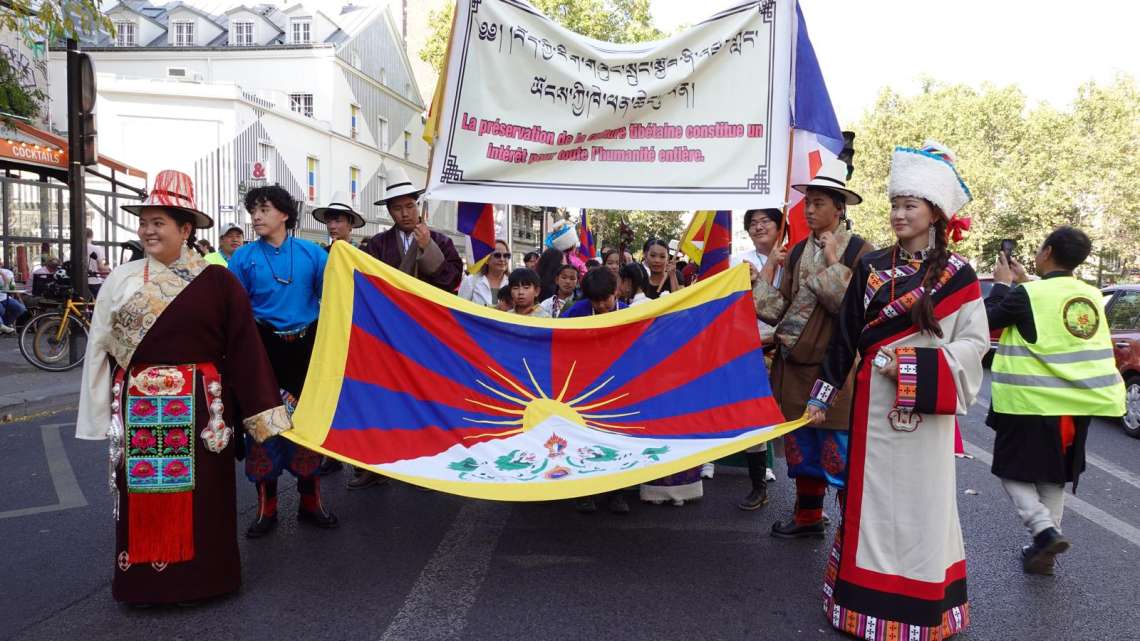
The Tibetan Youth Congress staged a protest outside the Chinese Embassy in Delhi on China’s 77th National Day….reports Asian Lite News Desk
The Tibetan Youth Congress (TYC) staged a protest outside the Chinese Embassy in Delhi on Thursday, opposing Beijing’s policies in Tibet and calling for greater respect for the cultural and political aspirations of Tibetans.
The demonstration was held on the 77th anniversary of the founding of the People’s Republic of China (PRC), which was established on October 1, 1949.
During the protest, the youth organisation rejected China’s sovereignty claims over Tibet and also criticised Beijing’s policies towards East Turkistan, Southern Mongolia and Manchuria.
In a statement, the TYC alleged that China’s governance of these regions represented an imperialist and colonial approach and argued that government policies could not erase the distinct identity and historical claims of Tibetans.
“Tibet is never part of China and will never be. Forced invasion and resultant incorporation of erstwhile Independent state of Tibet, and other nation like East Turkistan, Southern Mongolia and Manchuria mark new assault on freedom in general, particularly, its colonialist practice of territorial invasion and border incursion on other neighbouring state reflects imperialist intent of Chinese state existence,” the organisation said.
The TYC added: “No any measure and its colonial law as well as policies will succeed in erasure of Tibetan’s distinct national historical claims, identity and will to determine their own political future.”
The protest also saw participation from Tibetan leaders, who called on the Chinese leadership to recognise the cultural identity, aspirations and way of life of Tibetans and other non-Han communities.
Speaker of the Tibetan Parliament-in-Exile Dolma Tsering Teykhang said China’s emphasis on unity, harmony and development should also include respect for diversity, freedom and cultural rights.
“Unity without diversity is assimilation, and progress without freedom or having any say is not freedom. Harmony without freedom is not harmony,” she said.
Teykhang said Tibetans were not seeking confrontation with China but wanted the freedom to preserve their religion, culture and way of life.
“Our way of life, our religion and our culture are deeply rooted in the Nalanda tradition of compassion, non-violence and coexistence,” she said.
She urged the Chinese leadership to respect Tibetan Buddhism and allow Tibetan children to learn about their cultural heritage.
Teykhang also referred to the recently adopted Ethnic Unity and Progress Law, expressing opposition to what she described as an attempt to weaken the identities of non-Han nationalities.
She called on the international community to support Tibetans, Uyghurs and Mongols and raise their concerns at the United Nations.
Tenzin Lekshay, spokesperson for the Central Tibetan Administration, also criticised China’s approach to ethnic communities and said National Day celebrations should be accompanied by recognition of their aspirations.
“The most important thing that they should do on this National Day is to realise that there are lots of aspirations from different nationalities who are being oppressed by the Chinese government, and their aspirations have to be fulfilled,” Lekshay said.
Lekshay also raised concerns about China’s new ethnic-related legislation, alleging that it could contribute to the assimilation of Tibetan identity and affect other communities, including Uyghurs.
He said Tibetans and other affected communities would continue to voice their grievances and urged greater international pressure on the Chinese leadership over implementation of the new legislation.
The protest took place as China marked the 77th anniversary of the founding of the People’s Republic of China, with October 1 observed as its National Day.
The Tibetan groups’ remarks reflect their continuing opposition to Chinese policies in Tibet and their calls for greater protection of Tibetan cultural, religious and political identity. China maintains that Tibet is an integral part of its territory, while Tibetan representatives and supporters dispute Beijing’s position.