East Asia and the Pacific is forecast to grow 4.5% in 2026, with AI-related activity supporting growth while skills and adoption remain challenges….reports Asian Lite News Desk
East Asia and the Pacific is expected to grow 4.5% in 2026 despite global economic uncertainty, with a surge in artificial intelligence-related activity boosting several economies while exposing gaps in technology adoption, skills and infrastructure.
The World Bank said in its latest regional Economic Update that countries must now move beyond producing the hardware powering the global AI boom and focus on using the technology across their economies to raise productivity and create better-paid jobs.
Several economies have outperformed earlier expectations this year, driven in part by manufacturing and exports of high-tech goods linked to growing global demand for AI technologies.
The World Bank raised its 2026 growth forecast for Vietnam by 1.1 percentage points to 7.4%, while Malaysia’s forecast was increased by 0.7 percentage points to 5.1%. Thailand’s forecast was also raised by 0.7 percentage points to 2%.
China, the region’s largest economy, is projected to grow 4.4%, with domestic demand constrained by weakness in the labour market and continued adjustments in the property sector.

Pacific island economies, meanwhile, are expected to grow 2.2%, 0.5 percentage points below the previous forecast. The World Bank said these economies remain particularly exposed to high energy prices and external shocks because of their limited economic buffers.
“East Asia and Pacific’s deep integration into global value chains and economic dynamism have positioned the region to benefit from the surge in global AI-related activity,” said Carlos Felipe Jaramillo, World Bank Vice President for East Asia and Pacific.
He said the key challenge was turning the region’s strength in producing AI-related goods into wider adoption that could boost productivity and generate more and better jobs.
“If countries act boldly now, AI can become a powerful engine for opportunity, rising incomes, and a more prosperous future for all,” Jaramillo said.

AI adoption remains uneven
The report’s special analysis on AI found that while several economies are benefiting from supplying the technology and equipment behind the global investment boom, adoption across businesses and households remains uneven.
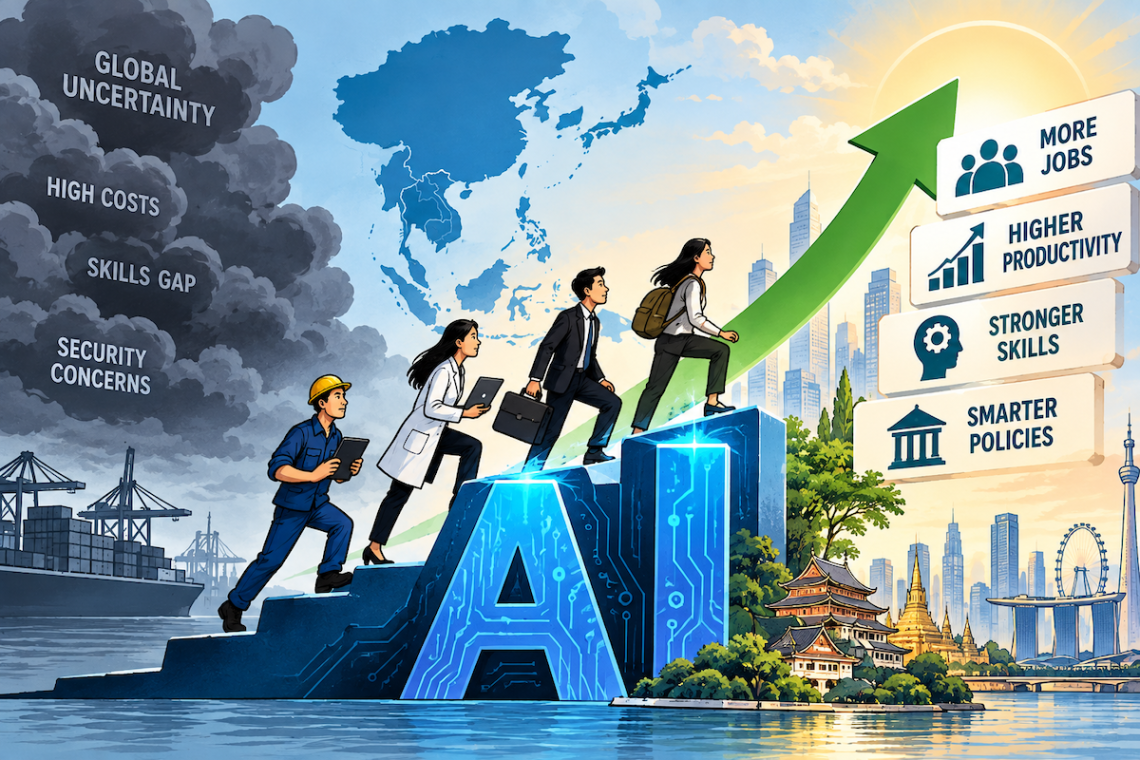
The use of AI among individuals and companies is increasing but continues to lag behind advanced economies. Businesses face barriers including high costs, a shortage of expertise and concerns over security and privacy.
For most countries in the region, the World Bank said the biggest immediate gains are likely to come from what it calls “Small AI”, involving the adoption and adaptation of existing and more accessible AI tools rather than the development of advanced systems from scratch.
The report also found that AI has not yet had a major impact on jobs that can be automated, but it is already changing the skills employers are seeking.
Companies are increasingly looking for workers who combine AI expertise with analytical and social skills. However, only 13% of jobs in East Asia and the Pacific fall into the category of work requiring complex thinking and judgement, compared with 39% in advanced economies.
The figures underline the need for countries to strengthen education, training and digital infrastructure if workers are to benefit from the technology rather than be left behind.
Sarvesh Suri, IFC Regional Vice President for Asia and the Pacific, said the private sector could play a central role in turning AI’s potential into employment opportunities.
“The private sector can play a central role in translating AI’s promise into more and better jobs across East Asia and Pacific,” Suri said.
He called for greater private investment in digital and energy infrastructure, improved access to business finance and stronger workforce skills to accelerate AI adoption.

World Bank urges action on AI and jobs
The World Bank recommended action in three key areas to sustain economic growth and improve employment opportunities.
First, governments should create conditions that allow businesses and workers to adopt AI, including reliable energy and digital infrastructure, access to finance, a supportive business environment and relevant skills.
Second, countries should adapt AI to local needs, including developing affordable tools in local languages for sectors capable of employing workers at scale, such as tourism and agribusiness.
Third, governments should make greater use of AI while developing appropriate regulations and strengthening digital public infrastructure and regional cooperation.
The report said East Asia and the Pacific had benefited from its deep integration into global supply chains during the current AI investment surge. But it warned that maintaining growth will depend on whether countries can translate that advantage into broader productivity gains and employment.
The World Bank’s assessment therefore places the region at a crucial stage in its AI transition, with infrastructure, skills and policy reforms likely to determine whether the technology becomes a wider source of jobs and rising incomes.